
An antique Pembroke table is an 18th- or early 19th-century lightweight drop-leaf accent table characterized by two short hinged leaves supported by pivoting wooden “fly brackets.” Commissioned around the 1760s for Mary Herbert, Countess of Pembroke, it features four slender stationary legs on brass cup casters, a functional frieze drawer at one end, and a matching “dummy” drawer on the opposite end for visual symmetry. Designed for multi-purpose mobility, authentic Georgian and Federal Pembroke tables command between $800 and $4,500 at auction.
Key Pembroke Table Identification Hallmarks
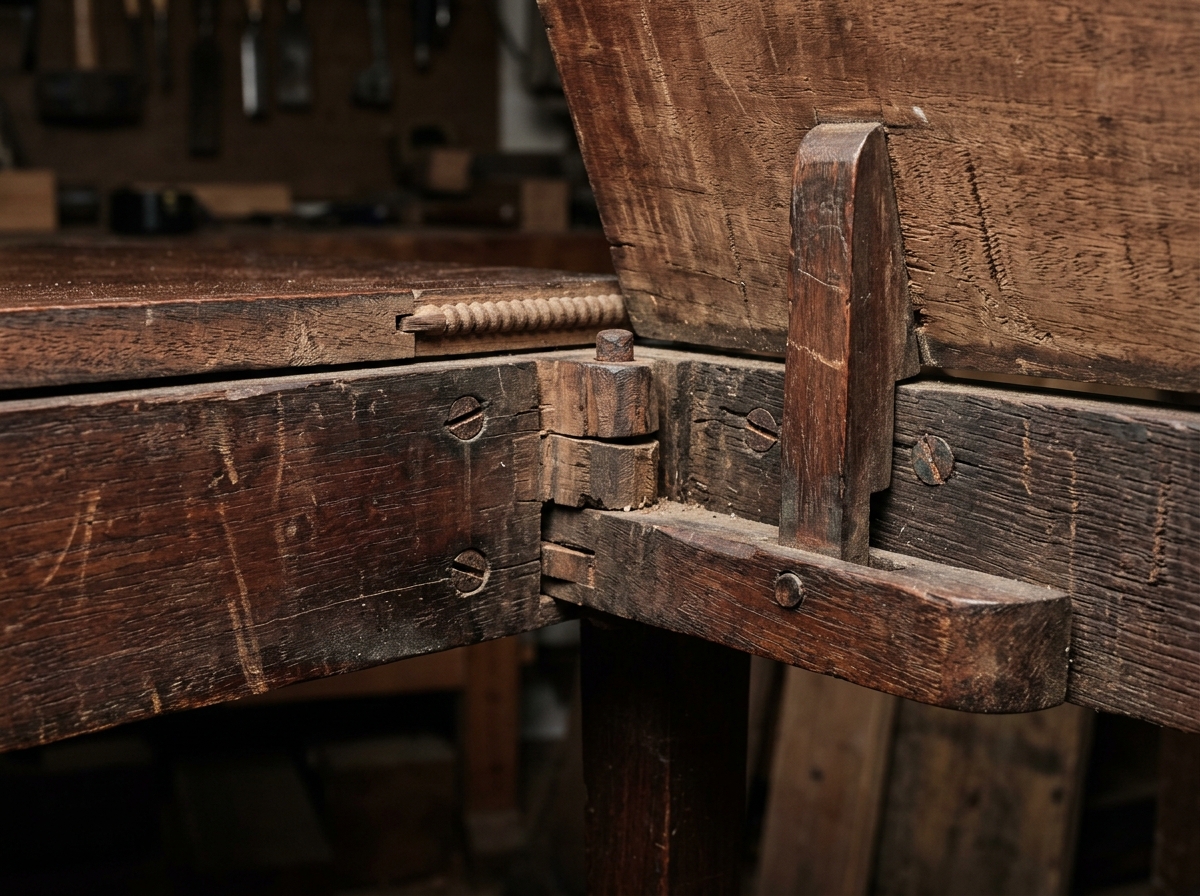
- The Fly-Bracket Mechanism: Unlike gateleg tables where entire legs swing outwards, a Pembroke table rests on four stationary legs. Its leaves are supported by pivoting wooden arms called fly brackets or lopers hinged to the underframe.
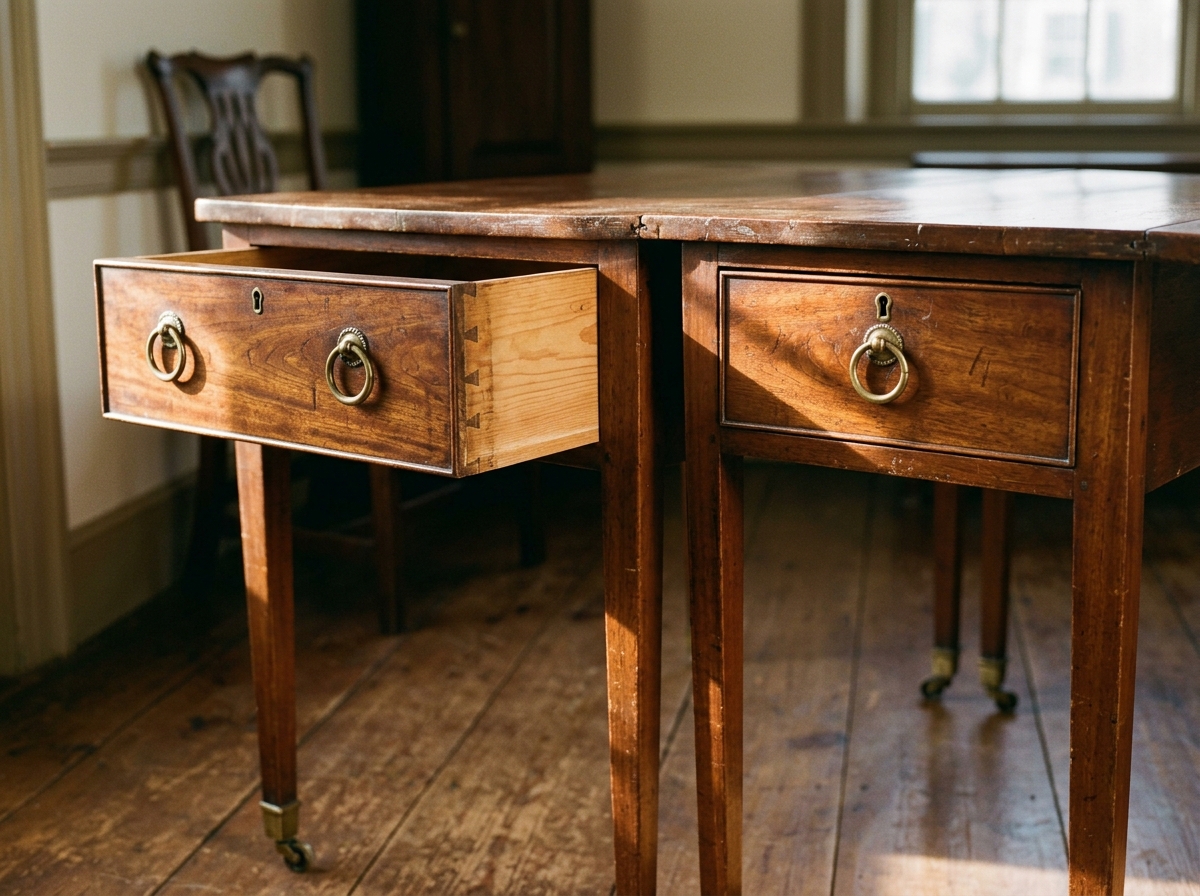
- The “Dummy Drawer” Signature: Authentic Pembroke tables almost always feature one functional pull-out drawer at the front apron and an identical faux (“dummy”) drawer front at the rear apron to maintain aesthetic balance.
- Short Drop Leaves: The hinged leaves are relatively short compared to the central fixed top, creating an oval, rectangular, or bowed surface when extended.
- Brass Cup Casters: Originally conceived as mobile parlor furniture, the slender legs are almost universally capped with original brass cup casters or leather barrel wheels.
- Primary Timbers: High-style English examples feature solid Cuban or Honduran mahogany with satinwood stringing, while American Federal pieces frequently utilize native black cherry, walnut, and tiger maple.
The Aristocratic Origins of the Pembroke Table
In the mid-18th century, English domestic life underwent a quiet revolution. Stately Georgian homes shifted away from rigid, formal dining halls toward intimate, multi-functional morning rooms and parlors. Aristocrats demanded lightweight, versatile furniture that could be wheeled effortlessly to the fireside for morning tea (often paired with antique tilt-top tables), breakfast, needlework, or writing letters.
According to legendary furniture designer Thomas Sheraton in his 1793 landmark folio The Cabinet-Maker and Upholsterer’s Drawing-Book, the table was named in honor of Mary Herbert, Countess of Pembroke (1737–1831), who was the first person to commission a table of this ingenious design from a London cabinetmaker. Celebrated designers like Thomas Chippendale, George Hepplewhite, and Sheraton quickly adopted and refined the form, making it a fixture of high-society Georgian and American Federal homes.
The 4 Defining Anatomies of an Authentic Pembroke Table
To confirm whether a piece is an authentic antique Pembroke table rather than a standard drop-leaf or modern occasional stand, examine these four structural hallmarks:
1. The Wooden Fly-Bracket (Loper) Support
The single most important structural distinction of a Pembroke table is its support mechanism. While an antique gateleg table swings heavy turned legs outward from a pivot, a Pembroke table’s four main legs remain completely stationary at the corners. Beneath each leaf, a wooden bracket (frequently shaped like an elongated triangular elbow or wedge) swings horizontally on an integral wooden knuckle joint to prop up the leaf. On early 18th-century tables, these brackets are made of secondary woods like oak, beech, or ash.
2. The “Dummy Drawer” Symmetry Clue
Because Pembroke tables were meant to float freely in the middle of a room rather than sit flush against a wall, cabinetmakers obsessed over 360-degree symmetry. At one end of the table apron, you will find a working frieze drawer crafted with hand-cut dovetails. At the opposite end, cabinetmakers installed a matching “dummy” (false) drawer front complete with identical cockbeading, brass ring pulls, and false brass keyholes. If both ends open, it is a dual-drawer variation; if one end is completely blank, it may be a later Victorian adaptation.
3. Proportion: Pembroke vs. Drop-Leaf vs. Sofa Table
Collectors frequently confuse Pembroke tables with sofa tables and standard drop-leaf dining tables. The distinction lies entirely in proportions and leaf placement:
| Table Type | Top Proportions | Leaf Placement | Support Mechanism | Original Purpose |
|---|---|---|---|---|
| Pembroke Table | Rectangular central top (approx. 18–22" wide); compact | Two short side leaves (8–12" deep) extending along long sides | Pivoting wooden fly-brackets; 4 fixed legs | Breakfast, afternoon tea, mobile bedside writing |
| Standard Drop-Leaf Table | Large dining surface; wide central leaf (24–36") | Expansive drop leaves (15–24" deep) reaching nearly to floor | Swinging gate legs or heavy hinged timber arms | Family dining in compact colonial homes |
| Antique Sofa Table | Long, narrow central top (approx. 36–48" long, 18–22" deep) | Short flaps dropping from the narrow short ends | Wooden or brass brackets; trestle end supports | Placed directly behind a high-backed sofa for lamps |
4. Slender Legs with Brass Cup Casters
Because Pembroke tables were designed to glide across oriental rugs between the wall and the hearth, genuine period examples feature brass cup casters or barrel casters pinned to the base of the legs. The presence of authentic hand-cast brass casters secured with handmade slotted screws is a strong indicator of pre-1830 craftsmanship. Learn how to date these fasteners in our collector’s guide to dating antique furniture by screws and hardware.
Evolution Across Eras: Chippendale, Hepplewhite, Sheraton & Federal
As decorative tastes shifted from the rococo curves of the 1760s to the neoclassicism of the early 1800s, the Pembroke table adapted rapidly. Consult our cornerstone overview of antique table styles to trace this broader timeline:
1. Chippendale Pembroke Tables (1760–1780)
Early Georgian Chippendale examples reflect solid, muscular proportions. They feature straight square “Marlborough” legs, often decorated with pierced Chinese fretwork corner brackets beneath the apron. Tops are almost exclusively solid, heavy Cuban mahogany, and drawer fronts display cast brass swan-neck or bail handles with pierced backplates.
2. Hepplewhite Pembroke Tables (1780–1800)
George Hepplewhite popularized the most elegant and refined iteration of the Pembroke form. He introduced oval and serpentine drop leaves that create a graceful elliptical silhouette when opened. Legs became slender, square, and sharply tapered, often terminating in brass spade feet. Surfaces feature intricate neoclassical inlays—such as satinwood crossbanding, boxwood stringing, and oval floral patera medallions.
3. Sheraton Pembroke Tables (1790–1815)
Thomas Sheraton’s designs favored round, vertically reeded, or turned legs rather than square tapered posts. Sheraton Pembroke tables often showcase dramatic book-matched flame mahogany veneers bordered with rosewood or ebony stringing, paired with round brass ring pulls stamped with lions’ heads or neoclassical urns.
4. American Federal & Duncan Phyfe Pembroke Tables (1795–1820)
In the young United States, cabinetmakers in New York, Boston, and Baltimore embraced the Pembroke table with fervor. Master cabinetmaker Duncan Phyfe introduced saber legs, carved acanthus leaf knees, and lion-paw brass casters. In rural American shops, makers substituted imported mahogany with native American black cherry, walnut, and tiger oak, creating charming country Federal pieces.
Pembroke Table Valuation: What Is an Antique Pembroke Worth?
Valuing an antique Pembroke table requires assessing age, wood condition, original hardware, and inlay preservation. Here is a realistic market pricing guide based on current auction comps:
| Category & Era | Typical Features | Average Estate Sale Price | High-End Retail / Auction Value |
|---|---|---|---|
| 18th-Century English Georgian (Hepplewhite / Sheraton) | Cuban mahogany, satinwood string inlay, original brass cup casters, dummy drawer | $750 – $1,400 | $2,200 – $4,500+ |
| American Federal Period (1795–1820) | Baltimore/New York school, eagle inlays, bellflower legs, hand dovetails | $1,200 – $2,200 | $3,500 – $7,500 |
| American Country Cherry / Walnut Pembroke | Solid native cherry/walnut, simple tapered legs, pine secondary drawer wood | $350 – $700 | $950 – $1,800 |
| Victorian Era Reproduction (1870–1900) | Eastlake or Queen Anne revival, machine joinery, Knapp drawer joints | $175 – $350 | $450 – $750 |
| 20th-Century Colonial Revival (Mersman, Imperial) | Mahogany veneer over poplar core, factory stamped numbers, modern screws | $45 – $120 | $150 – $250 |
Care, Cleaning & Restoring Antique Pembroke Tables
Because Pembroke tables frequently combine delicate drop-leaf hinges with thin veneer crossbanding and decorative inlays, they require careful conservation:
- Preserving String Inlay & Veneers: Never use abrasive liquid chemical polishes or silicone sprays on Georgian Pembroke tables. Silicone seeps under loose boxwood string inlays, dissolving historic hide glue and causing inlays to buckle. Apply a high-grade museum paste wax to nourish the grain, following our conservator guidelines in the best wax for antique mahogany tables.
- Lifting White Moisture Rings: Hot teacups placed on shellac or French polished drop leaves frequently leave cloudy heat rings. Rather than refinishing the valuable original patina, follow our non-destructive protocol on how to remove white heat rings from antique wood.
- Stabilizing Drop-Leaf Hinges: If a leaf sags when extended, check the pivot pin of the wooden fly bracket. Never install modern oversized drywall screws into historic rule joint hinge pockets, which can split 200-year-old mahogany flaps.
- Distinguishing Solid Wood from Later Laminates: Inspect the tabletop edges for authentic rule joint molding cut into solid planks versus 20th-century factory laminates from makers like Mersman Tables, and contrast them with quartersawn tiger oak medullary rays in our guide to how to tell if a table is antique oak.
Frequently Asked Questions
Why is it called a Pembroke table?
The Pembroke table is named after Mary Herbert, Countess of Pembroke (1737–1831). According to 18th-century furniture designer Thomas Sheraton, the Countess was the first to commission an elegant, mobile drop-leaf occasional table suited for morning tea, correspondence, and bedside use in grand country estates.
What is the difference between a Pembroke table and a drop leaf table?
While all Pembroke tables are drop-leaf tables, not all drop-leaf tables are Pembrokes. A Pembroke table is specifically an accent or occasional table with four stationary legs and short leaves supported by pivoting wooden fly-brackets (lopers, similar in concept to early colonial butterfly wing brackets). Standard drop-leaf tables are typically larger dining surfaces with deeper leaves that rely on swinging gate legs or heavy sliding wooden arms.
Why do Pembroke tables have dummy drawers?
Pembroke tables were designed to stand out in the room or next to armchairs rather than against a wall. To ensure the table looked equally balanced and finished from every viewing angle, 18th-century cabinetmakers built a functional drawer at one end and matched it with an identical false “dummy drawer” front on the opposite apron.
Are antique Pembroke tables valuable?
Yes. Authentic 18th-century Georgian and American Federal Pembroke tables in fine condition generally sell between $1,000 and $4,500 at auction, with documented masterworks by cabinetmakers like Duncan Phyfe or John Townsend reaching $10,000+. 19th-century Victorian revival models typically realize $250 to $650.
Pingback: Antique Drop Leaf Table Identification & Value Guide (With Dating Marks) - Antique Tables
Pingback: Antique Tilt-Top Tables: History, Identification & Value Guide - Antique Tables
Pingback: How to Date Antique Furniture by Dovetails: Hand-Cut vs. Machine Guide