
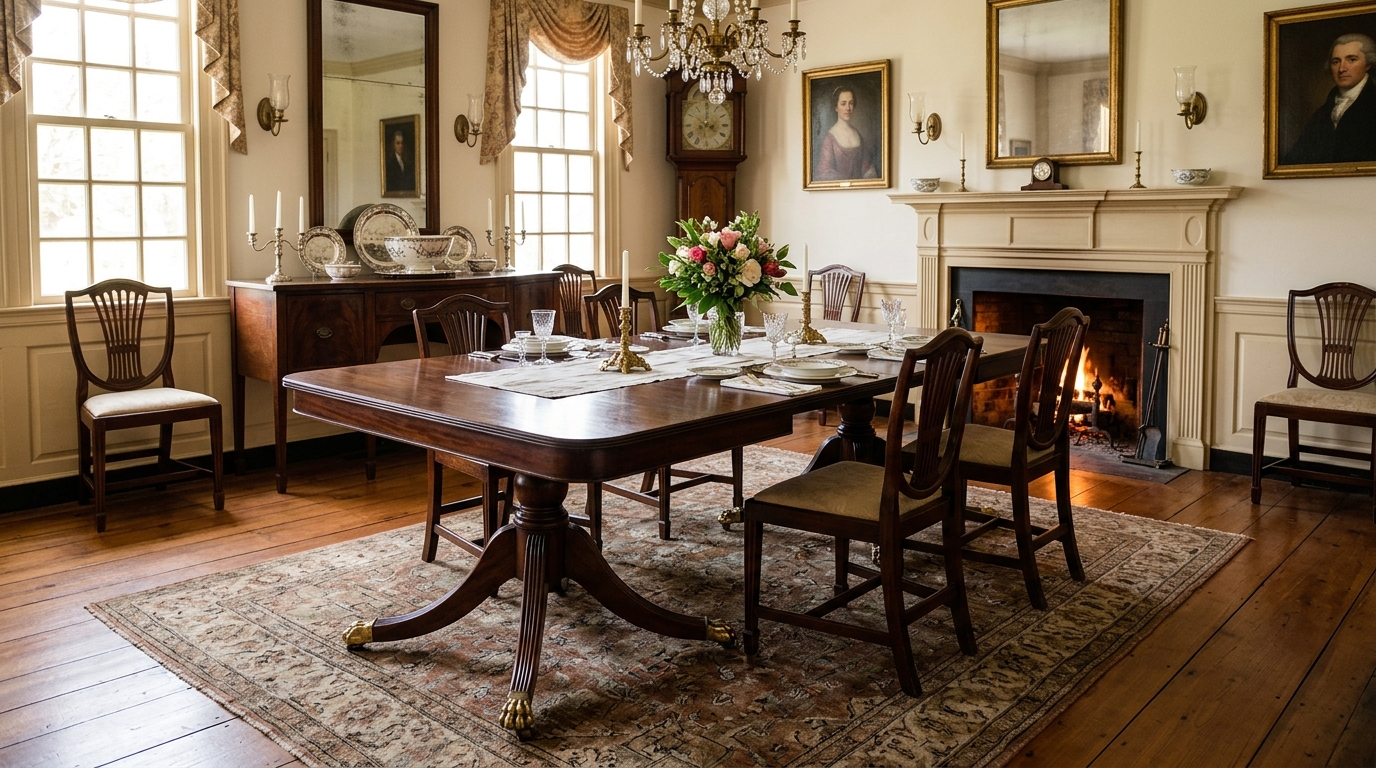
If you recently inherited or spotted a rich mahogany dining table featuring curved saber legs, brass claw feet, or an elegant lyre-shaped pedestal, you are likely looking at a Duncan Phyfe style table. But is your piece a museum-caliber 19th-century treasure worth thousands of dollars, or a well-crafted 1940s vintage reproduction?
⚡ Quick Answer: How to Spot an Original Duncan Phyfe Table
A genuine Duncan Phyfe table was handcrafted between 1795 and 1840 from solid Cuban or Santo Domingo mahogany, featuring hand-cut joinery, hand-carved reeded legs, uneven slotted handmade screws, and heavy cast brass hardware. Crucially, Duncan Phyfe almost never signed or stamped his furniture. If your table has a stencil, badge, or paper label that explicitly says “Duncan Phyfe,” it is guaranteed to be a 1920s–1950s Colonial Revival reproduction manufactured by companies like Mersman and Tell City, Imperial, or RWAY.
Who Was Duncan Phyfe & Why Are Reproductions Everywhere?
Duncan Phyfe (1768–1854) was a Scottish-born cabinetmaker who immigrated to New York City in the late 18th century. His exceptional joinery and mastery of the Neoclassical, Federal, and American Empire styles (part of the broader evolution of historical antique table styles) earned him commissions from America’s wealthiest families, including the Astors. His designs became synonymous with early American elegance, celebrated for their restrained symmetry, reeded details, curule (X-shaped) bases, and classical Greek lyre motifs.
However, during the 1920s through the 1950s, the United States experienced a massive Colonial Revival movement. American furniture manufacturers in Grand Rapids, Michigan, and throughout Indiana began mass-producing “Duncan Phyfe Suite” dining tables, drop-leaf consoles (see our complete antique drop leaf table identification guide), and Pembroke tables. Millions of these tables were sold to middle-class households across America—which is why over 99% of the “Duncan Phyfe” tables found at estate sales, antique shops, and attics today are high-quality vintage reproductions rather than Federal-era originals.
Comparison: Original Federal Duncan Phyfe vs. 1940s Reproduction
Before examining individual components, review this side-by-side diagnostic breakdown:
| Diagnostic Feature | Genuine Original (1795–1840) | Vintage Reproduction (1920s–1950s) |
|---|---|---|
| Primary Wood | Dense solid Cuban or West Indian mahogany; richly figured flame mahogany veneers over solid pine/tulipwood core. | Honduran mahogany (see our guide on telling cherry from mahogany) veneer over gumwood, poplar, or laminated plywood substrate. |
| Leg Reeding & Carving | Hand-carved with subtle irregularities; crisp, deep reeding down the sweep of each saber leg. | Machine-routed reeding; perfectly symmetrical with shallower, rounded contours. |
| Hardware & Claw Feet | Heavy cast brass hairy paw or lion’s claw casters; hand-filed details; secured with hand-cut screws. | Stamped thin brass or antiqued zinc caps; attached with modern machine screws or steel nails. |
| Saw & Tool Marks | Straight, parallel saw marks from hand pit saws; hand-plane scoop marks on underside. | Circular saw arcs or perfectly smooth planed machine finishes on unexposed secondary wood. |
| Makers’ Labels | Virtually non-existent (Phyfe only used paper labels between 1802–1816 on rare pieces). | Factory stencils, metal tags, or “Duncan Phyfe Style” stamps (e.g., Tell City, Imperial, RWAY). |
| Estimated Market Value | $5,000 – $35,000+ (provenance-dependent) | $150 – $600 (complete set: $800–$1,500) |
The 5-Point Authentication Checklist
To inspect your own table, flip it over or inspect underneath with a strong flashlight. Check these five physical evidence indicators:
1. The Legs & Brass Paw Feet
Duncan Phyfe popularized the saber leg (also called a sweep leg), which curves outward in a graceful, concave arc. On authentic tables:
- Hand-Carved Reeding: The narrow, convex vertical ridges along the top of the legs were hand-carved with gouges. Under close inspection, you will notice minute variances in depth and width.
- Cast Brass Casters: The brass paw feet on originals are solid, heavy cast brass shaped like animal paws (often lions or dogs) with functioning casters. Reproductions from the 1940s use thin, hollow stamped brass sheet metal that bends easily, or cast pot-metal coated with a brass-colored wash.
2. The Pedestal & Lyre Motif
Phyfe tables frequently rest on a central pedestal base or dual pedestals connected by a stretcher. A hallmark of his Neoclassical work is the classical Greek lyre (harp) motif:
- Lyre “Strings”: In genuine Federal-era tables, the strings inside the carved lyre are constructed of solid brass rods or finely carved wood stringing, pinned securely through the top and bottom blocks.
- Reproduction Shortcuts: Mid-20th-century reproductions often used plain wooden dowels, wire, or cast brass inserts that are screwed in with modern Philips-head screws.
3. Fasteners, Hinges & Saw Marks
The underside of an antique table reveals its true construction date without ambiguity:
- Hand-Cut Screws (Pre-1840): Look at the screws securing the drop-leaf hinges or pedestal brackets. Genuine 18th- and early 19th-century screws have irregular, hand-filed single slots that are slightly off-center, with blunt ends and flat tips (gimlet points were not invented until 1846). If the screws have clean machine threads or cross-slots (Phillips), the piece or its hardware was made after 1930.
- Saw Marks: Examine the raw wood on the underside of the table leaves. Straight parallel saw marks indicate a manual pit-saw (pre-1840). Curved, arced saw marks indicate a circular saw blade, which did not enter widespread American furniture manufacturing until the 1840s to 1850s.
4. The Wood: Solid Cuban Mahogany vs. Modern Plywood
Phyfe worked almost exclusively with high-grade West Indian or Cuban mahogany, famed for its extreme density, dark reddish-brown hue, and luminous chatoyancy. In authentic Federal tables, drop leaves are typically cut from massive single planks of solid mahogany.
By contrast, 1940s reproduction dining tables almost always utilize 5-ply or 7-ply lumber-core plywood faced with a thin (1/28-inch) veneer of Honduran mahogany. Check the edge of the drop leaf: if you see thin sandwich-like layers beneath the finish, it is a 20th-century factory piece.
5. The “Makers’ Mark” Paradox
One of the biggest misconceptions among antique owners is that an authentic Duncan Phyfe table should bear his name. In reality:
- Duncan Phyfe almost never signed his furniture. Only between 1802 and 1816 did Phyfe occasionally affix a delicate paper trade label reading “Duncan Phyfe, Cabinet Maker and Upholder, 34 & 35 Partition-Street, New-York.” Because these paper labels were fragile, most were lost centuries ago.
- If your table has a metal tag, stencil, or branded burn that says “Duncan Phyfe,” it is 100% a reproduction. Manufacturers in the 1930s–1950s stamped the style name on the underside to market the historical collection to consumers.
🔍 Need an Expert Opinion on Your Table?
Because early American furniture can be deceptively replicated, professional appraisal is the safest way to verify provenance, date of construction, and replacement value for insurance or estate liquidation.
Get an Online Antique Appraisal →
(Certified reports in 24–48 hours)
Who Made Your 1930s–1950s “Duncan Phyfe” Table?
If your table turns out to be a vintage Colonial Revival piece, do not be disappointed. Many mid-century American manufacturers constructed these tables with extraordinary craftsmanship using solid hardwood substrates and exquisite matched veneers. Look on the table underside, slide rails, or inside drop-leaf drawers for these famous American maker marks:
- Tell City Chair Company: Highly collectible Indiana manufacturer noted for its durable, finely proportioned Duncan Phyfe dining suites and lyre-back chairs. Usually identified by a brass oval medallion or golden paper seal.
- Imperial Furniture Company (Grand Rapids, MI): Famous for high-grade mahogany drop-leaf tables and tea tables. Identified by a green and gold shield-shaped decal or embossed metal medallion.
- RWAY Furniture (Northern Furniture Co.): Known for luxury multi-pedestal extension dining tables with ornate reeded legs and brass claw feet.
- Mersman Brothers: Produced hundreds of thousands of lyre-base parlor and console tables, marked with a distinctive cursive “Mersman” stamped or burned into the underside wood.
What Is a Duncan Phyfe Table Worth Today? (Value Guide)
Market valuations vary dramatically between verified museum-grade antiques and everyday vintage reproductions:
- Museum / Provenance-Documented Duncan Phyfe (1795–1840): $10,000 to $45,000+ at major auction houses (such as Christie’s, Sotheby’s, or Freeman’s). Pieces with verified colonial family bills of sale can command over $100,000.
- Unattributed Federal Period Table in Phyfe Style (c. 1810–1830): $1,500 to $5,000 depending on condition, wood figure, and originality of brass casters.
- High-End Vintage Reproductions (Tell City / Imperial, 1920s–1940s): $250 to $650 for a single drop-leaf or console table; $800 to $1,800 for a complete dining table with leaves and a matching set of 6 to 8 lyre-back chairs.
- General Mid-Century Thrift/Estate Sale Tables: $100 to $250. These make fantastic, sturdy dining tables for everyday family use.
Preserving the Finish: A Crucial Warning for Collectors
Never strip or refinish a potential antique Duncan Phyfe table! Up to 70% to 80% of an antique furniture piece’s collector value is tied to its original aged patina and shellac finish. If the finish is dull or hazy, clean it gently with a damp cotton cloth and apply a museum-grade paste wax like Renaissance Micro-Crystalline Wax (read our full guide to the best wax for antique mahogany dining tables) or pure beeswax polish. Avoid silicone-based spray polishes, which penetrate and damage historical wood pores.
Frequently Asked Questions
Did Duncan Phyfe sign his tables?
No, Duncan Phyfe almost never signed, engraved, or branded his furniture. A minute percentage of pieces produced between 1802 and 1816 featured a fragile paper trade label. Any table with a metal plate or stamped label bearing the name “Duncan Phyfe” is a 20th-century reproduction.
What wood is a real Duncan Phyfe table made of?
Original Duncan Phyfe tables were built using solid Cuban and Santo Domingo mahogany. Secondary woods used for drawer linings, glue blocks, and underside framing were native American softwoods such as white pine, tulip poplar, and chestnut.
How can I tell if the brass claw feet are original?
Original Federal-era brass feet were cast from heavy solid brass, with visible file marks on unexposed edges and natural dark patina settling into the crevices. They were attached using handmade, flat-ended iron screws. Reproduction feet from the 1940s are thin stamped metal, hollow, and secured with standard round-head machine screws or modern nails.
Are 1940s Duncan Phyfe reproduction tables worth anything?
Yes. While they do not command the thousands of dollars seen at fine art auctions, well-preserved 1940s reproduction dining tables made by renowned manufacturers like Tell City or Imperial typically sell between $200 and $600, with complete dining sets fetching $800 to $1,500.
Pingback: The Complete Guide to Antique Table Styles: Eras, Identification & Values - Antique Tables
Pingback: The Best Wax for Antique Mahogany Dining Tables (Preserve Patina Without Build-Up) - Antique Tables
Pingback: Antique Drop Leaf Table Identification & Value Guide (With Dating Marks) - Antique Tables
Pingback: Dating Antique Furniture by Screws & Hardware: The Forensic Collector’s Guide - Antique Tables
Pingback: Mersman Table Markings, Model Numbers & Value: Complete Collector’s Guide - Antique Tables
Pingback: How to Tell Cherry from Mahogany in Antique Furniture: The Collector’s Wood Guide - Antique Tables