
Collector & Appraiser Quick Reference: Antique Tilt-Top Tables
- Golden Eras: Queen Anne (1730–1760), Chippendale (1755–1785), and Federal/Sheraton (1790–1820). Revival copies proliferated between 1880 and 1930.
- Primary Function: 18th-century tea service. Designed to tilt vertically to save space against the parlor wall and showcase prized, figured mahogany grain when tea was concluded.
- The “Birdcage” Hallmark: High-style tables feature a double-action wooden “birdcage” (four turned miniature colonnettes between two square wooden blocks) allowing the tabletop to both tilt vertically and revolve 360 degrees horizontally.
- Authentic Pie-Crust Construction: On genuine 18th-century tables, the scalloped “pie-crust” rim was dished out of a single dense plank of solid mahogany using hand gouges and scrapers. Applied or glued-on rims indicate a 20th-century reproduction or altered top.
- Current Fair Market Value: $250 – $550 for Victorian snap-tops; $700 – $1,800 for English Georgian mahogany tilt-tops; $1,800 – $4,500+ for American Chippendale birdcage tables; $8,000 – $25,000+ for museum-grade Philadelphia or Newport carved pie-crust specimens.
Among all forms of 18th-century cabinetmaking, few pieces synthesize mechanical ingenuity, social ritual, and virtuoso woodcarving quite like the antique tilt-top tea table (also historically documented as the tip-table, snap-table, or cant-table).
Emerging in England and Colonial America during the first half of the 1700s, the tilt-top table served as the theatrical centerpiece of the afternoon tea ceremony. Yet when the tea service concluded, a simple flick of a spring latch allowed the massive circular or serpentine tabletop to tilt up 90 degrees on its tripod pedestal base—transforming an expansive serving table into a slender, vertical sculptural statement that tucked neatly against a parlor wall.
For modern collectors, estate pickers, and antique dealers, evaluating a tilt-top table requires keen forensic observation: Is the top original to the base, or is it a “married” composite? Does it possess a true double-action revolving birdcage? Was the pie-crust rim carved from solid timber or steam-bent and glued on? And how does an authentic 1760s Chippendale piece differ from a 1920s Colonial Revival copy?
In this authoritative identification guide, we dissect the anatomy of the antique tilt-top table, decode the mechanics of the birdcage mechanism, examine edge treatments, and establish real-world auction valuations.
1. The 18th-Century Tea Ritual & Why Tilt-Top Tables Existed
To understand the construction of a tilt-top table, one must first appreciate the cultural gravity of tea in the Georgian era. In 18th-century England and British Colonial America (Boston, Newport, Philadelphia, and New York), tea was a precious, heavily taxed luxury imported from China. Loose tea leaves were kept under lock and key in tea caddies, and hosting afternoon tea was the preeminent display of refined hospitality, wealth, and sophisticated manners.
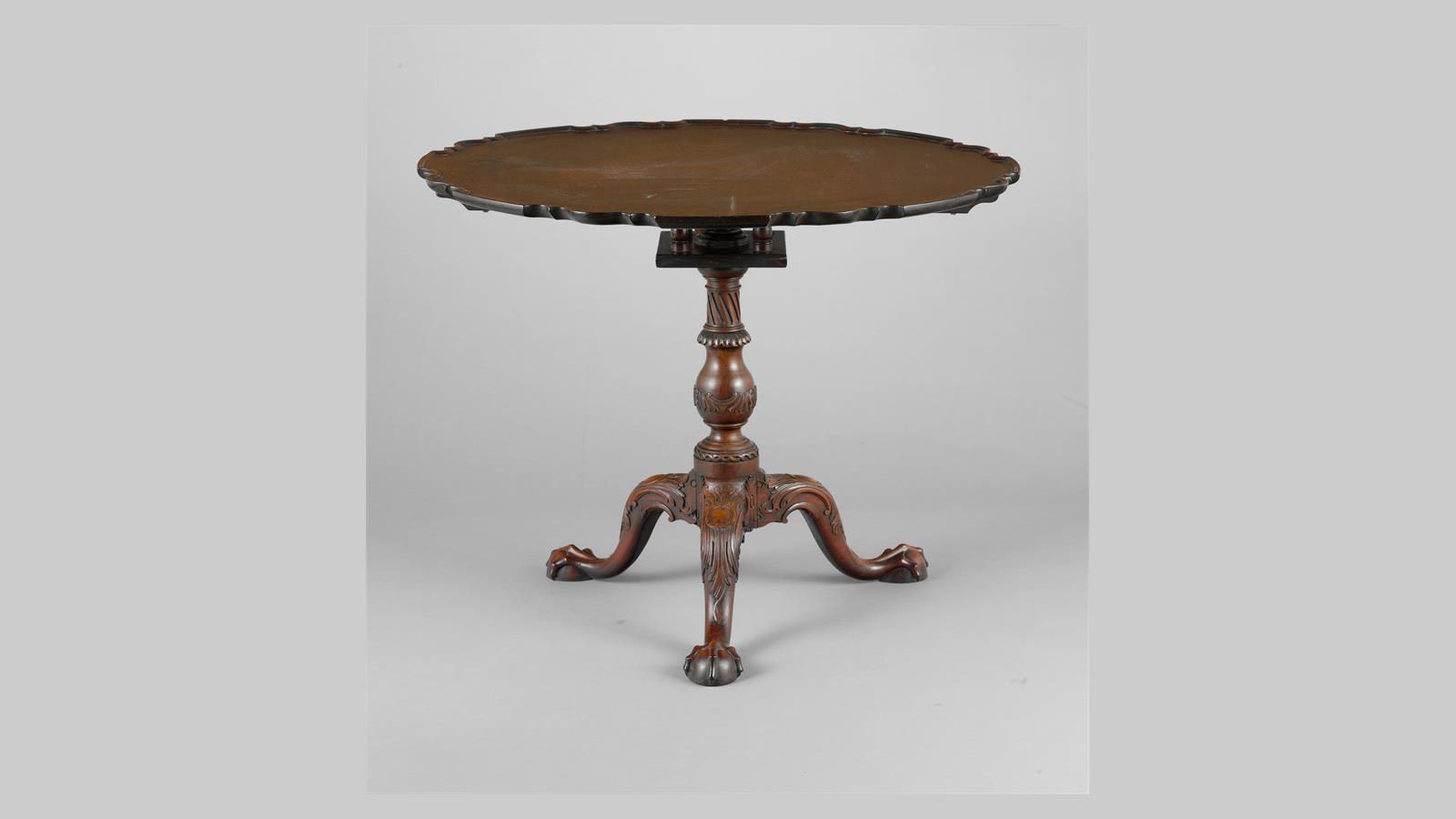
An extraordinary 18th-century Philadelphia Chippendale mahogany tilt-top tea table (circa 1760–1775) in the Metropolitan Museum of Art collection, showcasing a hand-dished pie-crust rim, spiral-fluted pillar, and acanthus-carved ball-and-claw feet.
Georgian parlors and drawing rooms were multifunctional social spaces. Unlike modern dining rooms with permanently anchored center tables, 18th-century rooms were kept relatively clear in the center. Furniture was arranged strictly around the perimeter of the room and brought out only when needed.
As explored in our comprehensive Guide to Antique Table Styles and our study of Antique Pembroke Tables, cabinetmakers developed two distinct solutions for space-saving tea service: the drop-leaf Pembroke table with fly-brackets, and the tripod pedestal tilt-top table.
When tea was served, the tilt-top was wheeled into the center of the room and locked horizontal. When the hostess completed the service, the table was unlocked, tilted upward, and rolled against the wainscoting. In this vertical position, the tabletop acted as a grand decorative screen, proudly displaying the rich figure of imported Cuban mahogany to everyone in the room.
2. The Double-Action “Birdcage” Mechanism Explained
The single most celebrated joinery feature of high-style 18th-century tilt-top tables is the wooden “birdcage” support (also called a birdcage action or squirrel cage). Understanding how this mechanism operates is essential for distinguishing masterwork antiques from ordinary country pieces.
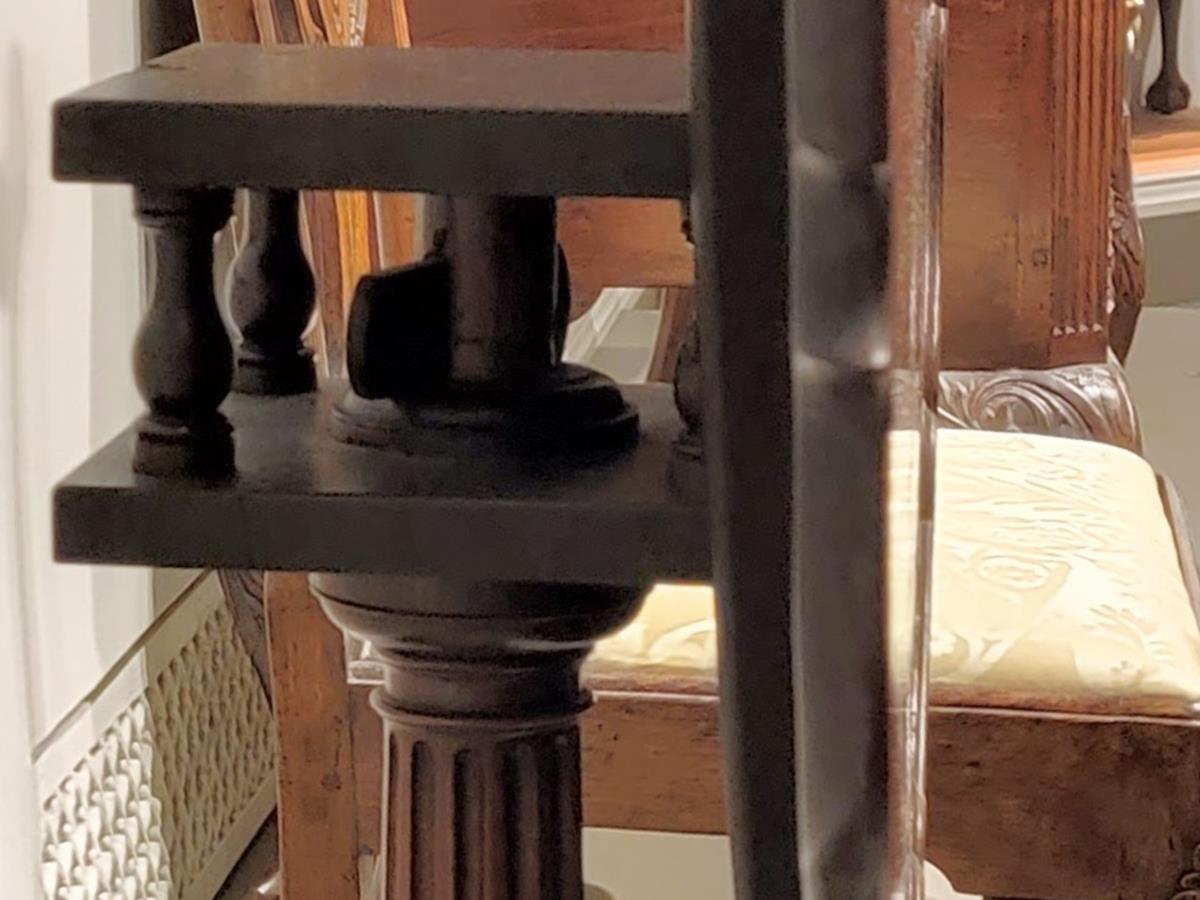
Forensic underside evidence: An authentic wooden double-action birdcage mechanism showing four turned miniature colonnettes, the cylindrical tenon of the central column, and the hand-hewn locking wedge holding the assembly securely in place.
How the Birdcage Operates
A true birdcage consists of two horizontal square wooden plates (top and bottom) joined at the four corners by miniature turned wooden colonnettes (balusters):
- The Tilting Action: The upper square block of the birdcage is attached to the two long underside table battens (cleats) via two horizontal pivot pins (either hand-turned wooden trunnels or hand-forged steel pins). This allows the tabletop to pivot 90 degrees from flat to vertical. A spring-loaded brass catch (or iron slide latch) locks the top firmly horizontal when in use.
- The Revolving Action: The center of the birdcage has a cylindrical hole bored through both plates. The top of the table’s central pedestal column terminates in a turned cylindrical wooden tenon (the “neck”) that passes up through both plates of the birdcage. Because the tenon is round, the entire birdcage and tabletop can spin 360 degrees horizontally around the pillar!
- The Locking Wedge: To prevent the entire revolving tabletop from pulling off the column, the top of the column tenon has a small horizontal mortise hole. A removable tapered wooden wedge pin (the “key”) is driven through this hole above the lower birdcage plate. Removing this single wedge allows the collector or conservator to lift the entire tabletop and birdcage completely off the pedestal in seconds.
Why Revolving Was Critical: In Georgian high society, rotating the tabletop allowed the hostess to spin the tea service around to serve different seated guests without reaching awkwardly across the hot teapot or delicate porcelain cups. It was the elegant 18th-century precursor to the Lazy Susan.
Birdcage Table vs. Simple Snap-Top Table
Not every antique tilt-top table has a birdcage. Simpler rural pieces (often referred to simply as snap-top tables or tip tables) mounted a single solid rectangular wooden block (the “box”) directly onto the column top without colonnettes. These tables can tilt vertically, but they cannot revolve. Tables with fully functioning, original birdcage mechanisms command a 50% to 100% price premium over non-revolving snap-top tables.
3. Tabletop Rim Forensics: Pie-Crust, Dish-Top & Molded Edges
The profile of the tabletop rim is the second major diagnostic focal point for authentication and valuation. In the antique marketplace, tables are classified into three primary rim treatments:
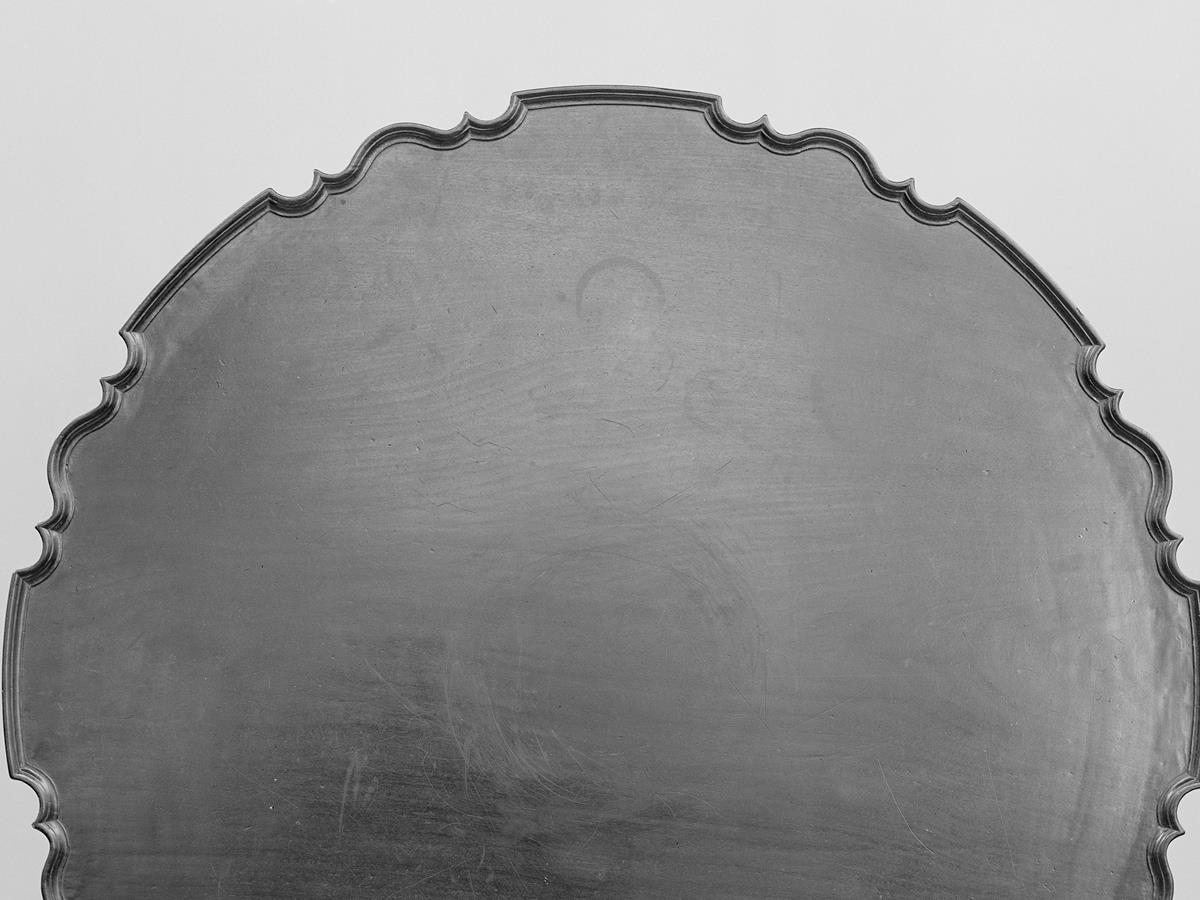
The hallmark of 18th-century cabinetmaking virtuosity: A scalloped pie-crust edge dished out of a single continuous slab of dense Cuban mahogany, showing subtle hand-tool facets under raking light.
1. The Pie-Crust Edge (Dished & Scalloped)
The zenith of Chippendale craftsmanship. A pie-crust table features a raised, dished perimeter carved into a series of rhythmic serpentine curves, scrolls, and ogee moldings resembling the crimped crust of a pastry. The raised edge served a practical purpose: it prevented precious Chinese export porcelain tea cups from sliding off the table if jostled.
The Crucial Diagnostic Test (Single Slab vs. Applied Molding):
- Authentic 18th-Century Original: The raised rim and the recessed flat tabletop were carved out of a single, massive 1.5-inch-thick solid board. The cabinetmaker used gouges, planes, and hand scrapers to carve away nearly a half-inch of wood across the entire central field, leaving the raised molded lip standing proud around the edge.
- Fake or Reproduction: Because carving a single slab was extraordinarily labor-intensive and wasteful of valuable timber, 19th- and 20th-century reproductions (including popular Federal Revival tables by makers like Imperial Furniture Company) often used a flat plank and glued or nailed a thin strip of steam-bent scalloped molding around the rim. Always inspect the joint between the flat top and the raised rim. If you see a seam line, glue bleed, or tiny brad nail heads, it is an applied edge, not an authentic 18th-century carving.
2. The Dish-Top (Tray-Top)
Prevalent during the Queen Anne era (1730–1760). Rather than ornate scallops, a dish-top features a smooth, circular raised lip with a simple molded bead or cove profile. Like the pie-crust, authentic Queen Anne dish-tops were turned on a massive pole lathe or hand-carved from a single solid plank.
3. The Plain Molded or Beveled Edge
Common on utilitarian Federal and country tilt-tops. The tabletop is completely flat, terminating in a rounded bullnose, thumb-molding, or beveled chamfer. While less valuable than pie-crust or dish-top tables, they represent honest 18th-century rural and vernacular craftsmanship.
The Cross-Grain Shrinkage Rule: Over 200+ years of seasonal humidity changes, solid hardwood shrinks across the grain while barely shrinking along the length of the grain. If you measure an authentic antique round tilt-top with a tape measure, it will not be perfectly round! A genuine 32-inch table will typically measure 31.25″ to 31.5″ across the grain and 32″ with the grain. A table that is mathematically circular down to 1/16th of an inch is virtually guaranteed to be a modern reproduction.
4. Chronological Evolution of Bases, Pillars & Feet (1730–1840)
The tripod base provides the clearest visual timeline for dating an antique tilt-top table. Because tripod tables stand on three legs, they remain completely stable even on uneven wide-plank colonial tavern floors.
| Period & Style | Approximate Dates | Pillar / Column Form | Leg & Foot Characteristics | Wood Species |
|---|---|---|---|---|
| Queen Anne | 1730–1760 | Clean urn-and-ring turning; smooth vase baluster; simple birdcage or direct block | Smooth cabriole legs terminating in unadorned snake feet or rounded pad feet | Walnut, Cherry, Cuban Mahogany |
| Chippendale (High Style) | 1755–1785 | Spiral-fluted urn; acanthus-leaf-carved baluster; reeded cup; double-action birdcage | Cabriole legs with deep acanthus leaf carvings on knees; crisp ball-and-claw feet with undercut talons | Dense Cuban Mahogany, Santo Domingo Mahogany |
| Federal / Hepplewhite | 1790–1815 | Slender neoclassical vase; reeded baluster; urn-form pillar; often octagonal top | High-arched spider legs; square-tapered saber legs; spade feet or brass cup casters | Honduran Mahogany, Satinwood inlays, Flame Birch |
| Empire / Classical | 1815–1840 | Heavy architectural pillar, rope-turned column, or Duncan Phyfe lyre shape | Heavily splayed saber legs with brass paw casters or carved lion paws | Crotch Mahogany veneer over pine core |
| Victorian / Papier-Mâché | 1845–1885 | Bulbous spool-turned or bobbin pillar; cast iron tripod base; japanned lacquer finish | Scroll feet, gilded rococo cast iron legs, mother-of-pearl painted tops | Japanned Papier-Mâché, Walnut, Rosewood |
For collectors seeking to identify wood species, cross-reference our diagnostic guide on How to Tell Cherry from Mahogany in Antique Furniture. American country cabinetmakers in Connecticut and Pennsylvania frequently interpreted London Chippendale designs in rich, native Pennsylvania black walnut or wild cherry rather than expensive Caribbean mahogany.
5. Detecting “Married” Tables & Reproductions: The Top 5 Red Flags
Because tilt-top tables consist of two separable components (the tabletop with battens and the tripod pedestal base with birdcage), they are among the most frequently “married” furniture pieces in the antique trade. A “married” table occurs when a damaged base is paired with an unrelated top (or vice versa) to create a salable whole.
Before purchasing or appraising a tilt-top table, conduct these five forensic tests:
- The Underside “Ghost Hole” Check: Tilt the tabletop vertical and inspect the raw wood between the battens. Look closely for plugged screw holes, extra hinge mortises, or shadowy outline stains (“ghosting”). If you find unused holes in the underside of the top, it was previously mounted to a different base or desk.
- Hardware & Latch Forensics: Examine the spring catch and screws holding the battens to the underside. As detailed in our forensic guide on Dating Antique Furniture by Screws & Hardware, pre-1812 screws feature off-center hand-cut slots, blunt non-tapered tips, and variable thread pitches. Uniform, modern machine-threaded pointed screws in original holes indicate a 20th-century build.
- The Leg Dovetail Joint: Turn the table upside down and inspect where the three legs join the bottom of the central pillar. Authentic 18th-century tripod legs are attached with sliding dovetail joints running vertically into the column base, often reinforced with an original hand-forged three-legged iron spider plate screwed to the bottom. In modern reproductions, legs are often secured with machine wooden dowels and modern yellow PVA glue.
- Saw Mark Analysis: Inspect the rough-cut underside of the tabletop and the undersides of the birdcage blocks. Authentic pre-1830 pieces will show straight, parallel up-and-down sash saw marks or hand-plane sweep marks. Circular, curved arching saw kerfs indicate post-1840 lumber milling.
- Carving Crispness & Tool Wear: Examine the acanthus leaves on the knees and the ball-and-claw feet. 18th-century carvers used hand gouges that leave subtle facet planes. Victorian and Centennial revival reproductions (1876–1930) used high-speed machine routing, resulting in stiff, mechanical symmetry lacking fluid organic depth.
6. Antique Tilt-Top Table Valuation & Resale Price Guide
Values for antique tilt-top tables span a vast continuum—ranging from a few hundred dollars for a modest Victorian papier-mâché piece to hundreds of thousands of dollars for celebrated American museum treasures (such as a documented Philadelphia Chippendale pie-crust table attributed to Thomas Affleck or Benjamin Randolph).
Here is an empirical valuation guide for the secondary antiques market (LiveAuctioneers, antique galleries, and high-end estate sales):
| Category / Style | Key Distinguishing Features | Fair Market Resale (Very Good) | Pristine / High Auction Tier |
|---|---|---|---|
| Victorian / Papier-Mâché Snap-Top | Black lacquer, mother-of-pearl inlays, floral painted center, no birdcage | $250 – $450 | $550 – $850 |
| American Country Queen Anne Dish-Top | Solid walnut or cherry, dish rim, simple urn baluster, snake/pad feet | $600 – $1,200 | $1,400 – $2,200 |
| English Georgian Mahogany Birdcage Table | Revolving birdcage, solid mahogany, plain or molded edge, pad/claw feet | $850 – $1,800 | $2,200 – $3,800 |
| American Chippendale Birdcage Table | Cuban mahogany, birdcage mechanism, spiral-turned pillar, ball-and-claw feet | $1,800 – $3,500 | $4,500 – $7,500+ |
| Philadelphia Carved Pie-Crust Tea Table | Single-slab dished pie-crust rim, acanthus carved knees and pillar, masterwork ball-and-claw | $6,500 – $14,000 | $18,000 – $60,000+ |
What Multiplies or Destroys Value?
- The Birdcage Premium: A functioning, authentic birdcage mechanism immediately adds 50% to 100% to the price compared to a fixed-block table.
- Pie-Crust Carving: An authentic single-slab pie-crust edge commands 2x to 4x the value of a plain-edge table of identical age.
- Original Finish: Original 18th-century patination with hand-rubbed beeswax or shellac commands top dollar. Stripping the original dark amber patina with modern harsh chemicals will cut the table’s auction appraisal by 50% or more. If your mahogany table suffers from moisture clouding, follow our gentle protocol for Removing White Heat & Water Rings.
- Replaced or Married Parts: A married base or replaced batten reduces market value by 40% to 60%.
7. Care, Operation & Latch Maintenance
Operating and maintaining an authentic 250-year-old mechanical table requires gentle care:
- Supporting the Top When Releasing: Never depress the spring latch without supporting the heavy mahogany top with your other hand. Allowing a dense 32-inch solid mahogany tabletop to snap down under gravity can shear the wooden pivot pins or split the battens.
- Managing Indoor Humidity: Large single-slab tabletops are particularly vulnerable to dry, forced-air winter heating, which can induce stress cracks along the medullary grain lines. Maintain indoor relative humidity between 40% and 55%.
- Waxing the Revolving Tenon: If the birdcage mechanism squeaks or sticks when revolving, do not apply lubricating oils or WD-40. Instead, remove the locking wedge, lift off the birdcage, and rub pure dry paraffin wax or beeswax along the wooden column tenon. This provides silky rotation without penetrating or staining the unfinished wood fibers. For tabletop luster, see our recommendations in the Guide to the Best Wax for Antique Tables.
Frequently Asked Questions (FAQ)
What is a birdcage on an antique tilt-top table?
A birdcage is a wooden mechanical support box consisting of two square plates joined by four miniature turned balusters (colonnettes). It sits directly atop the central pedestal pillar. The birdcage allows the tabletop to perform a dual action: tilting 90 degrees vertically for storage, and spinning 360 degrees horizontally to serve tea around a circle of guests.
How can you tell if an antique tilt-top table is a married piece?
Look underneath the tabletop between the battens for “ghost” screw holes, plug marks, or shadow outlines from a previously mounted base. Additionally, check that the wood species, color, and grain shrinkage of the battens match the tabletop, and verify that the latch hardware exhibits authentic hand-forged 18th-century screws and uniform age oxidation.
Why are authentic antique tilt-top tables not perfectly round?
Solid wood expands and contracts across the grain with seasonal humidity fluctuations, but experiences almost zero movement along the length of the grain. Over 200+ years, this natural cross-grain shrinkage causes authentic antique circular tabletops to become slightly oval—typically measuring 1/4 to 3/4 inch narrower across the grain than along the grain. A mathematically perfect circle usually signals a 20th-century reproduction.
What makes a Philadelphia Chippendale tilt-top table so valuable?
18th-century Philadelphia cabinetmakers (such as Thomas Affleck and Benjamin Randolph) achieved the highest pinnacle of American Rococo woodcarving. Their tilt-top tables combined dense, imported Cuban mahogany, intricately scalloped pie-crust rims carved from a single massive timber slab, elaborate acanthus leaf knee carvings, and exquisitely sculpted ball-and-claw feet with undercut talons.
Save this antique identification guide to your Pinterest board:
Pingback: The Complete Guide to Antique Table Styles: Eras, Identification & Values - Antique Tables
Pingback: Dating Antique Furniture by Screws & Hardware: The Forensic Collector’s Guide - Antique Tables
Pingback: Antique Pembroke Tables: History, Identification & Value Guide - Antique Tables
Pingback: Duncan Phyfe Table Identification: How to Spot an Original vs 1940s Reproduction - Antique Tables
Pingback: Straight Saw Marks vs Circular Saw Marks: How to Date Antique Furniture - Antique Tables