
Collector & Appraiser Quick Reference: Antique Butterfly Tables
- Historical Era: Early American Colonial, William & Mary period (~1700–1735). Developed predominantly in New England (Connecticut River Valley and coastal Massachusetts).
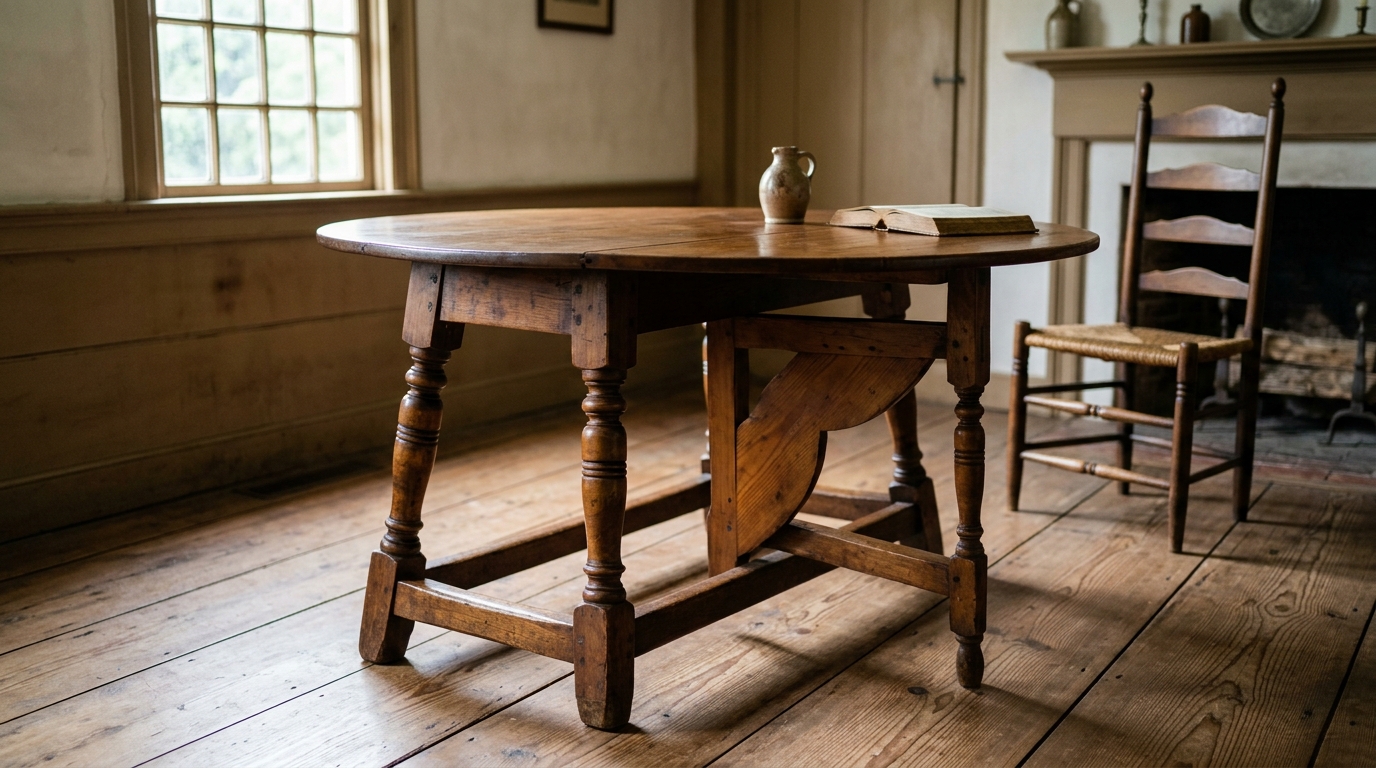
- The Defining Signature: A pivoting, wing-shaped wooden bracket (the “butterfly wing”) that swings outward from the lower box stretchers to support hinged drop leaves.
- Leg & Stretcher Architecture: Distinctly splayed (raked) legs with baluster or vase-and-ring turnings, tied together by low perimeter box stretchers joined with pegged mortise-and-tenon joints.
- Primary Timbers: Solid American native woods—frequently a mixed-wood marriage of Sugar Maple turned legs and stretchers with Eastern White Pine tabletops and drop leaves.
- 2026 Appraisal Value: Genuine untouched 18th-century colonial specimens: $3,500 – $14,000+. High-end 1920s Wallace Nutting signed reproductions: $600 – $1,500. Common vintage 20th-century factory reproductions: $150 – $350.
Among all forms of Early American furniture, few pieces capture the ingenuity and rustic elegance of the colonial craftsman quite like the antique butterfly table. Originating in rural New England during the dawn of the 18th century, this iconic drop-leaf variant solved a major domestic challenge: how to provide spacious dining and writing surfaces in cramped colonial homes without the heavy, leg-crowding undercarriages of traditional English gatelegs.
Today, true colonial butterfly tables rank among the most sought-after prizes in American decorative arts. However, because their charming aesthetic sparked massive waves of 1920s Colonial Revival reproductions (most notably by pioneer antiquarian Wallace Nutting), separating a genuine 300-year-old William & Mary masterpiece from a mid-century reproduction requires forensic examination of joinery, wing bracket pivots, and secondary wood tooling.
1. The Origin & Evolutionary Anatomy of the Butterfly Table
To understand the butterfly table, one must first examine the furniture it replaced. Throughout the 17th century, the dominant space-saving dining table in England and the American colonies was the antique gateleg table. While functional, gatelegs required an entire heavy wooden leg assembly to swing outward on wooden or iron hinges. This design added tremendous weight, was mechanically complex, and placed bulky legs directly where sitters’ knees needed to rest.
Around 1700, inventive country joiners in the Connecticut River Valley and southeastern Massachusetts devised a brilliant mechanical alternative. Instead of swinging an entire leg, they mounted a single, solid wooden bracket shaped like an outstretched insect wing between the lower horizontal stretcher and the upper apron. By pivoting this flat bracket outward, it firmly supported the raised drop leaf while leaving the floor space around the table legs completely unobstructed.
Historical Naming Note: Eighteenth-century cabinetmakers and estate probate appraisers never used the term “butterfly table.” Inventories from 1710 to 1740 simply listed them as “small oval leaf tables” or “folding tables with wings.” The romantic moniker “Butterfly Table” was coined in the late 19th and early 20th centuries by American antiquarians, inspired by the wing-like silhouette of the open support bracket.
2. The 5 Core Physical Identification Markers
When inspecting a prospective butterfly table at an antique auction, estate gallery, or museum collection, look for these five definitive structural benchmarks:
Marker 1: The Wing Support Bracket & Pivot Mechanics
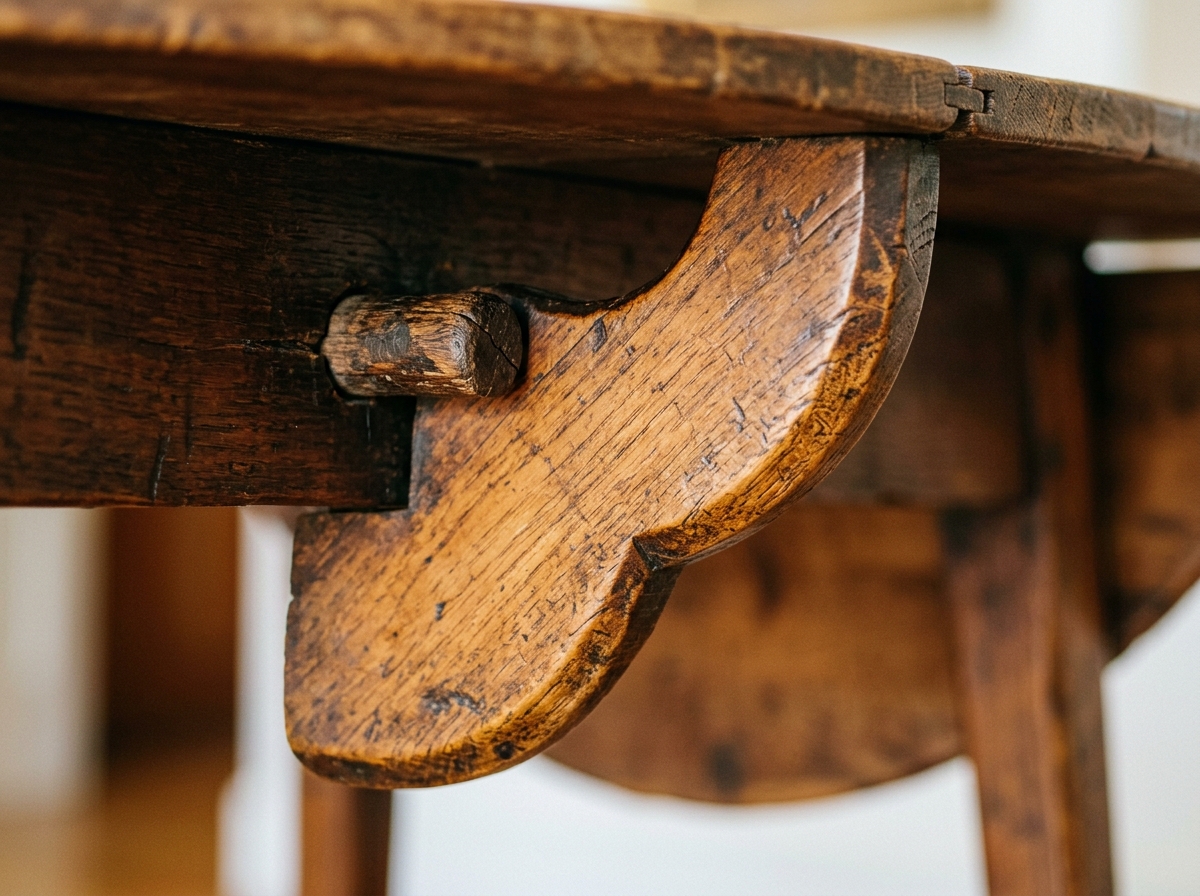
The bracket itself is the defining element of the form. On authentic 18th-century originals:
- Canted / Splayed Pivot Axis: Because the table legs splay outward, the wing bracket is mounted at a corresponding angle. When closed, it rests flush or near-flush against the angled leg or central frame.
- Wooden Trunnel Pivot Pins: True colonial brackets pivot on integral carved wooden tenons or round wooden dowel pins (trunnels) inserted into mortise holes in the lower stretcher rail and underside apron. If you find metal threaded bolts, modern piano hinges, or machine-turned steel pins, the table is either a modern reproduction or heavily altered.
- Curvilinear Chamfering: The edges of original butterfly wings feature hand-cut chamfers and curves shaped with a drawknife or spokeshave, showing slight human asymmetry under close inspection.
Marker 2: Splayed (Raked) Turned Legs
Authentic William & Mary butterfly tables feature legs that splay outward dramatically toward the floor. This outward rake was essential for stability: without it, extending both drop leaves would make the narrow central table frame dangerously top-heavy.
- Turning Styles: Colonial legs display bold hand-turned baluster, vase-and-ring, or “inverted trumpet” turnings. Look for slight micro-variations between the four legs—evidence of hand-lathe turning rather than automated multi-spindle modern copy lathes.
- Foot Terminations: Legs typically terminate in simple turned button feet, small ball feet, or plain cylindrical extensions. Many authentic originals show 1″ to 2″ of foot wear or minor height reduction from standing on damp colonial dirt or stone cellar floors.
Marker 3: Box Stretchers with Pegged Joinery
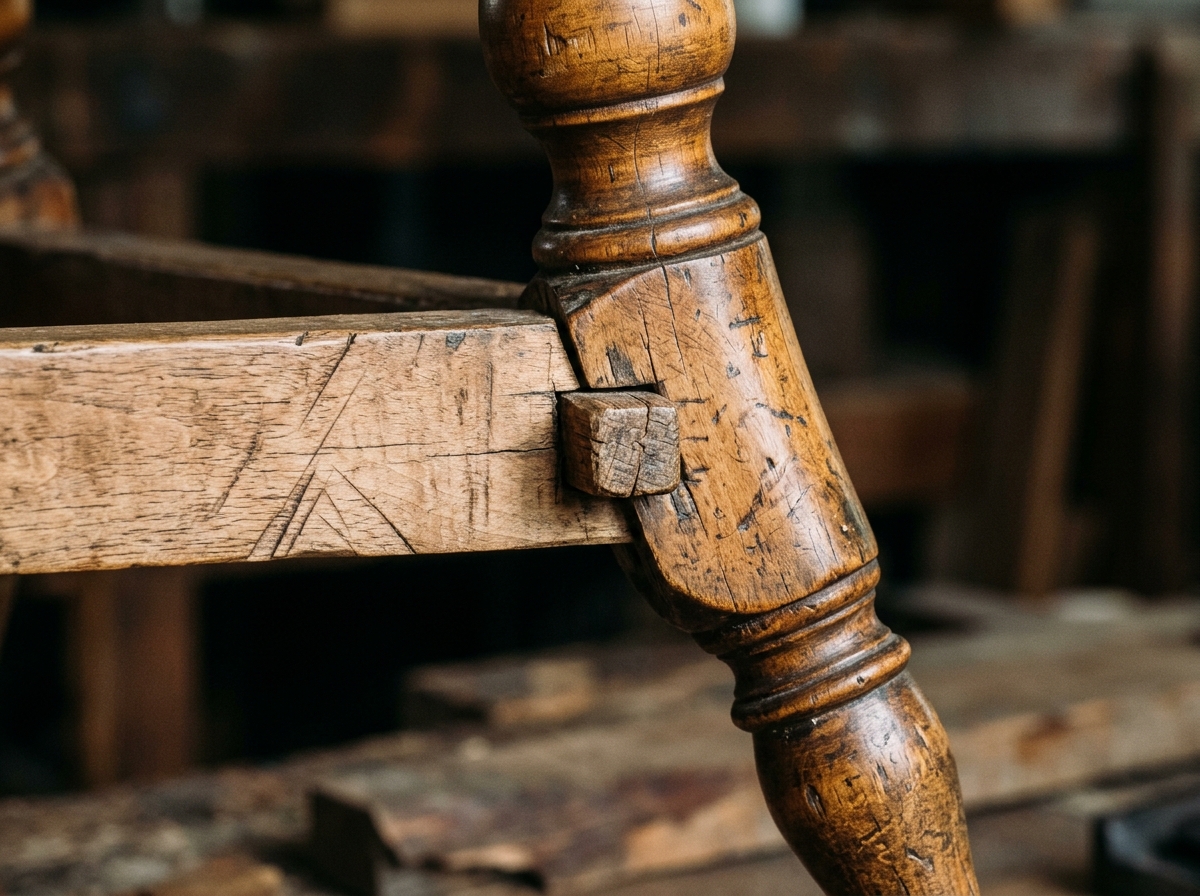
Unlike later Chippendale or Federal tables with open undercarriages, butterfly tables require a rigid, low box stretcher (four horizontal rails connecting all four legs near the floor).
- Pegged Mortise-and-Tenon: The stretchers join the leg stiles with deep mortise-and-tenon joints, secured with hand-whittled wooden pegs (draw-bored pins).
- Top Foot-Wear: The top surfaces of the front and side stretchers almost always display rounded, hollowed foot-wear where colonial sitters rested their leather boots to keep them off cold drafty floors.
Marker 4: Tabletop Construction & Rule Joints
The central stationary top and two semicircular or rectangular drop leaves reveal critical clues:
- Transverse Oval Shrinkage: Wood shrinks across its grain over centuries, not along its length. A genuine 18th-century table with an intended round top will measure 1/2″ to 1″ shorter across the grain than with the grain today. A tabletop that remains mathematically circular is a near-certain modern build.
- Primitive Rule Joint: The joint where the drop leaf meets the central plank features a hand-cut convex bead and concave cove (“rule joint”). Look for uneven hand-planed clearances.
- Hinges & Fasteners: Original drop leaves are secured with hand-forged iron strap hinges or early butt hinges fastened with hand-filed, blunt-tipped screws (see our guide on dating antique furniture by screws) or hand-hammered rosehead nails (dating furniture by nails).
Marker 5: Secondary Underside Timber & Tooling Scars
Crawl beneath the table with a raking light to inspect the unpolished secondary timber:
- Saw Kerfs: Early 18th-century pieces feature straight, slightly irregular hand pit-saw kerfs or water-powered straight sash saw marks (see straight saw marks vs circular saw marks). They never show curved circular saw arcs, which did not appear until the 1840s.
- Hand Scrub-Plane Marks: The underside of the pine or maple leaves should display shallow, scalloped hand-plane marks where the joiner rough-dimensioned the plank.
3. Native Timbers: The Classic “Mixed-Wood” Construction
Unlike urban Philadelphia or Boston mahogany showpieces, the butterfly table was a product of the New England countryside. Country cabinetmakers worked with local, readily available native American hardwoods and softwoods:
- Sugar Maple (Acer saccharum): The premier wood for legs, stretchers, and frame stiles. Hard maple turned cleanly on the lathe and withstood the stress of splayed joints and swinging bracket pivots.
- Eastern White Pine (Pinus strobus): Preferred for wide tabletops and drop leaves. White pine grew in massive old-growth stands, allowing joiners to cut broad, knot-free single planks for the central top and leaves.
- Red Oak & Chestnut: Often used for interior frame cleats, drawer runners, and secondary stretchers.
- Cherry & Black Walnut: Occasional high-grade examples from the Connecticut River Valley were fashioned entirely from native black cherry or walnut. (To distinguish these timbers, refer to our diagnostic guide on how to tell cherry from mahogany).
4. Authentic Colonial Original vs. 1920s Wallace Nutting Reproduction
During the 1920s American Centennial and Colonial Revival movement, pioneer antiquarian and photographer Wallace Nutting launched his famous reproduction furniture studio. Nutting adored the butterfly table, producing exquisite bench-made reproductions (such as his famous No. 516 and No. 518 models). Later mid-century commercial manufacturers (Ethan Allen, Cushman, Pennsylvania House) mass-produced tens of thousands of factory versions.
Use this forensic matrix to distinguish a true 18th-century original from a 20th-century reproduction:
| Diagnostic Feature | Colonial Original (~1700–1735) | Wallace Nutting Replicas (~1920s) | Factory Revival (~1940s–1970s) |
|---|---|---|---|
| Tabletop Shape | Distorted oval due to cross-grain shrinkage (1/2″–1″ variance) | Near-perfect circle/oval; minor artificial aging | Mathematically perfect symmetry; uniform edge profiling |
| Fasteners & Screws | Hand-filed blunt screws; hand-forged rosehead nails | Modern pointed slotted screws; branded block stamps | Phillips screws or modern machine-stamped screws |
| Underside Saw Marks | Straight pit-saw or sash mill kerfs; hand scrub-plane scallops | Smooth rotary planed; occasional intentional hand-scraping | Uniform circular saw arcs or modern rotary planer ripples |
| Wing Bracket Pivot | Hand-carved wooden trunnel pins; loose historical play | Precise wooden dowel pin or hidden metal pivot pin | Machine metal pin, spring-loaded hinge, or factory dowel |
| Makers’ Identification | Unsigned; occasional chalk marks or colonial brandings | “Wallace Nutting” branded iron mark on underside stretcher | Paper factory label, metal tag, or stenciled model number |
5. Appraisal & Valuation Guide: 2026 Price Realities
The market for butterfly tables spans from entry-level vintage decorative furniture to five-figure American folk art treasures:
Museum-Grade Colonial (~1700–1735)
$4,500 – $15,000+
Original untouched surface or historic 18th-century dry red-wash finish, full height feet, original butterfly brackets, and provenance from a documented New England estate.
Restored Colonial Original
$1,800 – $3,800
Period 18th-century table with minor condition issues: replaced hinges, spliced feet, or refinished top. Solid collector value with high functional appeal.
Wallace Nutting Replicas (~1920s)
$600 – $1,500
Bench-made 1920s studio tables bearing the crisp Wallace Nutting branded hot stamp. Highly collectible in their own right among Americana enthusiasts.
Mid-Century Factory Colonial Revival
$150 – $350
Mass-produced solid maple or birch tables from the 1950s–1970s. Decorative utility furniture with minimal antique appraisal equity.
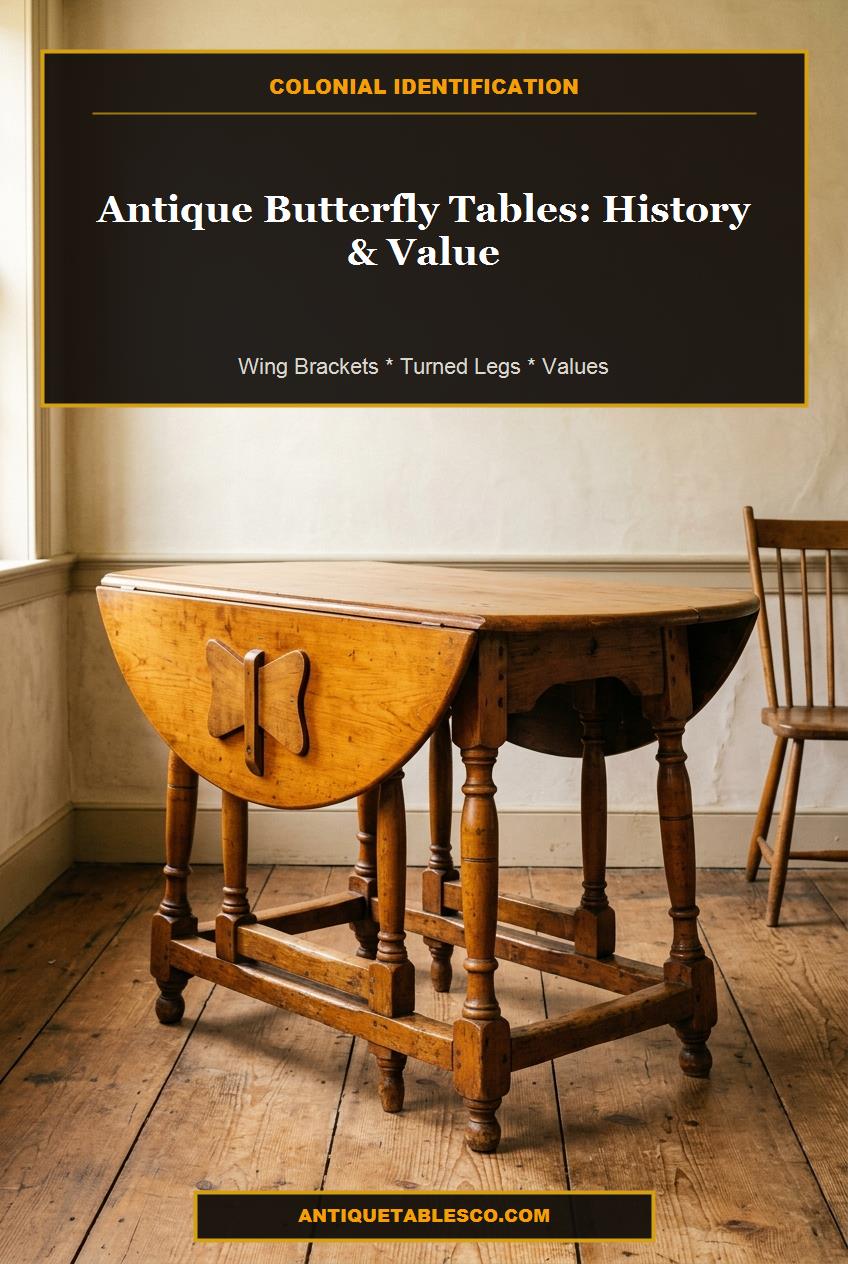
Save This Butterfly Table Field Guide on Pinterest
Pin our forensic visual guide to your antique furniture identification board for instant appraisal reference at auctions, flea markets, and estate sales.
Frequently Asked Questions About Antique Butterfly Tables
What is a butterfly table in antique furniture?
A butterfly table is an Early American colonial drop-leaf table developed circa 1700–1730 during the William & Mary period. Its defining feature is a pair of wooden, wing-shaped pivoting brackets (“butterfly wings”) that pivot outward from the lower box stretchers to support the hinged drop leaves, eliminating the heavy swinging legs of earlier gateleg tables.
When were original antique butterfly tables made?
Original antique butterfly tables were crafted primarily between 1700 and 1735 in colonial New England (especially the Connecticut River Valley and Massachusetts). By the 1740s and 1750s, Queen Anne cabriole drop-leaf tables largely replaced the form, until it was revived during the 1920s Colonial Revival movement.
What wood is an authentic antique butterfly table made of?
Colonial butterfly tables were predominantly built from mixed native North American woods. The turned splayed legs, stretchers, and frame were typically crafted from hard Sugar Maple for strength, while the central tabletop and drop leaves were fashioned from wide planks of Eastern White Pine. Occasional high-style specimens were crafted from native black cherry or black walnut.
How much is an antique butterfly table worth?
Authentic early 18th-century colonial butterfly tables in untouched museum condition generally sell between $4,500 and $15,000+ at auction. Examples with restored feet, replaced hinges, or older refinishing typically bring $1,800 to $3,800. Bench-made 1920s Wallace Nutting reproductions command $600 to $1,500, while common mid-century factory revival pieces sell for $150 to $350.
How do you tell a real 18th-century butterfly table from a 1920s reproduction?
Original 18th-century tables display cross-grain shrinkage distortion (measuring 1/2″ to 1″ out of round), hand pit- or sash-saw marks on the underside (never circular saw marks), hand-forged rosehead nails or blunt-tipped screws, hand-whittled wooden pivot pins, and noticeable hand-turned variations in the splayed baluster legs. Modern reproductions display uniform machine saw marks, pointed screws, and perfectly symmetrical machine-turned legs.
Explore More Antique Table Identification Guides
Continue mastering historical table authentication across our core editorial archives:
- Antique Gateleg Tables: Complete Identification Guide: The 17th-century precursor to the butterfly table.
- Antique Drop Leaf Table Identification & Value Guide: Rule joints, wooden knuckle supports, and swing legs.
- Straight Saw Marks vs Circular Saw Marks on Antique Furniture: Pit saws, sash mills, and circular arcs.
- Dating Antique Furniture by Nails: Hand-forged rosehead nails vs machine-cut square nails.
- Complete Guide to Antique Table Styles: From Early American Colonial and Queen Anne to Victorian and Empire.
Pingback: Antique Gateleg Tables: Complete Style, Era & Value Identification Guide - Antique Tables