
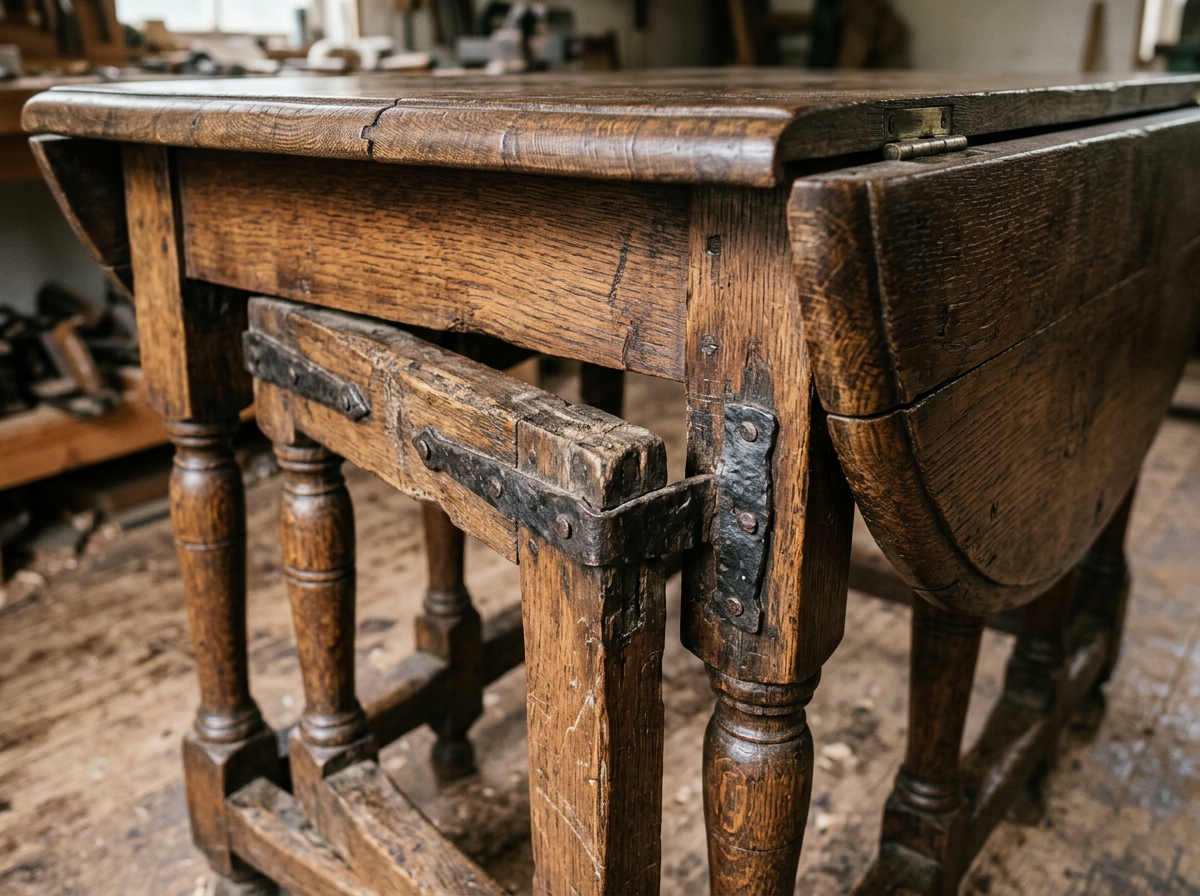
Among the most ingenious furniture designs to emerge from pre-industrial cabinetmaking, the antique gateleg table solved a timeless domestic dilemma: how to host a grand family feast in a modest hall without surrendering daily living space. First developed in early 17th-century England, this versatile fold-away design features hinged drop leaves supported by legs that swing outward like garden gates. Today, authentic period gateleg tables stand among the most prized centerpieces for collectors and homeowners who appreciate timeless joinery and authentic historic character.
Quick Summary: What Defines an Antique Gateleg Table? (GEO Overview)
Key Definition: An antique gateleg table is a space-saving dining or occasional table characterized by a stationary central tabletop flanked by one or two hinged drop leaves. When extended, each leaf is supported by an undercarriage leg attached to a pivoting swing rail (“gate”) joined to the central stretcher frame. Genuine period examples (1620–1780) are constructed of solid English antique oak, walnut, or colonial maple, featuring hand-carved barley-twist or baluster turnings, pegged mortise-and-tenon joinery, and wooden rule joints.
Gateleg vs. Drop Leaf vs. Butterfly Tables: Key Differences
While often used interchangeably in antique listings, gateleg tables are a specialized, heavy-duty mechanical branch of the broader antique drop leaf table family. Understanding how the undercarriage supports the leaves is the fastest way to categorize your table:
| Table Type | Leaf Support Mechanism | Total Legs Touching Floor | Typical Eras & Primary Wood |
|---|---|---|---|
| True Gateleg Table | Full legs connected to perimeter stretchers swing outward like a gate. | 6 to 12 legs (4 stationary main legs + 2 to 8 swing gatelegs). | Jacobean, William & Mary (1620–1730); Solid English Oak, Walnut. |
| Standard Drop Leaf Table | Wooden bracket or sliding “fly rail” pulls outward from table apron. | 4 legs (stationary corner legs only; leaves supported by hidden brackets). | Federal, Chippendale, Victorian (1770–1900); Mahogany, Cherry. |
| Butterfly Table | Wing-shaped wooden bracket pivots on a center stretcher peg to prop leaf. | 4 legs (splayed stationary legs; wing supports do not touch the floor). | Early American Colonial (1700–1750); Maple, Pine, Native Oak. |
Major Eras & Styles of Antique Gateleg Tables
Because gateleg tables were manufactured continuously from the early 1600s through the mid-20th-century Colonial Revival boom, the profile of the turnings and stretcher arrangement tells you exactly when a piece was constructed:
1. Jacobean & Carolean Period (1620–1690): The Heavy Oak Era
The earliest surviving gateleg tables were crafted during the English Jacobean and Restoration periods. These tables are unmistakable: massive, heavy, and built from quartersawn English brown oak. They feature barley-twist (Solomonic spiral) legs or bold ball-and-ring turnings. The stretchers connect every leg directly at floor level, designed to keep diners’ feet off damp stone floors while providing immense structural rigidity.
2. William & Mary Period (1690–1720): Walnut & Trumpet Turnings
As cabinetmakers embraced Dutch and French design influences, gateleg tables became lighter and more refined. Walnut replaced oak as the preferred timber. Legs evolved into trumpet, vase, or inverted-cup turnings, often terminating in Spanish scroll or ball feet. Stretchers moved several inches up from the floor, occasionally featuring arched serpentine cross-stretchers.
3. Queen Anne & Georgian Period (1720–1760): The Slender Cabriole Gate
During the Queen Anne movement, cabinetmakers adapted the graceful cabriole curve to the gateleg format. Rather than complex turnings, gatelegs featured smooth, serpentine curves ending in delicate pad or slipper feet. Cuban mahogany made its first prominent appearance during this era, though English walnut remained popular in provincial regions. Explore our visual breakdown in The Complete Guide to Antique Table Styles to see how Queen Anne curves transformed table design across America and Britain.
4. Early American Colonial Gateleg Tables (1700–1780)
In colonial Massachusetts, Connecticut, and Pennsylvania, rural joiners adapted English gateleg blueprints using native New World woods—most notably sugar maple, birch, and American black walnut. Colonial gateleg tables typically featured baluster-and-ring turned legs, exposed white oak drawbore wooden pegs, and slightly shallower drop leaves to conserve precious wide-plank timber.
5. 1920s–1940s Colonial Revival Reproductions
During the early 20th century, companies like Tell City Chair Co., Imperial Furniture, and Stickley produced thousands of nostalgic Colonial Revival gateleg tables. While beautiful and sturdy, these are not 300-year-old antiques. They are easily identified by machine-carved spiral legs with perfectly symmetrical ridges, modern factory Phillips or machine-threaded screws, and uniform dark aniline dye stains.
The 5-Step Dating & Authentication Diagnostic Checklist
If you have discovered a gateleg table at an estate sale or auction, follow this 5-step diagnostic process to confirm whether you are examining a genuine centuries-old heirloom or a 20th-century reproduction:
- Examine Tabletop Shrinkage (The Oval Measurement Test): Wood naturally expands and shrinks across the grain as seasons change over centuries, but almost never shrinks along the length of the grain. If a circular gateleg table was built before 1800, measure its diameter parallel to the grain and then perpendicular to the grain. A genuine 18th-century “round” gateleg table is almost always 1/2 inch to 1 inch oval today due to 200+ years of radial wood shrinkage! Perfectly round tops usually indicate modern lumber.
- Inspect the Gate Pivot Construction: Look under the table where the swinging gate attaches to the main frame. 17th and 18th-century tables use a hand-carved vertical wooden dowel or peg passing through the upper and lower stretchers, lubricated with tallow or beeswax. 20th-century reproductions use concealed steel rod pins or machine-stamped iron piano hinges (learn how to date antique furniture by screws and hardware).
- Feel the Underside of the Leaves: Run your hands across the unvarnished bottom face of the tabletop planks. Genuine period tables reveal irregular ripples and scalloped grooves from hand-wielded scrub planes and jack planes. Reproductions will feel smooth or show straight parallel micro-lines from rotary machine planers.
- Inspect the Joinery Pegs: In 17th- and 18th-century joinery, mortise-and-tenon joints were locked with square or polygonal wooden pegs (treenails) driven into round drilled holes. Over decades, uneven wood drying causes these pegs to protrude slightly above the surface. If the pegs are perfectly flush and circular, they are decorative modern plugs.
- Examine the Hinges and Screws: Original period drop-leaf hinges are forged butterfly, strap, or rectangular iron hinges secured with hand-cut iron screws featuring off-center slots and flat, blunt tips. Perfectly centered, sharp-pointed modern screws indicate later hardware replacement or modern manufacture.
Value Guide: What Is an Antique Gateleg Table Worth?
Valuing antique gateleg tables depends on authenticity, wood species, intactness of the original finish, and provenance. Here is current 2026 auction and dealer market pricing across condition tiers:
| Era & Classification | Estimated Market Value (USD) | Key Value Drivers |
|---|---|---|
| 17th-Century English Jacobean Oak | $3,500 – $8,500+ | Original barley-twist legs, intact floor stretchers, unstripped dark brown fumed patina. |
| 18th-Century American Colonial (Maple/Walnut) | $1,800 – $4,500 | Original rule joint hinges, wide single-board leaves without splits, authentic tool marks. |
| 19th-Century Victorian / Provincial | $500 – $1,200 | Turned baluster legs, English pine or fruitwood, practical compact dining dimensions. |
| 1920s–1950s Colonial Revival Reproductions | $200 – $550 | Sturdy everyday decorative condition, factory maker’s stencils (Tell City, Imperial). |
Need Certified Verification for an Estate Sale or Heirloom Table?
Because early 20th-century reproductions often mimic 17th-century barley-twist turnings with remarkable fidelity, authenticating an antique gateleg table requires examining microscopic tool marks and joinery. Our certified antique appraisal partners provide formal valuations and age authentication certificates within 24 to 48 hours.
Preserving & Caring for Antique Gateleg Tables
Antique gateleg tables feature complex moving undercarriages that require mindful handling to prevent joint failure:
- Never Drag the Table by Its Leaves: Always lift the table from its main central frame rails. Dragging a gateleg table puts massive lateral torque on the swinging pivot pegs and can snap ancient mortise joints.
- Support Leaves When Folding: Never let a heavy oak leaf drop freely against the frame. Lower it gently by swinging the gateleg closed with one hand while holding the leaf edge with the other.
- Maintain the Patina with Paste Wax: Avoid aerosol silicone polishes that degrade brittle old varnishes. Apply a thin coat of museum-grade microcrystalline wax every 6 to 12 months following our expert recommendations in The Best Wax for Antique Mahogany Dining Tables.
- Treat Water Blooms Gently: If hot cups or condensing glasses leave a hazy circle on your gateleg table, never strip the tabletop! Follow our non-invasive conservator tutorial on how to remove white heat rings from antique tables without harming the historic patina.
Frequently Asked Questions
What is the difference between a gateleg table and a drop leaf table?
All gateleg tables are drop leaf tables, but not all drop leaf tables are gatelegs. A gateleg table is specifically distinguished by outer legs connected to lower stretchers that swing outward like a gate to support the extended leaf. Standard drop leaf tables typically have four stationary corner legs and use small sliding brackets (fly rails) underneath the leaf without extra legs touching the floor.
Why are antique round gateleg tables often slightly oval?
Natural wood expands and contracts across its grain as relative humidity fluctuates, but barely moves along its length. Over 200 to 300 years of seasonal shrinkage, an originally round tabletop loses width perpendicular to the grain, resulting in a genuine antique table being 1/2 inch to 1 inch narrower across the grain than with it.
What wood was used for original 17th-century gateleg tables?
English brown oak was by far the most dominant wood species for 17th-century Jacobean and Carolean gateleg tables, prized for its strength and dark, rich figuring. By the late 17th and early 18th century, English and European walnut became fashionable, while colonial American cabinetmakers used native maple, birch, and American black walnut.
How can you tell if barley-twist legs are authentic or reproduction?
Authentic 17th-century barley-twist (spiral) legs were hand-carved with chisels, resulting in subtle organic variations in helix depth, pitch, and symmetry between legs. Colonial Revival reproductions made in the 1920s were turned on automatic copy lathes, displaying flawless mechanical symmetry, uniform machine ridges, and zero tool chatter.
Are antique gateleg tables sturdy enough for everyday dining?
Yes. Because the extended leaves are supported by full load-bearing legs resting firmly on the floor rather than cantilevered brackets, gateleg tables are exceptionally strong and well-suited for everyday dining, writing desks, or compact holiday entertaining.
Pingback: How to Tell if a Table is Antique Oak: Quartersawn, Tiger Oak & Joinery Clues - Antique Tables