
The “King of Cabinet Woods”:
For over two centuries, genuine mahogany (*Swietenia*) was the supreme status timber of European royalty and wealthy American merchants. Prized for its dimensional stability, remarkable resistance to wood rot, and luminous optical depth, genuine mahogany defined the golden ages of Queen Anne, Chippendale, Hepplewhite, and Federal cabinetry. However, because authentic antique mahogany commands astronomical prices at estate auctions, the market is flooded with mislabeled reproductions, red-stained domestic hardwoods (birch, poplar, gumwood), and modern tropical substitutes (*Khaya*, *Lauan*, *Sapele*). This forensic guide reveals how to separate true historical mahogany from deceptive imitations.
Few woods in history have captured the imagination of cabinetmakers like genuine antique mahogany. When Caribbean mahogany first arrived in London and Philadelphia in the early 1700s as ship ballast, craftsmen were stunned. Unlike temperamental European walnut or coarse native oak, mahogany carved like hardened butter, resisted shrinkage across changing seasons, and exhibited a three-dimensional optical phenomenon known as chatoyancy—where light ribbons dance through the wood grain like liquid gold. But if you are inspecting a prospective antique table, how can you be sure the timber is genuine historic *Swietenia* rather than a 1970s stained substitute?
How to Identify Real Antique Mahogany: Quick Forensic Summary
Direct Authentication Answer: To identify real antique mahogany, examine density, pore anatomy, and optical chatoyancy: True 18th-century Cuban mahogany is exceptionally dense and heavy (~53 lbs/cu ft), oxidizes to a dark wine-red or near-black patina, and contains distinctive white chalky calcium deposits inside its fine pores. Honduran mahogany (1780–1940) features warm golden-amber undertones and medium uniform pores. Modern fake substitutes (African Khaya, Philippine Lauan) are noticeably lightweight, lack optical chatoyancy, and display coarse, stringy, open pores filled with artificial reddish-purple dye.
By learning to read the physical micro-structure of the wood, you can bypass misleading seller descriptions and accurately determine whether a table leaf was cut from a 300-year-old virgin Caribbean forest or sliced in a 20th-century commercial plywood mill.
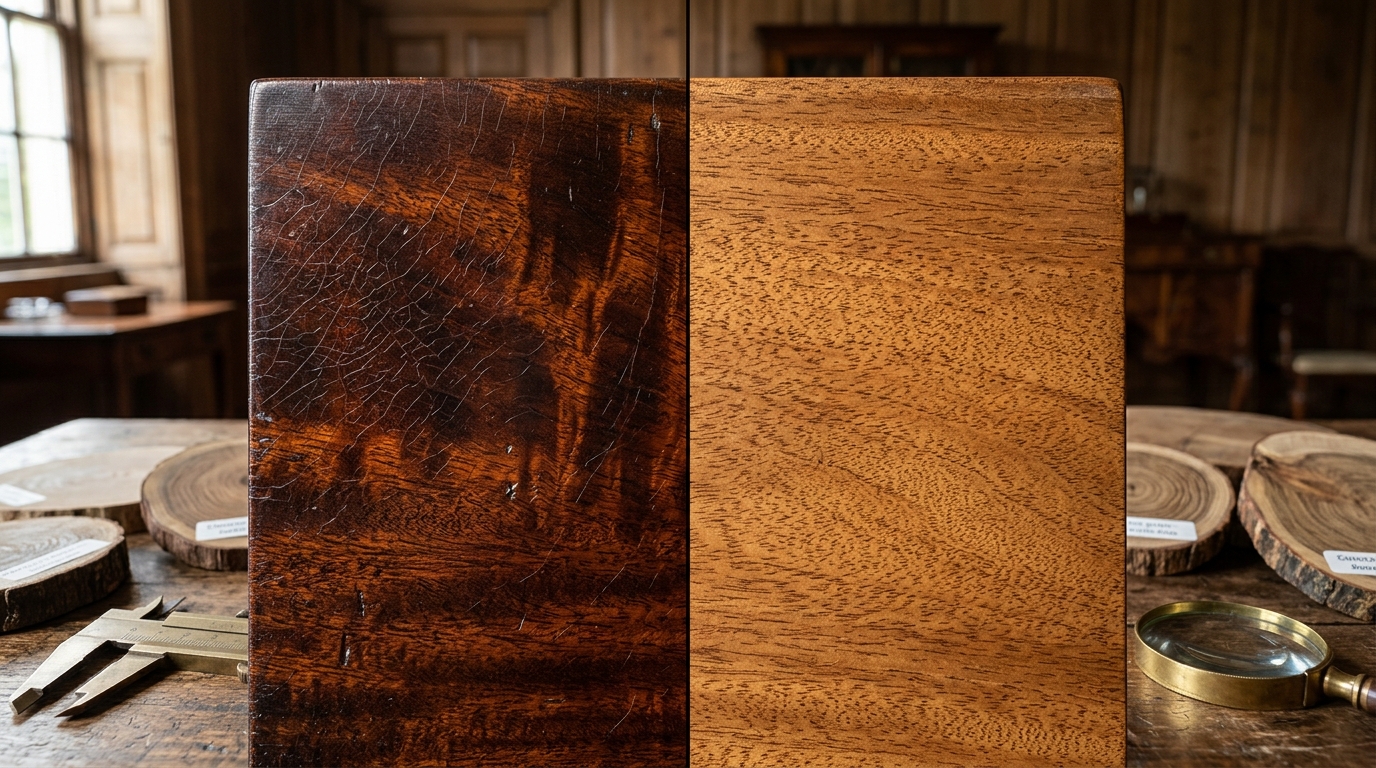
The True Mahoganies vs. Modern Commercial Substitutes
Botanically, only trees from the genus Swietenia (within the Meliaceae family) produce genuine mahogany. Over the last three centuries, furniture making relied primarily on two historic species, followed by several post-industrial commercial substitutes:
| Common Name | Botanical Name | Historic Era | Density & Weight | Key Diagnostic Markers |
|---|---|---|---|---|
| Cuban / West Indian Mahogany (Santo Domingo Mahogany) |
Swietenia mahagoni | 1700 – 1790 (Queen Anne, Early Chippendale) |
Extremely Heavy (~53 lbs / cu ft) |
Dense, tight grain; darkens to a deep chocolate/auburn-wine color. Contains microscopic white calcium carbonate crystals inside pores. Nearly logged to commercial extinction by 1850. |
| Honduran / Big-Leaf Mahogany (Genuine Central American) |
Swietenia macrophylla | 1780 – 1950 (Federal, Hepplewhite, Empire, Victorian) |
Medium-Heavy (~35 – 40 lbs / cu ft) |
Golden reddish-brown with fiery ribbon curl or fiddleback figure. Uniform open vascular pores; exceptional optical chatoyancy. The benchmark wood of 19th-century American furniture. |
| African Mahogany (Khaya Wood) |
Khaya ivorensis / anthotheca | 1920 – Present (Mid-Century & Modern) |
Light to Medium (~30 – 33 lbs / cu ft) |
Coarse, stringy open grain with prominent fuzzy pore walls. Paler pinkish-orange tone; lacks the rich reddish-brown depth of Swietenia. Prone to tear-out. |
| Philippine Mahogany (Lauan / Meranti) |
Shorea species (Not a true mahogany) |
1945 – Present (Post-WWII Commercial) |
Very Light (~25 – 32 lbs / cu ft) |
Botanically unrelated dipterocarp hardwood. Grayish-pink to dull straw color, heavily stained with red dye. Coarse resin canals, zero chatoyancy, soft fibrous surface that dents easily with a thumbnail. |
| Sapele (African Hardwood) |
Entandrophragma cylindricum | 1950 – Present (Modern High-End Veneers) |
Heavy & Hard (~42 lbs / cu ft) |
Distinctive cedar-like scent when planed. Characterized by tight, mathematically uniform striped ribbon grain. Darker than Khaya, but grain is unnaturally straight and mechanical compared to wild 18th-century antique figures. |
The 6 Forensic Diagnostic Tests for Real Antique Mahogany
To definitively authenticate whether a dining table, console, or desk is authentic antique mahogany, apply these six physical tests:
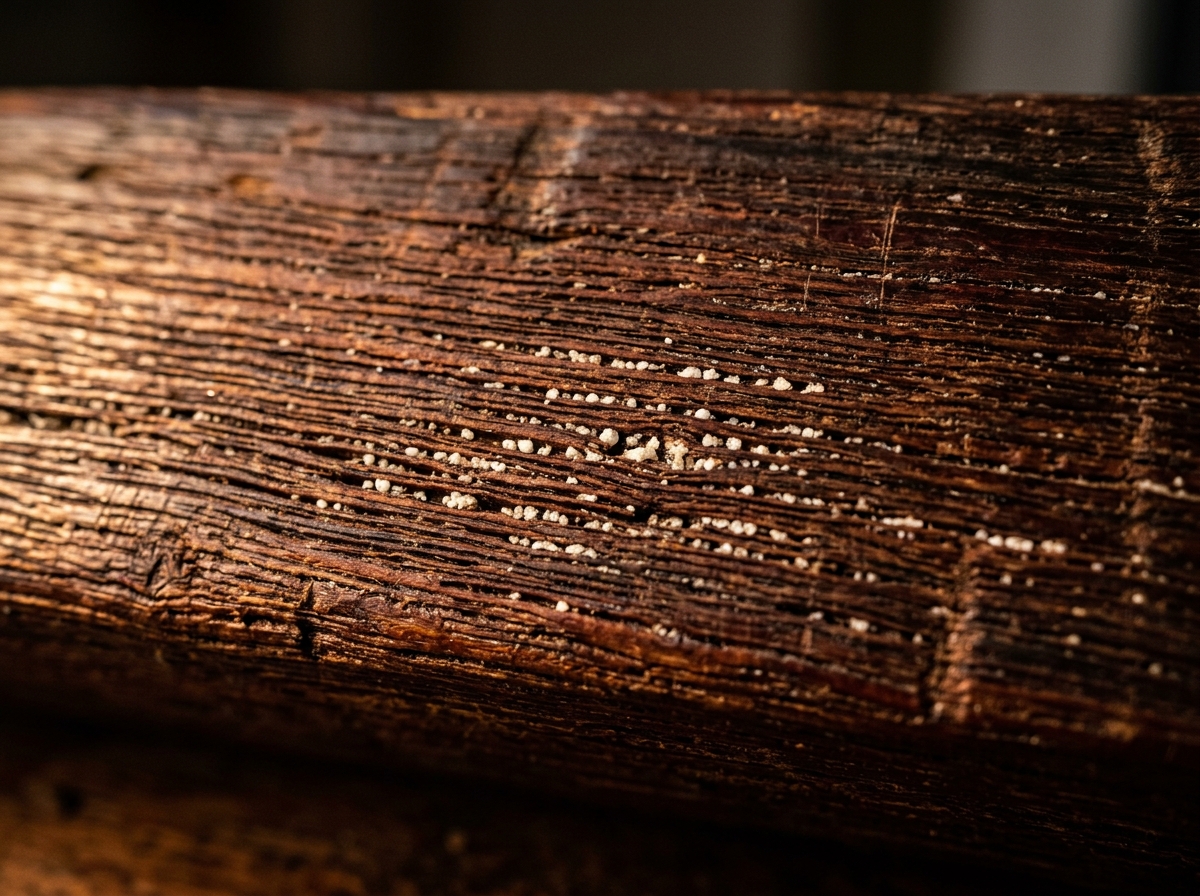
1. The “White Fleck” Calcium Test (The Cuban Mahogany Smoking Gun)
If you suspect a table is crafted from ultra-rare 18th-century Cuban mahogany, inspect the raw wood or unpolished secondary margins under a 10x jeweler’s loupe. Because virgin Swietenia mahagoni grew in the calcium-rich limestone soils of Cuba, Hispaniola, and Jamaica, the living trees absorbed dissolved minerals into their sap. As the timber cured, these minerals precipitated as chalky white calcium carbonate deposits embedded inside the open vascular pores. Under bright raking light, these appear as tiny white flecks or dashes peppering the dark wood grain. No other wood substitute on earth displays this marker. If you see distinct white calcium deposits inside dense, heavy reddish timber, you are holding authentic 18th-century Cuban mahogany.
2. Optical Chatoyancy (The “Hologram” Shift Test)
Authentic antique mahogany possesses an extraordinary optical property called chatoyancy (from the French for “cat’s eye”). The cellular fibers in Swietenia grew in an interlocking, wavy structure that reflects light directionally. To perform this non-destructive test:
- Position yourself next to a table under natural raking window light or a focused flashlight.
- Slowly move your head from left to right across the wood surface.
- In true antique mahogany, the grain will appear three-dimensional—ribbons of grain that looked light amber-gold from one angle will instantly flip to deep burgundy-wine from another, glowing from beneath the finish like liquid silk.
- In contrast, domestic woods stained to mimic mahogany (such as red gum, birch, or white pine) remain flat, two-dimensional, and static as you move your viewing angle. The color is merely resting on top of the fibers like a coat of paint. Cross-reference our guide on how to tell cherry from mahogany for companion grain checks.
3. The Heft and Specific Gravity Test
Nothing reveals wood species faster than lifting the table leaf. True 18th-century Cuban mahogany is remarkably dense—with a specific gravity ranging from 0.70 to 0.85, a solid one-inch-thick Cuban mahogany drop leaf feels as heavy as cast iron. In fact, seasoned Cuban timber barely floats in water. Honduran mahogany is slightly lighter (specific gravity ~0.55 to 0.65), while modern substitutes like African Khaya (0.45) and Philippine Lauan (0.40) feel feather-light by comparison. If a large dining table leaf feels unexpectedly light and flimsy when you lift it, it is almost certainly a modern substitute or softwood core.
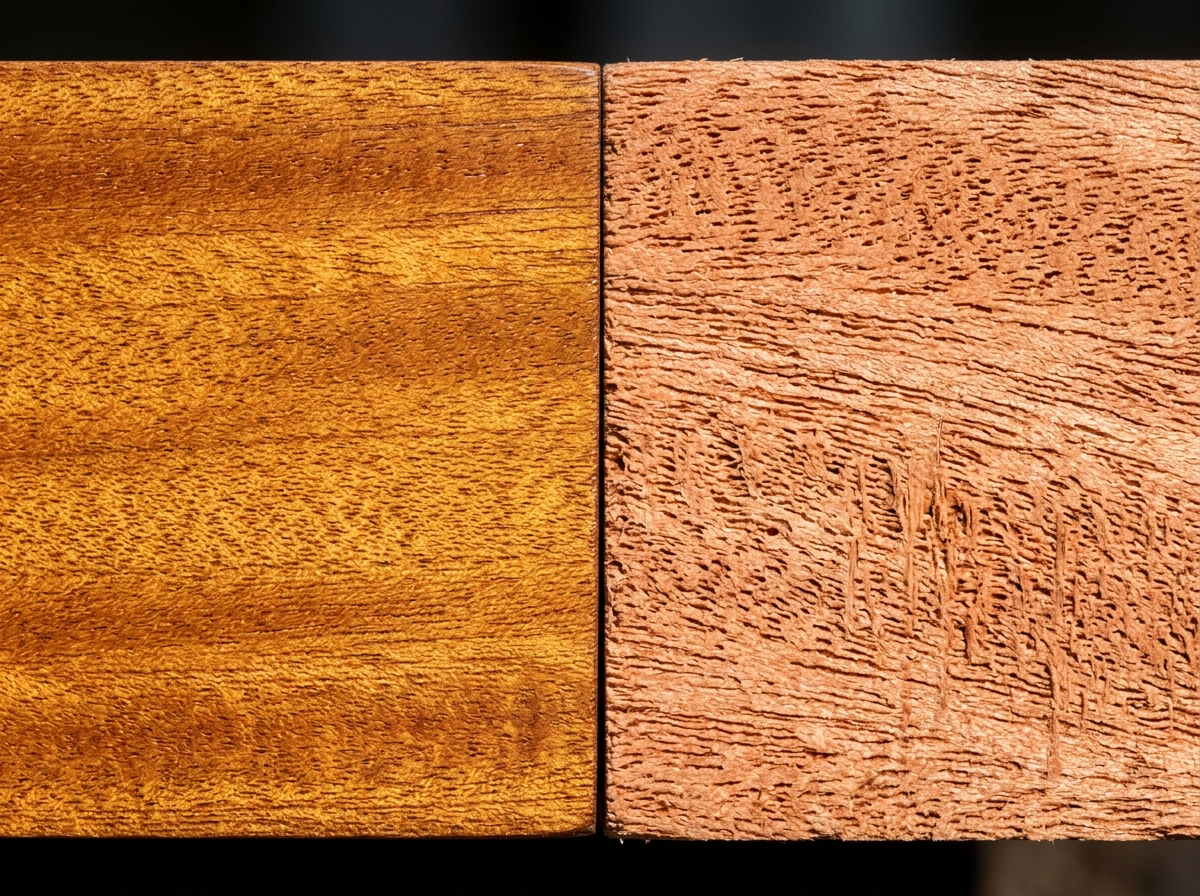
4. Vascular Pore Anatomy & End-Grain Structure
Mahogany is a diffuse-porous hardwood, meaning its vascular water-conducting tubes are distributed evenly throughout each annual growth ring rather than concentrated in earlywood bands (unlike ring-porous woods like antique oak). Under magnification:
- True Antique Mahogany (Swietenia): Displays clean, medium-sized oval pores that are often filled with dark amber resins or white mineral crystals. The wood rays crossing between pores are fine, crisp, and uniform.
- African Mahogany (Khaya): The pores are noticeably larger, more irregular, and have “fuzzy,” stringy cell walls that tear rather than cut cleanly during planing.
- Philippine Mahogany (Lauan): Displays massive open resin canals that look like coarse needle punctures in the wood surface, completely lacking the tight refinement of genuine antique timber.
5. Oxidation Color vs. Artificial Chemical Dye
A widespread myth among novice collectors is that mahogany is naturally dark purple or oxblood red when freshly harvested. In reality, freshly milled genuine mahogany is a soft salmon-pink or golden-tan hue. The magnificent deep reddish-brown color seen on authentic antiques is the result of photochemical oxidation—the reaction of wood tannins and lignins to over a century of natural UV daylight and atmospheric exposure.
To detect artificial staining, look at the unexposed margins: the underside of table aprons, behind drawer runners, or beneath removable leaves. In an authentic antique, unexposed areas will show a lighter golden-amber or honey hue, while exposed tops show deep wine-brown patina. In contrast, 20th-century reproductions use uniform red aniline dyes that look unnaturally pinkish-purple even on unexposed undersides.
6. Secondary Wood Diagnostics (The Underside Tell)
In high-grade 18th- and 19th-century American furniture, master cabinetmakers almost never wasted expensive imported mahogany on hidden internal structural components. If you examine the underside of a genuine antique mahogany dining table or pull out a cutlery drawer:
- Authentic Antiques: The structural drawer sides, backboards, and drop-leaf pivot brackets were made from domestic secondary timber—specifically Eastern white pine, Atlantic cedar, American chestnut, or tulip poplar. Examine our guides on dating antique furniture by dovetails and identifying straight vs. circular saw marks on these secondary boards.
- Modern Reproductions: Feature uniform stained plywood cores, particle board with rotary-peeled veneer, or use cheap tropical hardwoods throughout the entire carcass. Learn how to tell the difference in our comprehensive breakdown of solid wood vs. veneer antique furniture.
Mahogany Usage Across Major Antique Table Styles
The choice of mahogany species directly mirrors the stylistic evolution of American and English furniture:
Chippendale & Queen Anne (1740–1785)
Dominated by solid Cuban mahogany. Master carvers in Philadelphia, Boston, and Newport utilized dense West Indian timber for cabriole legs, ball-and-claw feet, and pierced tilt-top tea table galleries.
View Tilt-Top Table Guide →Federal & Duncan Phyfe (1785–1830)
Transitioned to Honduran mahogany. Showcased stunning book-matched flame mahogany veneers on table aprons, reeded pedestal legs, and brass claw casters.
View Duncan Phyfe Guide →Colonial Revival (1900–1950)
Grand Rapids manufacturers like Imperial Furniture and Mersman crafted mahogany drop-leaf dining tables and tea wagons using Honduran veneers over gumwood cores.
View Imperial Furniture Marks →Explore our complete architectural catalog of the diverse types of antique tables across American and British history.
Preserving Authentic Antique Mahogany Patina
Once you have authenticated a genuine antique mahogany piece, preserving its delicate historic finish is vital to maintaining its investment value:
- Never Use Silicone Sprays or Oil Polishes: Supermarket spray polishes contain silicone oils that penetrate the open pores of antique mahogany, forming a permanent, gummy white haze that prevents future re-polishing.
- The Shellac Denatured Alcohol Test: Historical 18th- and 19th-century mahogany was almost always finished with orange or garnet shellac applied with a cloth pad (French polishing). To confirm an original finish, apply a tiny drop of denatured alcohol to an inconspicuous underside spot; if the finish softens and dissolves slightly, it is authentic historic shellac. Modern polyurethane or lacquer finishes will not react.
- Nourish with Pure Paste Wax: To restore deep chatoyancy, fill microscopic wood pores, and protect against humidity fluctuations without altering the wood’s breathability, apply a high-grade microcrystalline or carnauba paste wax once or twice a year. Read our comprehensive field test on the best wax for antique mahogany dining tables.
How Mahogany Authenticity Affects Market Value (2026 Price Benchmarks)
In the secondary antique and fine art marketplace, authentic botanical mahogany commands significant valuation premiums over stained substitutes:
- Tier 1: Solid Cuban Mahogany Masterpieces ($5,000 – $35,000+): Verified 18th-century Queen Anne or Chippendale dining tables, drop-leaf tables, and desks crafted from solid virgin Cuban timber (*Swietenia mahagoni*). Untouched dark oxidized patina and original ball-and-claw or pad feet.
- Tier 2: Federal & Empire Period Honduran Mahogany ($1,200 – $4,500): Early 19th-century dining tables, Pembroke tables, and card tables featuring solid Honduran mahogany bases with intact historic flame veneers and original brass casters.
- Tier 3: Early 20th-Century Grand Rapids Mahogany ($300 – $800): High-quality Colonial Revival tables manufactured by companies like Mersman or Imperial Furniture featuring genuine Honduran mahogany veneers over solid hardwood cores. Excellent functional utility and historical charm.
- Tier 4: Mislabeled Stained Hardwoods & Modern Imports ($75 – $250): Mass-produced post-war tables made from red-stained gumwood, birch, or Philippine Lauan. Zero antique collector premium.
Frequently Asked Questions About Antique Mahogany
How can I tell if my antique table is real mahogany or stained wood?
To tell real mahogany from stained wood, check for optical chatoyancy and inspect the unpolished underside. Genuine mahogany exhibits a three-dimensional holographic shimmer that shifts between golden-amber and wine-red under moving light. Domestic substitutes like birch, poplar, or gumwood look flat and painted because the red dye sits only on the surface. Additionally, genuine mahogany undersides show distinct diffuse pores rather than the tight, non-porous grain of birch.
What is the difference between Cuban mahogany and Honduran mahogany?
Cuban mahogany (*Swietenia mahagoni*) was the premier wood of 18th-century cabinetry (1720–1785). It is extraordinarily dense and heavy (~53 lbs/cu ft), oxidizes to a dark wine-black patina, and contains unique white calcium carbonate deposits in its pores. Honduran mahogany (*Swietenia macrophylla*) became dominant after 1785; it is lighter in weight (~37 lbs/cu ft), has larger vascular pores, and displays a warmer golden-amber luster with dramatic ribbon figure.
Why does antique mahogany have white specks in the wood grain?
The tiny white specks in antique mahogany are microscopic calcium carbonate deposits. Because virgin Cuban mahogany trees grew in the limestone-rich soils of the Caribbean islands, they absorbed dissolved calcium through their roots. Over centuries of drying, these minerals crystallized inside the wood pores, creating a distinctive white-flecked signature that proves the wood is genuine 18th-century Cuban mahogany.
Is African mahogany (*Khaya*) considered real mahogany?
No, African mahogany (*Khaya*) is botanically distinct from genuine American mahogany (*Swietenia*). While belonging to the same broad botanical family (Meliaceae), African mahogany is significantly lighter in weight, has coarser, stringier pores, lacks the luminous optical chatoyancy of antique mahogany, and was not commercially used in American furniture until the 1920s.
Pingback: How to Tell Cherry from Mahogany in Antique Furniture: The Collector’s Wood Guide - Antique Tables