
Found in country farmhouses, historic parlors, and modern apartments alike, the drop leaf table is arguably the most ingenious, space-saving design in furniture history. But whether you inherited a weathered walnut piece from your grandparents or discovered a mysterious mahogany gem at an estate sale, one crucial question remains: how do you tell if your drop leaf table is a valuable antique, and what is it worth today?
🔍 Quick Answer: How to Identify an Antique Drop Leaf Table
To identify an authentic antique drop leaf table, inspect the hinge joint: true antique drop leaves feature a hand-milled rule joint (a rounded convex bead fitting into a concave groove) that conceals the hinges and antique screws when folded. Look underneath for straight saw marks (pre-1840) or rough hand-plane gouges, hand-cut dovetails on any drawers, and hand-filed single-slot iron screws. Authentic tables before 1880 rarely carry maker’s marks; any printed stencil or metal tag usually indicates a 1900s–1950s factory reproduction.
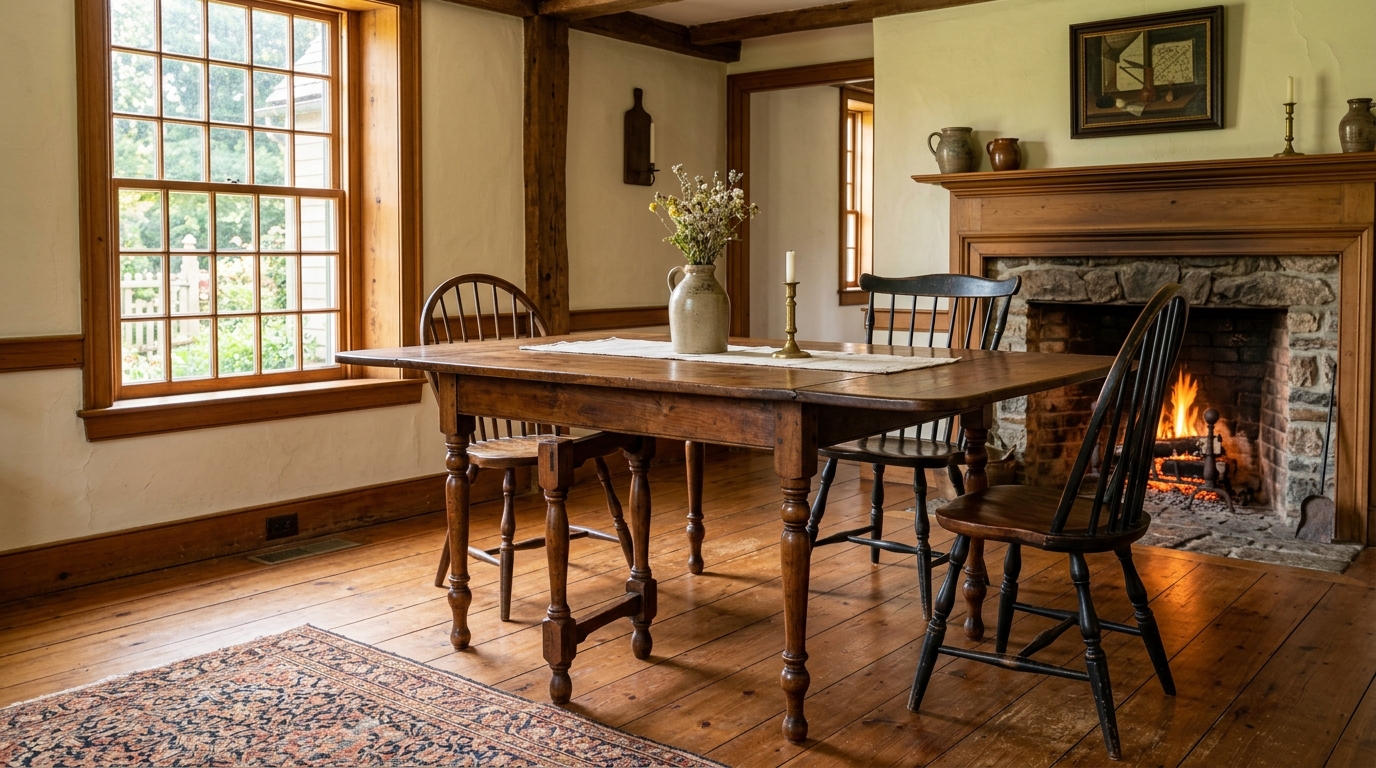
The 4 Primary Drop-Leaf Support Mechanisms (Dating by Design)
The mechanism used to hold the hinged leaves horizontal is one of the quickest ways to date a drop leaf table and determine its region of origin:
- The Butterfly Table (c. 1700 – 1750): One of the earliest American colonial forms, originating in New England. The leaf rests on a distinctive swinging wooden bracket shaped like an open butterfly wing, pivoting on wooden pins between the lower and upper stretchers. Authentic early butterfly tables are exceedingly rare and highly prized.
- The Gateleg Table (c. 1650 – 1800): Features an entire leg assembly (or “gate”) that pivots outward on wooden joints to support wide, heavy leaves. Gateleg tables almost always feature stretchers running along the floor.
- The Fly-Leg / Swing-Leg (c. 1750 – 1840): Popular during the Chippendale and Federal eras (including famous Duncan Phyfe drop leaf tables). A single fifth or sixth leg swings out from the center frame on a wooden knuckle joint to support each extended leaf.
- Wooden Knuckle Brackets & Pull-Out Slats (c. 1780 – 1900+): Common on Pembroke and Victorian parlor tables. The main legs remain stationary, while hinged triangular wooden brackets or sliding wooden runners pull out from beneath the center top to prop the leaves up.
The “Rule Joint”: The Hallmark of True Antique Craftsmanship
If you examine where the drop leaf meets the stationary tabletop, you will uncover the clearest sign of historical craftsmanship: the rule joint.
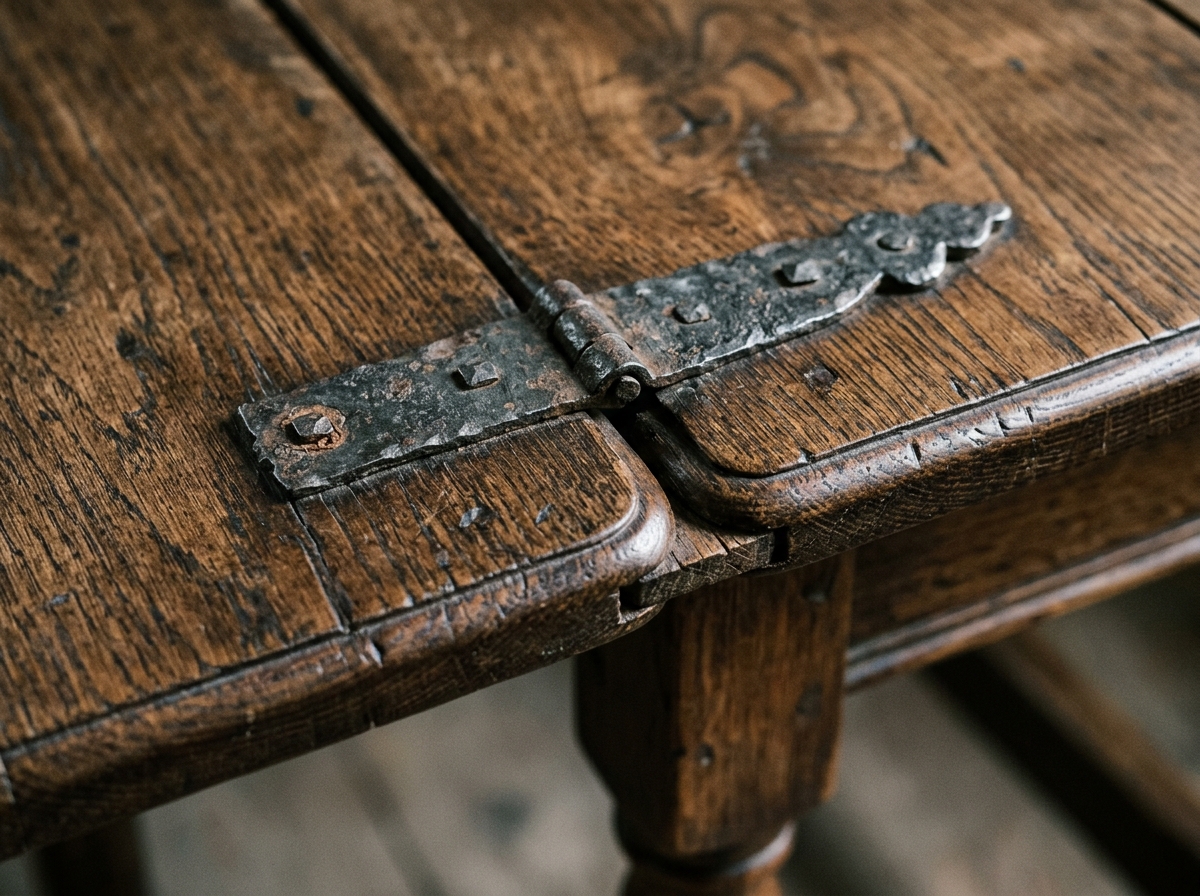
In a quality antique table, the edge of the tabletop is milled with a convex rounded profile (an ovolo or bead), while the mating edge of the drop leaf is hollowed with a matching concave profile (a cove). When the leaf is lowered, the two profiles glide over each other smoothly, concealing the hinge gap and hiding the unsightly metal hardware from view.
By comparison, cheap 20th-century reproductions or primitive utility tables feature simple square butt joints or exposed piano hinges with glaring 1/8-inch gaps that reveal the screws and hinges even when the leaves are dropped.
Antique Drop Leaf Table Dating Matrix (By Era & Style)
Drop leaf tables evolved across several distinct design movements (explore our comprehensive guide to all antique table styles and eras):
| Period & Style | Approximate Date | Key Diagnostic Features | Typical Woods | Estimated Value Range |
|---|---|---|---|---|
| Queen Anne | 1720 – 1760 | Delicate curved cabriole legs ending in pad, slipper, or trifid feet; scalloped aprons; wooden knuckle pivots. | Walnut, Cherry, Maple | $2,500 – $8,500+ |
| Chippendale | 1760 – 1790 | Sturdier cabriole legs with ball-and-claw feet or straight square “Marlborough” legs; rich figure; rule joints. | Cuban Mahogany, Walnut | $1,800 – $6,000 |
| Federal / Hepplewhite | 1790 – 1820 | Slender, square tapering legs; satinwood stringing inlays; bellflower motifs; Pembroke single-drawer styles. | Mahogany, Satinwood, Cherry | $1,200 – $4,500 |
| American Empire | 1820 – 1845 | Heavy turned bulbous legs; central lyre or column pedestals; paw feet; flame mahogany veneers. | Crotch Mahogany, Pine core | $500 – $1,800 |
| Victorian Farmhouse | 1850 – 1900 | Turned spool or trumpet legs; circular saw marks underneath; porcelain or brass wheel casters. | Oak, Yellow Pine, Poplar | $250 – $750 |
| Colonial Revival (like vintage Mersman tables) | 1920 – 1950s | Uniform plywood substrate; machine dovetails; factory labels; Philips screws on replacement hardware. | Honduran Mahogany, Gumwood | $100 – $350 |
The 5 Physical Dating Clues (Underside Inspection)
Never rely strictly on the tabletop finish to date an antique drop-leaf table. Turn the table upside down or inspect underneath with a flashlight to verify these forensic markers:
1. Saw Marks (Straight vs. Circular)
Look across the raw, unfinished wood on the bottom of the leaves and top planks:
- Straight, Slightly Uneven Parallel Lines: Proof of a manual two-man pit saw or early water-powered reciprocating sash saw. This conclusively dates the milling to pre-1840.
- Curved, Arced Parallel Lines: Created by circular saw blades, which came into common commercial use in American lumber mills after 1845–1850.
2. Fasteners & Screws
Inspect the drop leaf hinges. Pre-1846 screws were hand-finished on a lathe. They feature off-center single slots, blunt flat tips (no sharp gimlet points), and slightly irregular threads. If the table uses modern pointed screws, examine the holes: are they replacements in old oversized holes, or original modern fasteners?
3. Wood Shrinkage & “Ovaling”
Wood shrinks significantly across the grain over centuries, but almost never along its length. If you measure an antique drop leaf table that was originally round when both leaves were extended (such as a 48-inch round table), measure it in both directions. True antiques will almost always be 1/4 inch to 1/2 inch out of round due to natural tangential wood shrinkage.
4. Drawer Dovetails (On Pembroke & Side Tables)
If your drop leaf table includes an end drawer (characteristic of Pembroke tables), pull it completely out:
- Hand-Cut Dovetails (Pre-1880): Wide, slightly irregular pins and tails with visible layout scribe marks from the cabinetmaker’s marking gauge.
- Knapp Joint (1870 – 1900): A distinctive scallop-and-peg semicircular joint developed in New York; instant proof of late-19th-century American manufacturing.
- Machine Dovetails (Post-1890): Completely uniform, narrow, closely spaced pins cut by high-speed rotary routers.
⚖️ Need a Certified Appraisal of Your Drop Leaf Table?
Valuing an antique drop-leaf table requires verifying wood species, hardware authenticity, and structural integrity. If you are preparing for an estate sale or insurance valuation, professional certified appraisers can evaluate photos and provide an official market report in 24–48 hours.
Get an Online Table Appraisal →
(No in-person shipping required)
What Is Your Antique Drop Leaf Table Worth?
Current secondary market valuations for drop leaf tables depend primarily on four factors: rarity of form, wood species, condition of the original finish, and structural stability.
- Tier 1: High-Value Collector Pieces ($2,500 – $10,000+): Early 18th-century Queen Anne and Chippendale tables with original ball-and-claw or pad feet, single-plank leaves of solid figured walnut or Cuban mahogany, and intact untouched finishes.
- Tier 2: Mid-Range American Antiques ($600 – $1,800): Federal and Empire period swing-leg dining tables, Pembroke tables with original brass pulls, and well-proportioned Victorian tiger oak dining tables.
- Tier 3: Rustic Country & Farmhouse Tables ($250 – $600): Pine, poplar, or maple drop-leaf kitchen tables with turned legs. While less formal, these are in exceptionally high demand for modern rustic and farmhouse home decor.
- Tier 4: Vintage Colonial Revival Reproductions ($100 – $300): Sturdy mid-century tables made from plywood cores with mahogany or cherry veneers.
Preserving the Value: Do Not Strip the Finish!
Stripping an antique drop-leaf table with chemical strippers can permanently erase up to 60–80% of its market value. Instead, revive dry or neglected historical wood using a dedicated paste wax. Read our comprehensive guide on the best wax for antique dining tables to learn how to restore deep color and lustre without damaging original shellac.
Frequently Asked Questions
What is the difference between a drop leaf table and a antique gateleg table?
All gateleg tables are drop leaf tables, but not all drop leaf tables are gateleg. A gateleg table specifically uses an entire pivoting leg with stretchers that swings outward like a garden gate. Standard drop-leaf tables use stationary legs and swing-out wooden brackets (or a single fly-leg) to support the leaves.
Why are the drop leaves sagging or uneven?
Sagging leaves are caused by worn wooden pivot knuckles, loose hinge screws, or wood shrinkage around the iron hinges. Never force a sagging leaf upward, as this can crack the rule joint. In most cases, carefully tightening the hinge screws or inserting hardwood shims along the pivot knuckle restores a perfectly level surface.
Where can I find maker’s marks on an antique drop leaf table?
Check the bottom of the table leaves, the inside walls of any end drawers, or the side apron rails. True 18th-century tables rarely have marks, but 19th-century pieces may have paper labels or stamped impressions from manufacturers such as Mersman, Stickley, or Grand Rapids furniture makers.
Can an antique drop leaf table be used as a daily dining table?
Yes. Many solid oak and walnut drop-leaf tables were designed specifically for robust daily use. As long as the rule joints and hinges are sound, they offer unbeatable flexibility, folding down to 18–24 inches wide against a wall and expanding to 48–72 inches to seat 6 to 8 people comfortably.
Pingback: Antique Gateleg Tables: Complete Style, Era & Value Identification Guide - Antique Tables