
The Definitive Joinery Dating Rule:
When dating an antique chest, desk, or table, drawer joinery is the single most honest forensic fingerprint. Exterior wood finishes can be stripped, brass hardware replaced, and drawer fronts polished, but craftsmen rarely wasted time, labor, or sandpaper disguising the internal corner joints of secondary timber. By closely inspecting the geometry, spacing, and tool markings of drawer dovetails, you can pinpoint the manufacturing era of American and European furniture within a 15- to 25-year window.
If you pull out the drawer of an antique table or chest and turn it to examine the side joints, you are looking directly into the tool chest of the cabinetmaker who built it. Before the industrial revolution, joining the front of a drawer to its sides required cutting interlocking wedge-shaped fingers—known as pins and tails—entirely by hand using a backsaw and handheld wood chisels. Because this process demanded immense skill and hours of manual bench work, the evolution from crude early joints to delicate hand-cut dovetails, transitional mechanical joints, and modern factory machine routing tracks the technological history of furniture making.
How to Date Antique Furniture by Dovetails: Quick Forensic Summary
Direct Dating Answer: To date antique furniture by dovetails, inspect pin thickness, spacing symmetry, and tool markings: Hand-cut dovetails (pre-1860) feature narrow, triangular pins with slight spacing irregularities and visible knife scribe lines. Knapp joints (pin & cove) date strictly between 1870 and 1900. Machine-cut factory dovetails (post-1890) show mathematically uniform, rounded cutter corners and identical pin-to-tail widths.
Understanding this chronology prevents costly collector mistakes. A table sold as an “18th-century Queen Anne masterpiece” that reveals perfectly symmetrical, round-bottomed router dovetails inside the drawer box is either a 20th-century colonial reproduction or a married piece. Conversely, spotting subtle knife-scored layout lines and delicate, paper-thin pins guarantees your piece was crafted by an artisan before the American Civil War.
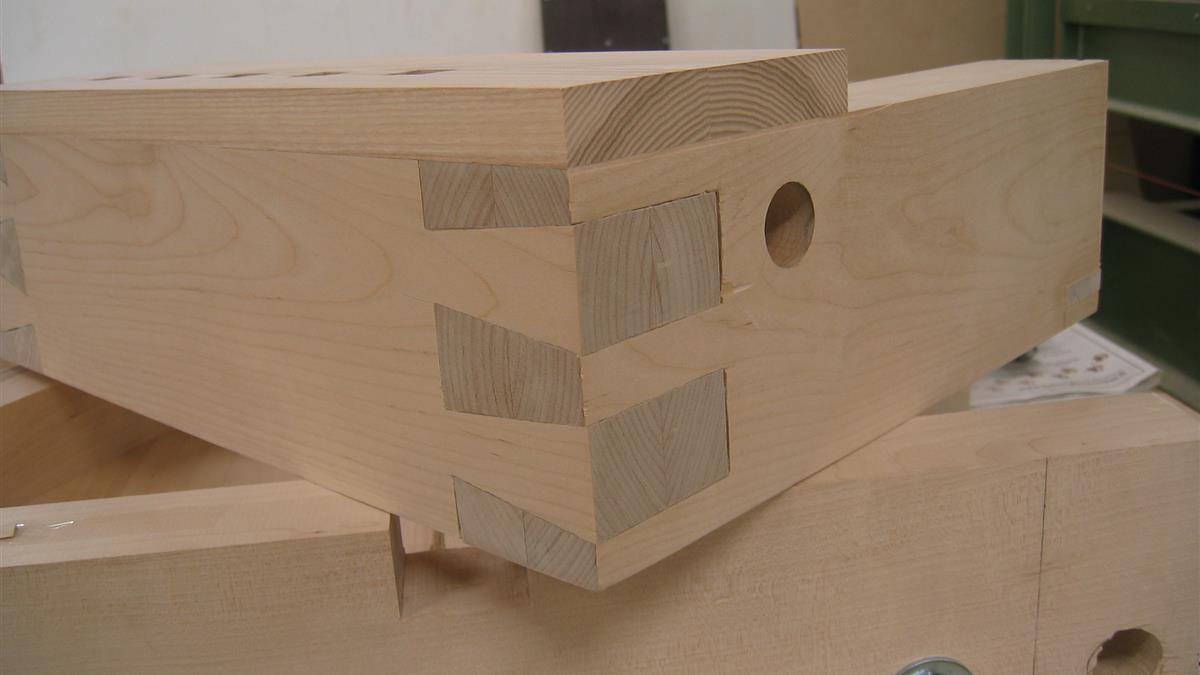
The Antique Dovetail Chronological Dating Matrix (1700–Present)
Use this comprehensive timeline matrix to match the dovetail joints on your drawer boxes to their historical manufacturing period:
| Era & Period | Dovetail Type | Pin & Tail Characteristics | Tooling & Scribe Marks | Common Furniture Forms |
|---|---|---|---|---|
| Pre-1700 Jacobean & Early Colonial |
Through-Dovetail or Nailed Butt Joint | Massive, thick, crude. Often only 1 to 2 huge dovetails per drawer side (1.5″ to 2.5″ tall). | Coarse hand-saw cuts; frequently reinforced with hand-forged wrought rosehead nails. | Joined chests with drawers, heavy oak trestle tables, early Bible boxes. |
| 1700 – 1780 William & Mary, Queen Anne, Chippendale |
Hand-Cut Through & Half-Blind | “Narrow Pins”: Pins tapered down to 1/16″ to 1/8″ at the face. Broad, expansive tails. Noticeable spacing variation between joints. | Prominent hand-scribed knife/gauge lines overshooting the joint. Hand-chiseled bottom corners. | Lowboys, highboys, tea tables, slant-front desks, Pembroke dining tables. |
| 1780 – 1860 Federal, Hepplewhite, Empire, Early Victorian |
Refined Hand-Cut Half-Blind | Pins slightly wider (1/8″ to 3/16″) than high-Georgian pieces, but still distinctly hand-proportioned. Tighter, cleaner joints. | Fine marking gauge score lines still present; drawer bottoms chamfered to slide into routed grooves. | Drop-leaf dining tables, sideboards, card tables, French-restoration chests. |
| 1870 – 1900 The Industrial Transition |
The Knapp Joint (Pin & Cove / Scallop & Dowel) |
Round wooden dowel/pin set into a scalloped circular socket. Non-traditional dovetail geometry. | Mathematically cut by high-speed machinery invented by Charles Knapp. Zero hand scribe lines. | Eastlake chests, Victorian walnut washstands, Grand Rapids dining buffets. |
| 1890 – 1930 Golden Oak, Arts & Crafts, Colonial Revival |
Early Machine-Cut Dovetail | Uniform Spacing: Pins and tails are roughly equal in width (often 1/4″ to 3/8″). Exactly identical distances between pins. | Curved circular cutter kerfs at inside corners from multi-spindle router bits. Clean, machine-milled secondary wood. | Tiger oak sideboards, Mission oak library tables, Mersman and Imperial tables. |
| 1930 – Present Mid-Century & Modern Factory |
CNC / Modern Router Dovetails | Strict mathematical perfection. Standardized cutter angles (typically 8° or 14°). Often visible in plywood or particle board cores. | Plasticized synthetic yellow PVA glues, stamped factory batch codes, zero chisel tear-out. | Mid-century modern credenzas, modern commercial furniture, contemporary reproductions. |
Anatomy of a Dovetail: Pins vs. Tails
To master dating antique joinery, you must understand how the joint is constructed. A dovetail joint consists of two mating components:
- The Pins: The wedge-shaped fingers projecting from the side of the board that receives the joint. In antique drawers, the pins are almost always cut into the drawer front and drawer back.
- The Tails: The broader, flared trapezoidal projections that resemble a dove’s spread tail feathers. These are cut into the drawer sides because the pulling force when opening the drawer naturally locks the tails against the angled pins, preventing the drawer front from separating even without glue.
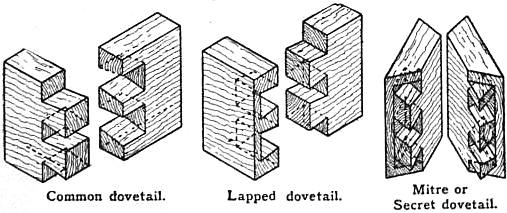
Through Dovetails vs. Half-Blind (Lap) Dovetails
Dovetail joints come in two primary variations on antique furniture:
- Through Dovetails: Both the end grain of the pins and the end grain of the tails are visible from the exterior of the box. In 17th-century and early 18th-century cabinetry, through-dovetails were commonly used on drawer fronts. However, by 1730, visible through-dovetails on the front of high-style furniture were considered visually crude. From the Queen Anne period onward, through-dovetails were reserved for the rear corners of the drawer box, while drawer fronts utilized half-blind joints.
- Half-Blind (Lap) Dovetails: The drawer front is cut with a front lip (usually 1/4″ to 3/8″ thick) that conceals the end grain of the drawer side tails. When the drawer is closed, only solid wood or decorative veneer is visible to the room. When the drawer is pulled open, the dovetail joint is revealed along the side cheek. This became the universal standard for fine tables, including antique Pembroke tables and antique drop-leaf cutlery drawers, from 1740 through the 20th century.
The 5 Physical “Smoking Gun” Tests for Authentic Hand-Cut Dovetails
How can you be certain whether a dovetail joint was crafted by hand with 18th-century chisels or milled on a 1910 electric machine? Check for these five physical forensic markers:
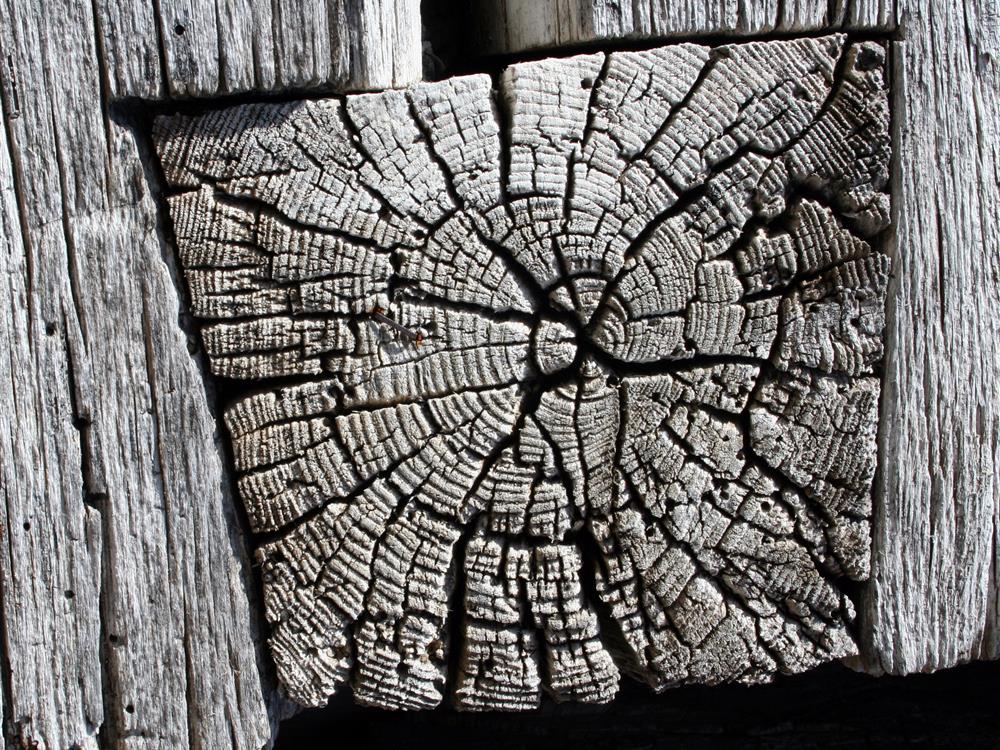
1. The Scribe Line (Marking Gauge Score Line)
Before cutting hand dovetails, an 18th- or early 19th-century joiner used a marking gauge—a wooden tool with a sharp steel spur—to scribe a reference line across the board indicating exactly how deep to saw and chisel the sockets. In authentic hand-cut work, this fine incised knife line is almost always visible running horizontally across the baseline of the pins and tails. Crucially, because the craftsman was working briskly by eye, the scribe line often overshoots the corner by 1/8″ to 1/4″ onto the raw secondary wood. Modern multi-spindle router machines do not use marking gauges; if you see a knife-scribed gauge line, you are looking at hand work.
2. Pin-to-Tail Width Ratio (“Narrow Pins”)
During the Chippendale, Queen Anne, and Federal periods, cabinetmakers took immense professional pride in cutting delicate, paper-thin pins. The tip of an 18th-century pin can be as narrow as 1/16″ or 1/8″, contrasted against a massive tail that might be 1.5″ or 2″ wide. In contrast, 20th-century factory dovetail router bits had structural thickness limitations; cutting steel router bits thinner than 1/4″ caused them to snap under high rotational torque. Consequently, modern and vintage factory dovetails feature thick pins that are nearly identical in width to the tails (a 1:1 or 1:1.5 ratio), whereas authentic pre-1840 hand joints feature dramatic 1:4 to 1:8 ratios.
3. Spacing Asymmetry & Angle Variations
Because hand-cut joints were laid out with handheld dividers and sawn with human judgment, no two dovetails on a pre-industrial drawer are mathematically identical. Take a precision ruler or brass calipers and measure the distance between the pins on the left side of a drawer versus the right side. On authentic antiques, you will detect slight variations of 1/32″ to 1/16″ in pin spacing, tail angles, and baseline depths. If every single pin and tail on all four drawers matches to within 0.1 millimeters, the piece was machine manufactured.
4. Saw Kerf Overcuts on Internal Baselines
When an 18th-century woodworker sawed down the cheeks of the pins using a fine-toothed backsaw, stopping the saw blade at the precise depth across both sides of the board was nearly impossible without automated stops. If you inspect the interior, unpolished corner of the drawer box with a flashlight, you will frequently see small, vertical saw kerfs that cut 1/16″ past the baseline into the secondary timber. These accidental overcuts were considered completely acceptable on hidden secondary drawer sides, but automated factory machinery never produces them.
5. Secondary Timber Species & Bottom Construction
True antique drawer boxes are virtually never made entirely from expensive primary show woods. While the drawer front might be solid Honduran mahogany, flame birch, or American black walnut, the drawer sides, back, and bottom were made from cheap local secondary timber—typically Eastern white pine, tulip poplar, Atlantic cedar, or American chestnut. Furthermore, examine how the drawer bottom is held:
- Pre-1800: The drawer bottom is hand-planed with tapered chamfers along all four edges so its thick center panel can slide into narrow hand-plowed grooves in the drawer sides. The rear of the bottom is secured with hand-hammered rosehead nails or early cut square nails. Cross-reference our detailed guide on dating antique furniture by nails.
- Post-1890: Drawer bottoms are uniform 1/4″ three-ply plywood or machine-milled secondary wood fitted into uniform saw-kerf dado grooves without hand chamfering.
The 1870–1900 Transition: The Famous Knapp Joint
The 30-Year Golden Dating Window:
If the drawer joint on your piece is not a triangular dovetail at all, but instead features a rounded peg inside a half-circle scallop, you have discovered the holy grail of antique dating: The Knapp Joint (also known as the “pin and cove” or “scallop and dowel” joint). Patented by Charles B. Knapp in 1867 and commercialized by 1870, this was the world’s first mechanized drawer joint. Because it was completely replaced by multi-spindle machine dovetails by 1900, any piece of furniture containing a Knapp joint dates strictly between 1870 and 1900.
The Knapp joint represents the bridge between hand craftsmanship and full-scale factory automation. To read the complete historical background, patents, and maker identification for this unique joint, explore our definitive companion guide to Knapp joint antique furniture identification.
Cross-Referencing Hardware, Screws & Saw Marks
Forensic furniture appraisal requires examining the entire drawer assembly as a cohesive historical system. Never date a piece solely on dovetails without cross-referencing these companion components:
Fasteners & Screws
Check the screws securing the drawer runners, dust boards, and brass handles. Hand-filed screws with off-center slots and blunt gimlet-free tips date to pre-1846, while modern pointed screws date to post-1850.
Read the Screws Dating Guide →Secondary Saw Marks
Examine the rough underside and backboards of the drawer box. Straight, uneven parallel saw kerfs indicate pre-1840 pit or sash saws, while curved arc kerfs prove circular saw milling after 1850.
Read the Saw Marks Guide →Solid Wood vs. Veneer
Check the drawer front edge. 18th-century antique furniture used thick 1/8″ sawn veneer over solid pine or chestnut cores, whereas 20th-century reproductions use paper-thin rotary-sliced veneers over plywood.
Read Solid vs. Veneer Guide →To see how these joinery diagnostics integrate across diverse historical table designs, consult our comprehensive encyclopedia on the types of antique tables across American and British decorative eras.
Beware: 3 “Fake Antique” Dovetail Tricks & How to Spot Them
Because antique dealers and auctioneers know that hand-cut dovetails command premium prices, reproduction workshops frequently attempt to artificially simulate aged joinery. Watch out for these three fraudulent techniques:
- Hand-Rasping Machine Dovetails: Deceitful sellers take a standard 20th-century machine-dovetailed drawer and run a coarse rasp or sandpaper across the joints to artificially create uneven gaps. How to catch it: Inspect the inside corner. A real hand-cut joint has crisp, razor-sharp inside 90-degree corners cut with a sharp wood chisel. A rasped machine joint will still retain the rounded bottom curve created by the original spinning router bit.
- Fake Scribe Lines: Fraudulent restorers occasionally drag an awl or utility knife along the baseline of a modern drawer to mimic an 18th-century marking gauge score line. How to catch it: A genuine marking gauge score line was pressed into the wood before the joint was assembled; therefore, the score line continues cleanly beneath the base of the pins. Fake score lines added after assembly will have interruptions and jagged hesitation marks where the blade hit the corner pins.
- “Married” Drawers in Older Carcasses: Sometimes an authentic 18th-century highboy or dining table carcass has had rotten or missing drawers replaced with 1920s reproduction boxes. How to catch it: Check the patina and wood shrinkage on the drawer sides. Authentic antique drawer sides will exhibit significant transverse cross-grain shrinkage and deep friction wear along the bottom runners where the drawer slid across its oak supports for over a century.
How Dovetail Quality & Condition Affect Antique Furniture Value
In the secondary collector and auction marketplace, intact original drawer dovetails are a major valuation driver:
- Museum & Investment Tier ($3,000 – $15,000+): Authentic 18th-century Queen Anne or Chippendale pieces retaining completely untouched drawer boxes with paper-thin hand pins, original chamfered pine bottoms, and virgin hide glue. Zero altered or rebuilt joinery.
- Mid-Range Collector Tier ($800 – $2,500): Federal and Empire tables or chests with authentic hand-cut half-blind dovetails that show minor historical repairs (e.g., small re-glued corner splits or re-planed bottom runners) that do not compromise structural authenticity.
- Late Victorian Machine Tier ($300 – $800): Eastlake and Golden Oak pieces with pristine Knapp joints or early 1890s uniform machine dovetails. High utility value and growing collector interest for intact Grand Rapids manufactured furniture like Imperial Furniture Company pieces.
- Reproductions & Married Pieces ($100 – $300): Modern colonial revival pieces with machine-cut dovetails or older pieces with rebuilt reproduction drawer boxes. Carries functional utility value but negligible antique investment premium.
Frequently Asked Questions About Antique Dovetails
When were hand-cut dovetails replaced by machine dovetails?
Hand-cut dovetails were gradually replaced between 1870 and 1890. The transition began with the invention of the mechanical Knapp joint (1870–1900), followed by the widespread adoption of multi-spindle steam-powered dovetail router machines in Grand Rapids and New England factories by the late 1880s. By 1895, virtually all commercial furniture manufactured in North America and Western Europe featured machine-cut dovetails.
Why are hand-cut dovetails so uneven on antique furniture?
Hand-cut dovetails are uneven because 18th- and early 19th-century cabinetmakers cut them freehand using handheld saws and wood chisels. Because hidden drawer joinery was functional rather than decorative, craftsmen worked quickly by eye rather than measuring each joint with micrometers. Slight variations in spacing, pin width, and angle are the hallmarks of authentic human craftsmanship.
What are “narrow pins” on an antique drawer?
“Narrow pins” refer to the extremely slender, wedge-shaped pins found on high-grade 18th-century Queen Anne and Chippendale furniture. Master cabinetmakers tapered the tips of the pins down to 1/16″ or 1/8″ to showcase their chisel virtuosity against wide, broad tails. Factory machines could not replicate these ultra-slender pins without snapping their steel cutter bits.
Does repairing loose dovetails hurt the value of antique furniture?
No, carefully re-gluing loose original dovetail joints using reversible, period-accurate hot hide glue preserves the structural integrity and value of the furniture. However, driving modern drywall screws into the drawer corners, using expanding polyurethane glue, or replacing original drawer sides with new wood can permanently erase 40% to 70% of an antique’s market value.
Pingback: The Knapp Joint: How Pin-and-Cove Joinery Dates Antique Furniture (1870–1900) - Antique Tables