
The “House of Brandt” Legacy:
Throughout the mid-20th century, The Brandt Cabinet Works of Hagerstown, Maryland, was celebrated across the United States as the “World’s Largest Maker of Occasional Tables.” While mass-market giants like Mersman focused on high-volume production lines, Brandt earned a dedicated following among upscale department stores and discerning homeowners for superior mahogany craftsmanship, exquisite Duncan Phyfe pedestal carvings, and heavy cast brass hardware. Today, vintage Brandt tables are experiencing a major collector renaissance. This comprehensive guide details how to decipher authentic Brandt maker’s marks, read stenciled model numbers, date construction eras, and determine 2026 market values.
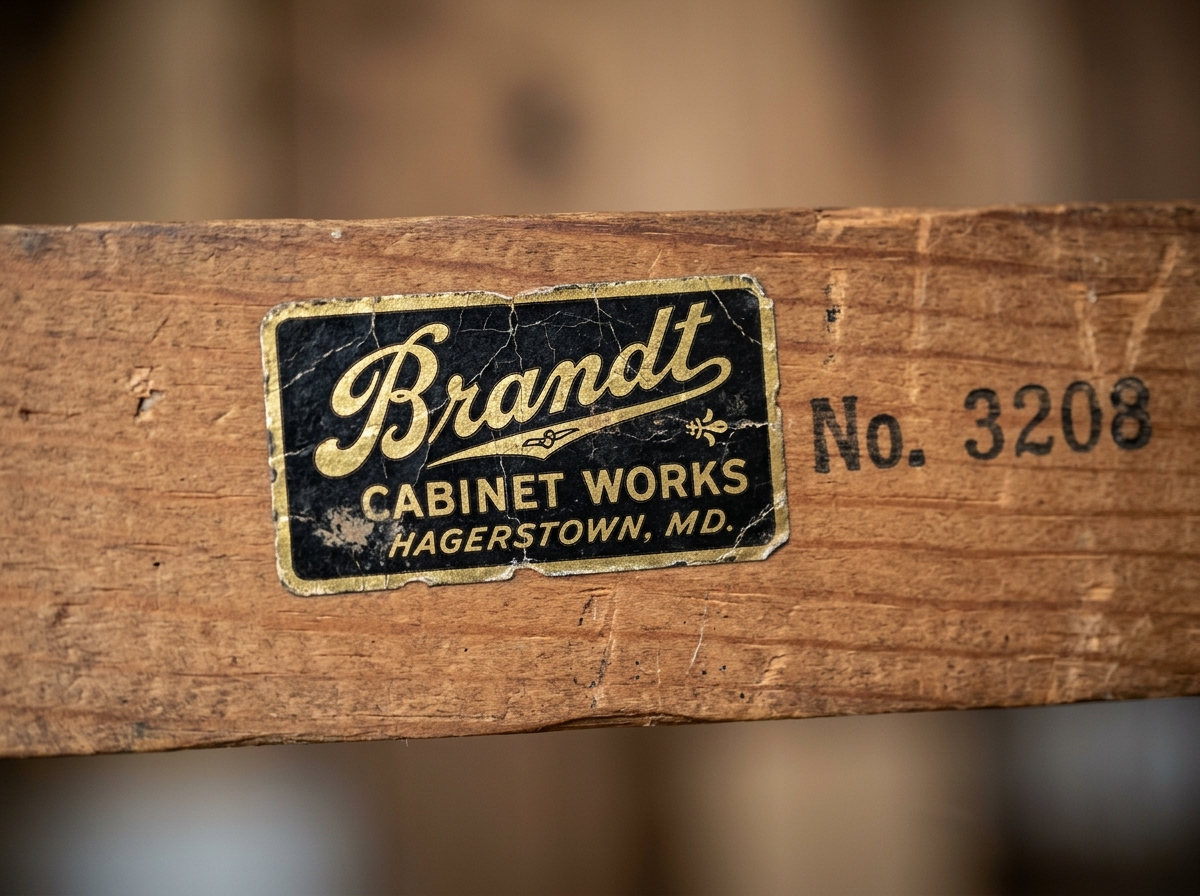
If you flip over a vintage mahogany drop-leaf table, leather-top drum table, or Duncan Phyfe occasional table and find a black-and-gold decal reading “Brandt — Hagerstown, Maryland,” you have found a piece of American furniture history. Founded in 1901 by Carl Brandt, the company spent eight decades perfecting small-format occasional furniture. Because Brandt specialized almost exclusively in tables rather than full bedroom or dining suites, their cabinetmakers mastered intricate tabletop veneers, scalloped piecrust borders, and complex drop-leaf support mechanisms that rivaled custom boutique workshops.
Brandt Cabinet Works Table Marks: Quick Identification Summary
Direct Identification Answer: To identify an authentic Brandt table, check the underside of the top or inside the drawer for three markers: 1) A black-and-gold foil or paper decal featuring stylized script “Brandt” with “Hagerstown, MD” or “The House of Brandt.” 2) A 3- or 4-digit stenciled pattern number (often accompanied by finish letters like “M” for Mahogany or “C” for Cherry). 3) Heavy cast brass lion paw casters or brass caps on reeded tripod or splayed legs.
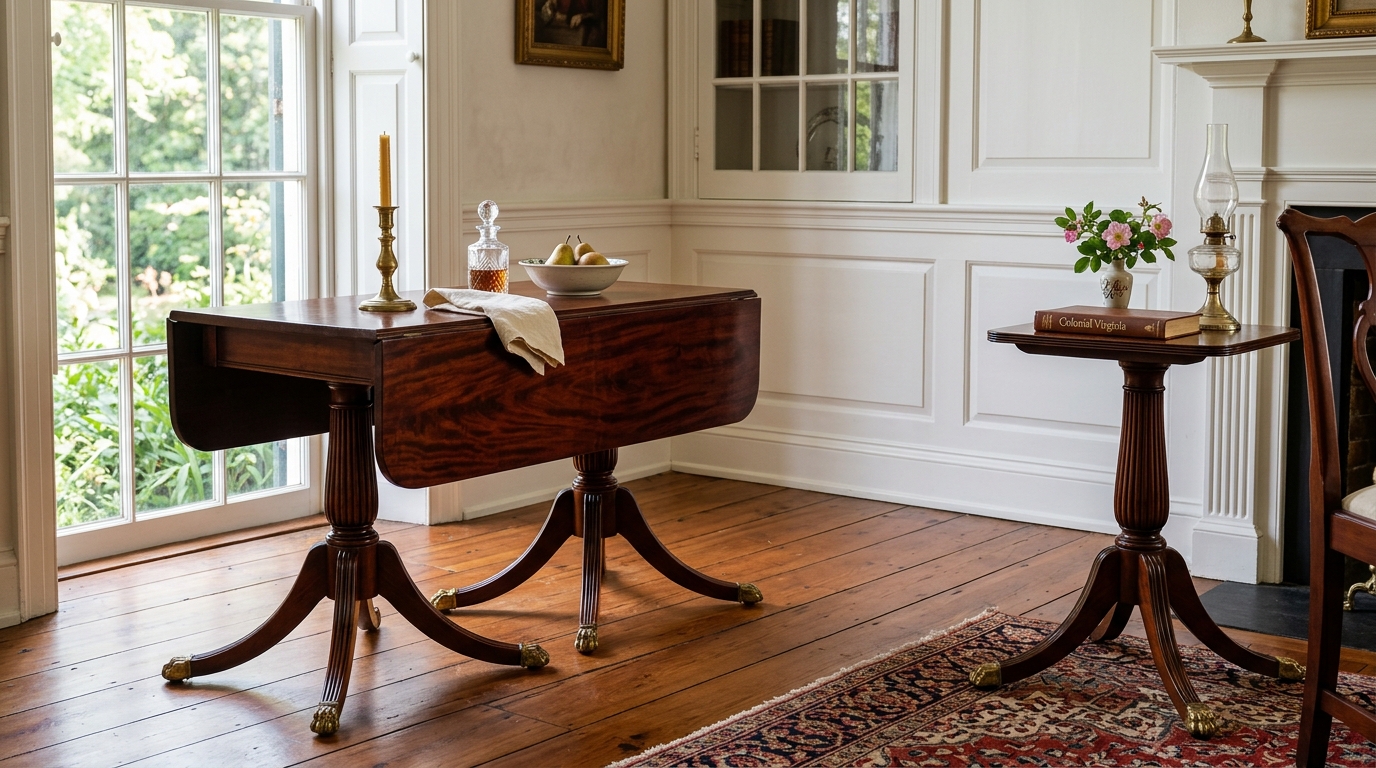
History of The Brandt Cabinet Works (Hagerstown, MD 1901–1985)
The story of Brandt Cabinet Works is inextricably tied to the industrial boom of Western Maryland at the turn of the 20th century:
- Founding & Early Years (1901–1918): Carl Brandt established the company on Pennsylvania Avenue in Hagerstown, Maryland, in 1901. Capitalizing on Hagerstown’s dense railway junction networks (which connected the factory directly to Appalachian hardwood timber and major East Coast retail markets), Brandt initially produced small parlor tables, library stands, and sheet music cabinets.
- The Golden Era of Occasional Tables (1920s–1950s): While competitors struggled during the Great Depression, Brandt doubled down on specialization. They recognized that while families could not afford full $1,000 dining room suites, they eagerly purchased a $25 to $65 mahogany coffee table, Pembroke table, or drop-leaf tea wagon to elevate their living rooms. By 1940, Brandt marketed itself nationwide as “The House of Brandt” and supplied luxury department stores including Marshall Field’s in Chicago, Wanamaker’s in Philadelphia, and Macy’s in New York.
- Post-War Expansion & Modern Designs (1950s–1970s): Post-World War II saw Brandt introduce cherry, walnut, and fruitwood lines alongside their flagship mahogany pieces. They expanded into Mid-Century French Provincial, Italian Neoclassical, and Colonial Revival styles.
- Closure (1985–1986): Facing intense pressure from cheap offshore imports and shifting consumer tastes toward modular particle board, Brandt ceased operations in the mid-1980s, cementing all authentic Brandt tables as finite vintage collectibles.
Deciphering Brandt Table Marks Across the Eras
Brandt used several distinct labeling systems over its 85-year operating lifespan. Examining the label’s design, material, and placement allows you to date your table accurately:
1. Stamped Metal Badges & Brass Plates (c. 1901–1920s)
On early Edwardian and 1920s pieces, Brandt attached small rectangular or oval stamped brass metal plates. These were typically tacked with tiny brass escutcheon pins directly onto the secondary wood framing under the table or inside the interior rim of a drawer side. They read: “The Brandt Cabinet Works — Makers of Tables — Hagerstown, MD.”
2. The Classic Black & Gold Foil Decal (c. 1930s–1950s)
This is the most famous and widely collected Brandt maker’s mark. It consists of a metallic gold foil or high-gloss transfer decal with a deep black background and gold border:
- Typography: Features the iconic stylized script “Brandt” angled across the label with an elongated tail flourish.
- Location Signature: Directly beneath the script, the words “HAGERSTOWN, MD.” or “HAGERSTOWN, MARYLAND” appear in clean sans-serif capital letters.
- Taglines: Often accompanied by “Tables by Brandt” or “The House of Brandt.”
- Placement: Usually found on the raw underside secondary wood (pine or poplar) of the tabletop, or pasted on the inner drawer bottom.
3. Stenciled & Impressed Model Numbers
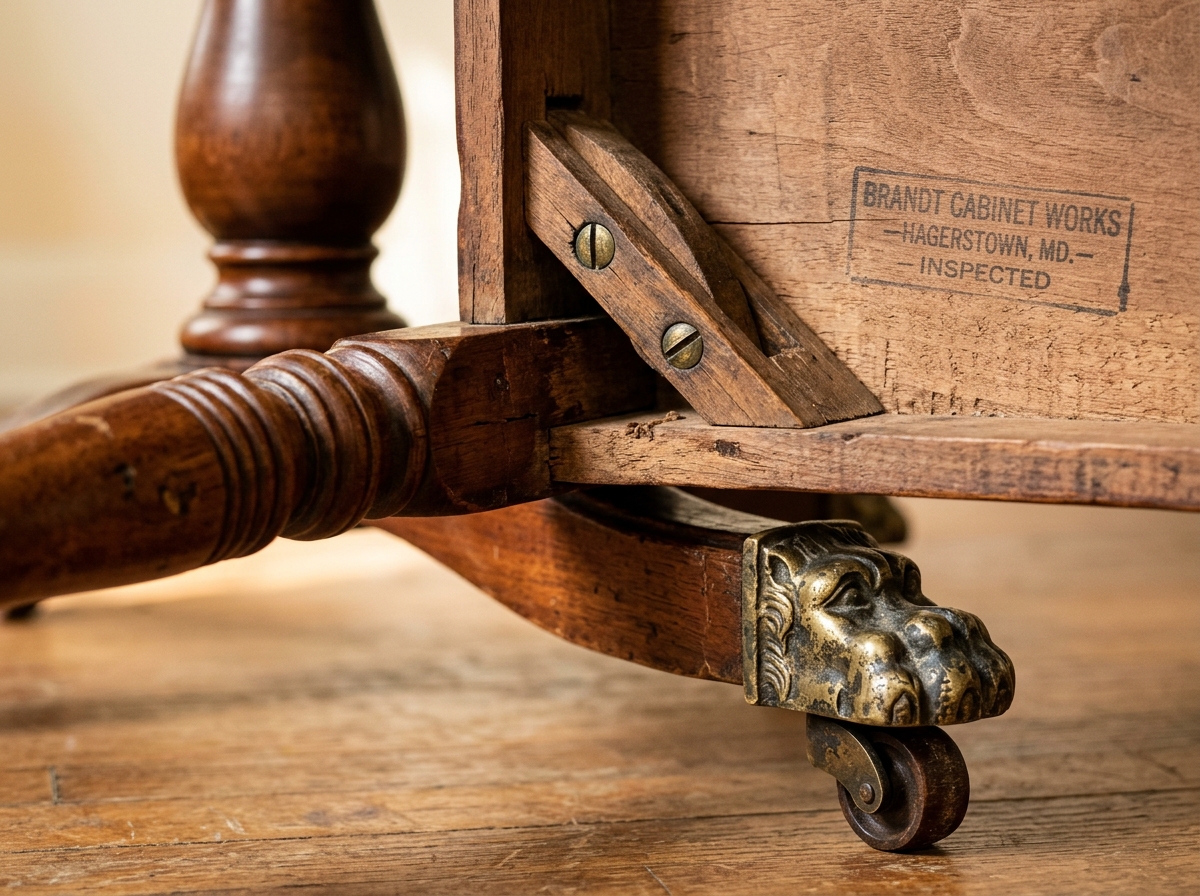
In addition to or sometimes in place of paper labels that wore away over time, Brandt stamped clear black ink stencils or hot-iron impressions directly into the unpolished secondary wood underside. Similar to our forensic breakdown of Mersman table markings and stamped numbers, these codes provide valuable dating information:
| Number Pattern | Typical Era | Table Style / Form | Suffix Letter Meaning |
|---|---|---|---|
| 3-Digit Numbers (e.g., 512, 784) |
1920s – Early 1930s | Early Federal revival, tilt-top piecrust, gateleg tables. | Usually no suffix, or single hand-penciled inspector mark. |
| 4-Digit (2000s–4000s Series) (e.g., 2418, 3052) |
1930s – 1940s | Duncan Phyfe lyre pedestal tables, Pembroke end tables, drum tables. | “M” = Mahogany finish / veneer “W” = Walnut finish |
| 4-Digit (5000s–8000s Series) (e.g., 5290, 8140) |
1950s – 1960s | Tiered step tables, French Provincial cherry, Italian marble-top stands. | “C” = Cherry wood “L” = Gold-tooled leather top insert |
| Foil Shield Labels (c. 1970s–1985) |
Late 1960s – 1985 | Bicentennial colonial reproductions, brass-trimmed glass-top occasional tables. | Computerized barcoded or stamped paper batch inspection tags. |
Hallmarks of Authentic Brandt Table Construction
Brandt tables occupied a distinct market niche: they were priced higher than utilitarian Sears or Montgomery Ward catalog pieces, but were more accessible than custom one-of-a-kind antiques. Look for these construction signatures:
1. Swirl & Crotch Flame Mahogany Veneers
Brandt was renowned for its exquisite veneering. Rather than using plain, straight-grained wood, Brandt selected high-grade book-matched flame mahogany and crotch mahogany veneers for its table tops and drop leaves. Cross-reference our definitive timber guide on how to identify real antique mahogany to distinguish authentic Honduran veneers from modern African substitutes.
2. Cast Brass Hardware & Paw Casters
Unlike cheaper manufacturers who used stamped tin or pot metal hardware, Brandt utilized solid cast brass lion paw feet, brass toe caps, and cast brass drawer pulls. On Duncan Phyfe style tripod legs, the brass caps are secured from underneath with aged slotted brass screws. Check our companion guide on dating antique furniture by screws to verify that the hardware fasteners match pre-1950 factory production.
3. Secondary Timber & Internal Framing
Flip the table over to inspect the underside framing. Brandt utilized solid Appalachian yellow poplar and Eastern white pine for its internal apron rails and drawer boxes. Drawer boxes typically feature machine-cut dovetails with neat, tight tolerances. Compare your drawer corners to our visual timeline on dating antique furniture by dovetails.
The 5 Most Desirable Brandt Table Styles
Duncan Phyfe Lyre Tables
Featuring carved wooden harp/lyre pedestal uprights with brass string rods, drop leaves, and splayed legs with brass paw casters. The quintessential 1940s American living room showpiece.
Read Duncan Phyfe Guide →Leather-Top Drum Tables
Circular Regency-inspired pedestal tables fitted with genuine gold-embossed leather top inserts, working frieze drawers, and brass lion-mask pulls.
Compare to Imperial Tables →Drop-Leaf Occasional Tables
Compact Pembroke-style side tables with rule-joint drop leaves supported by wooden fly rails. Highly functional for modern apartment and living room decor.
Read Drop Leaf Value Guide →Explore our complete architectural catalog of the diverse types of antique tables across American and British history.
How Much Is a Brandt Table Worth? (2026 Price Guide)
In today’s vintage and antique marketplace, Brandt tables command steady, reliable prices based on form, wood condition, and original label retention:
- Tier 1: High-Value Collector Pieces ($350 – $750): Pristine Duncan Phyfe lyre-base drop-leaf tables, tilt-top piecrust tables with hand-carved ball-and-claw feet, and multi-tier dumbwaiter tables. Requires intact original decal, untouched finish, and all original brass casters.
- Tier 2: Desirable Mid-Range Tables ($175 – $350): Genuine leather-top drum tables, Pembroke drop-leaf end tables, and mahogany nesting table sets in good condition with minor historic handling wear.
- Tier 3: Common Vintage Accent Tables ($75 – $175): Standard two-tier step end tables, French Provincial cherry lamp tables, or pieces where the paper label is missing but the stenciled model number is legible.
- Tier 4: Project & Refinished Pieces ($30 – $75): Heavily scratched table tops, tables stripped of their original dark mahogany finish and recoated in modern polyurethane. Learn how finish alterations damage collectible prices in our guide on how to tell if antique furniture has been refinished.
Frequently Asked Questions About Brandt Cabinet Works Tables
Where is the maker’s mark on a Brandt table?
The maker’s mark on a Brandt table is almost always located on the raw underside secondary wood of the tabletop or inside the drawer box. Look for a rectangular black-and-gold foil decal reading “Brandt — Hagerstown, MD” or a 3- to 4-digit stenciled black ink model number stamped into the raw timber.
Is Brandt furniture solid wood or veneer?
Brandt tables utilize both solid wood and high-grade veneers. The legs, pedestal columns, stretchers, and carved details are carved from solid mahogany, cherry, or walnut. Table tops and drop leaves feature premium flame or crotch wood veneers laid over solid Appalachian hardwood cores (poplar or gumwood), which prevents seasonal warping.
When did Brandt Cabinet Works go out of business?
The Brandt Cabinet Works operated in Hagerstown, Maryland, from its founding in 1901 until it ceased manufacturing operations around 1985–1986, following competition from overseas mass production.
Are Brandt Cabinet Works tables valuable?
Yes, authentic Brandt occasional tables are valued collectibles in the vintage American furniture market. Depending on the model, condition, and presence of original decals, Brandt tables typically sell between $150 and $750 at antique shops, estate sales, and auction houses.
Pingback: Mersman Table Markings, Model Numbers & Value: Complete Collector’s Guide - Antique Tables