
A Knapp joint (also called a pin-and-cove, pin-and-scallop, or half-moon joint) is an unforgeable woodworking signature that dates antique American furniture strictly to 1870–1900. Patented in 1867 by Charles B. Knapp of Waterloo, Wisconsin, it was the first mechanized drawer joint in history. Characterized by circular wooden pins set into rounded scalloped sockets, the Knapp joint appeared primarily on Victorian Eastlake, Renaissance Revival, and Golden Oak tables and dressers before being replaced by modern machine dovetails around 1900.
Key Knapp Joint Forensic Takeaways
- The Infallible Date Window: Used commercially exclusively between 1870 and 1900. If a drawer has Knapp joints, it was definitively built during this 30-year Victorian window.
- Other Names: Known among antique collectors as the pin-and-cove, pin-and-scallop, scallop-and-dowel, or half-moon joint.
- American Invention: Developed and utilized almost exclusively in the United States; virtually unheard of on European imports of the era.
- Market Value: Most antique tables and case pieces with Knapp joints sell between $150 and $450 at estate sales. While historically revolutionary, they signify high-volume Victorian factory production rather than rare 18th-century benchmade masterworks.
- Unforgeable: Modern counterfeiters cannot reproduce the Knapp joint because the specialized dual-action milling machinery ceased production over 120 years ago.
The History of the Knapp Joint: Industrial Revolution in Cabinetmaking
Prior to the late 1860s, constructing drawers was the most labor-intensive bottleneck in furniture manufacturing. Every single drawer required a master cabinetmaker to painstakingly chisel hand-cut dovetails—a process taking 20 to 30 minutes per drawer box. While water and steam power had mechanized sawmills and leg turners, automated machines could not duplicate the complex interlocking undercut angles of traditional dovetails.
Enter Charles B. Knapp of Waterloo, Wisconsin. In 1867, Knapp patented a revolutionary machine that replaced angular trapezoidal dovetails with a series of bored holes and rounded scalloped cuts. By 1870, Knapp perfected the commercial production machine, and factories across Michigan, Indiana, and New York adopted the technology. The machine could rout and drill both the drawer front and drawer side simultaneously in under 40 seconds.
Why Did the Knapp Joint Disappear by 1900?
If the Knapp joint was stronger and vastly faster to produce than hand-cut dovetails, why did it vanish so suddenly around 1900? The answer lies in consumer aesthetics and mechanical evolution:
- The Traditionalist Backlash: Victorian buyers associated circular machine joints with “cheap factory goods.” Wealthier buyers longed for the traditional, handcrafted prestige of triangular dovetails.
- The Invention of Machine Dovetailing (1895–1900): By the late 1890s, industrial engineers developed automated routers capable of mass-producing traditional interlocking trapezoidal dovetails cheaply.
- The Rapid Phase-Out: Once factories could churn out traditional-looking dovetails by machine, furniture makers immediately abandoned the Knapp machine. By 1900, commercial production of the Knapp joint ceased entirely.
Visual Anatomy: How to Spot a Genuine Pin-and-Cove Joint
To inspect a drawer for a Knapp joint, pull the drawer out and look at the exterior side edge where the drawer side meets the finished drawer front. You will immediately notice a pattern completely distinct from any modern or hand-chiseled joint:
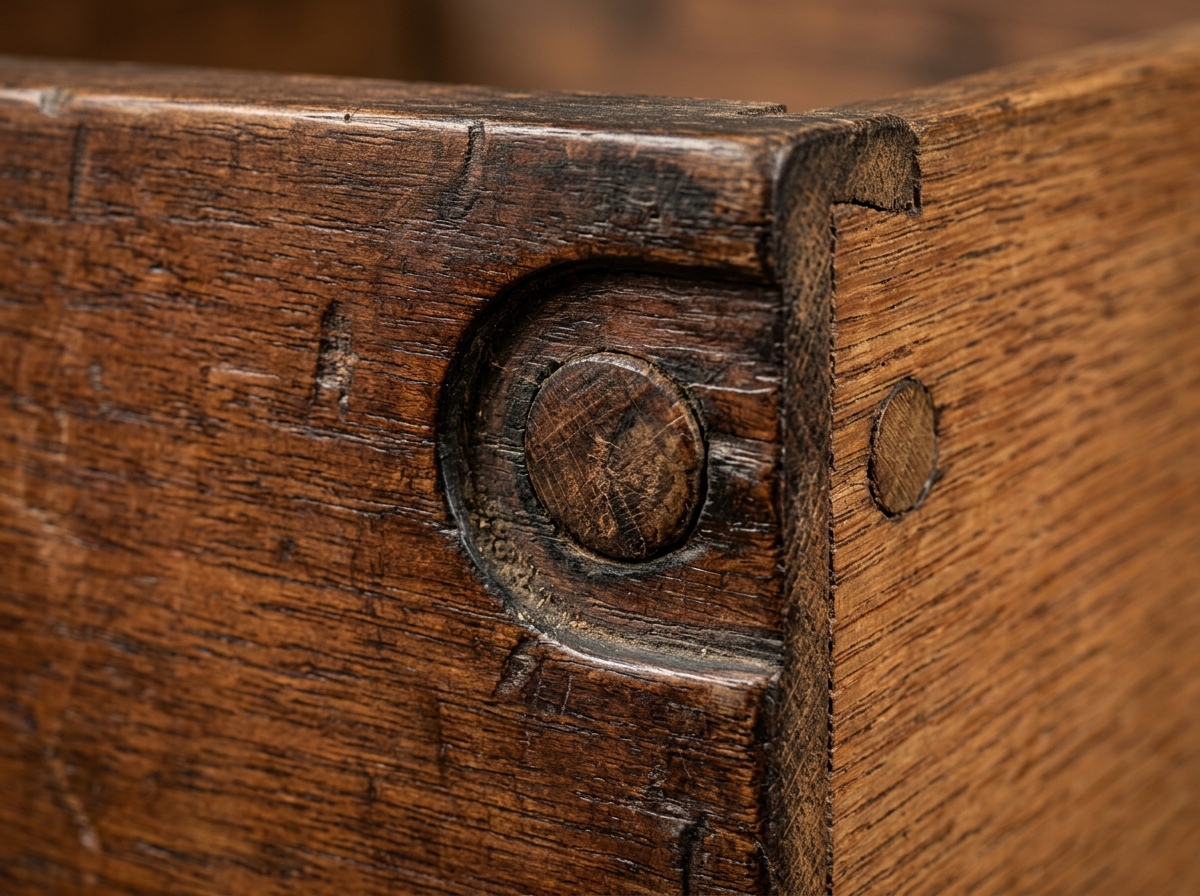
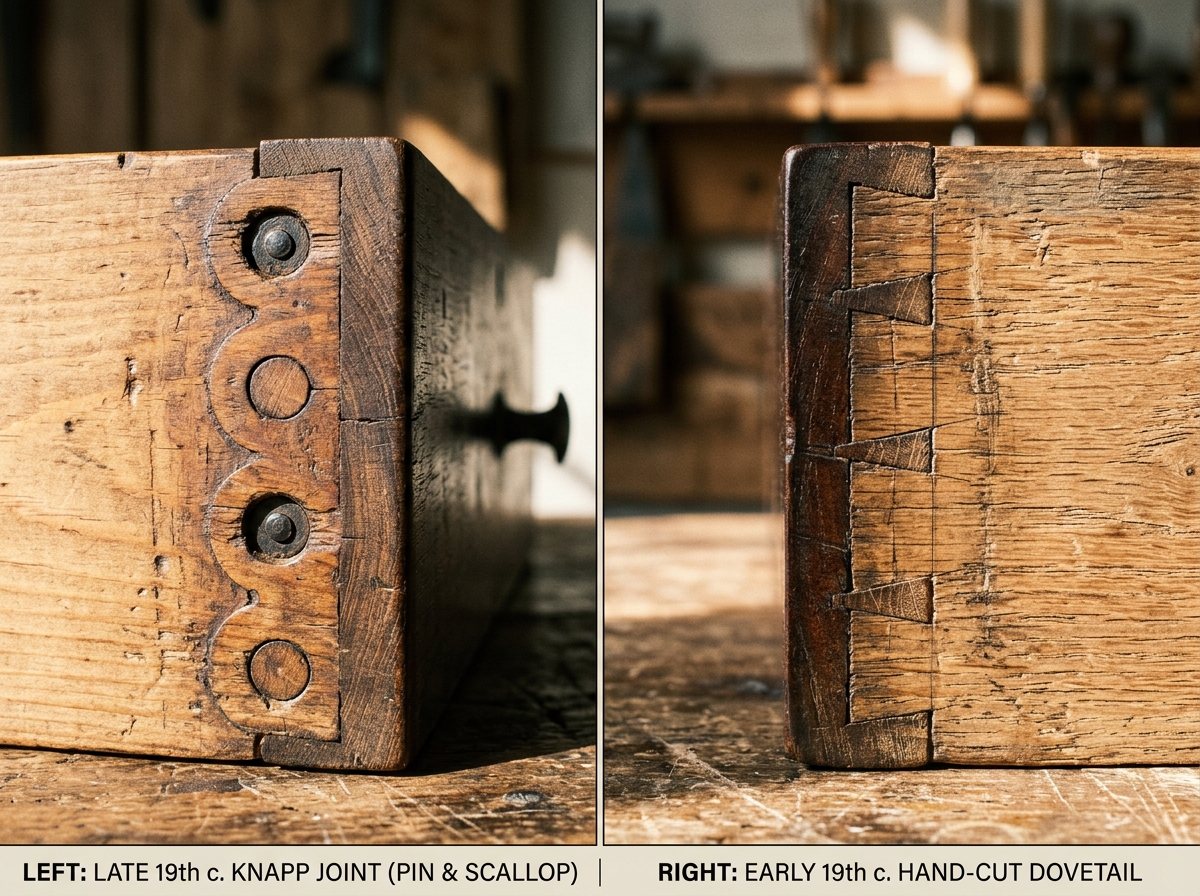
- The Central Pin: On the drawer front, you see round, circular wooden plugs (the “pins”) measuring approximately 1/2 inch in diameter. These are not wooden dowels hammered into holes—they are solid extensions machined directly from the drawer front lumber.
- The Scalloped Cove: On the drawer side board, you see a series of undulating semicircular cutouts (the “coves” or “scallops”) that cup around each pin like a series of half-moons.
- Tight, Machine-Flushed Seams: Because the pieces were cut by high-speed rotary cutters, the tolerance is incredibly tight. There are no hand-chisel overrun marks or knife layout scribe lines.
Knapp Joint vs. Hand-Cut Dovetail vs. Machine Dovetail
Understanding drawer joinery is the single fastest way to date an antique table or case piece. Use this chronological comparison matrix when evaluating pieces in the field:
| Joinery Type | Era | Visual Shape | Tool Marks | Common Furniture Styles |
|---|---|---|---|---|
| Hand-Cut Dovetail | Pre-1870s | Irregular, narrow triangular pins; varied spacing | Hand knife layout marks, chisel strike gouges | Queen Anne, Chippendale, Federal, Duncan Phyfe |
| Knapp Joint (Pin & Cove) | 1870–1900 | Circular wooden pin surrounded by scalloped half-moon cove | Clean rotary milling; absolutely no chisel marks | Eastlake, Renaissance Revival, Golden Oak |
| Machine-Cut Dovetail | 1895 to Present | Perfect mathematical symmetry; chunky, uniform pins | Curved router radiuses at inside corners | Arts & Crafts, Mission, Colonial Revival, Mid-Century |
What Furniture Styles Feature Knapp Joints?
Because the Knapp joint was manufactured exclusively between 1870 and 1900, it corresponds precisely with the high Victorian design boom in the United States. You will encounter Knapp joints on three dominant design movements:
1. Eastlake Style Furniture (1870–1890)
Named after British architect Charles Locke Eastlake, American Eastlake furniture rejected heavy Rococo curves in favor of geometric incised carvings, reeded moldings, and rectilinear forms. Eastlake library tables, parlor tables, and drop-leaf sewing stands are the single most common furniture items featuring authentic Knapp joints. For a complete guide to Victorian silhouettes, consult our comprehensive resource on antique table styles.
2. Late Victorian Golden Oak & Chestnut (1880–1900)
As American factories expanded, richly figured quartersawn oak and sweet chestnut became the woods of choice. Victorian dining tables with drawer friezes, roll-top desks, and library tables frequently combined Knapp joints with heavy cast-brass drawer pulls. Learn how to identify these grain patterns in our guide on how to tell if a table is antique oak.
3. Victorian Drop-Leaf & Occasional Tables
Many Victorian side tables and drop-leaf console tables featured a single functional drawer tucked into the apron. If you find a drop-leaf table with rule joints and a Knapp-jointed drawer, you can immediately date the table to the late 19th century rather than the Federal era. Review our in-depth analysis of antique drop-leaf table identification and value.
Does a Knapp Joint Make Furniture Valuable? (Appraisal Reality)
A common misconception on online forums is that finding a Knapp joint means you have struck antique gold. In reality, the Knapp joint indicates industrial mass production. These pieces were manufactured in quantities of hundreds of thousands by Midwest furniture factories for middle-class American homes.
Current Market Valuation Benchmarks:
- Eastlake Occasional & Parlor Tables: Typically sell between $125 and $275 at estate sales and antique malls.
- Oak Library & Writing Tables: Range from $200 to $450 depending on carvings, drawer count, and wood condition.
- Eastlake Dressers & Commode Chests: Usually realize $250 to $500 with original marble tops and high-back mirrors.
While not six-figure museum investments, Knapp-jointed pieces represent exceptional value for collectors: they offer superb 100% solid old-growth timber, indestructible joinery, and an ironclad guarantee of late-Victorian provenance.
Cross-Referencing Hardware with the Knapp Joint
To confirm that your table has not been altered or married with parts from different eras, always cross-reference the drawer joinery with the surrounding hardware:
- Screws: Since Knapp joints date to 1870–1900, the screws securing table cleats, drawer pulls, and hinges should be post-1856 fully machine-made screws with centered slots and sharp gimlet points. If you encounter early handmade blunt screws on a Knapp-jointed piece, someone has replaced fasteners. For detailed timelines, consult our forensic guide on dating antique furniture by screws and hardware.
- Saw Marks: Timber milled between 1870 and 1900 typically displays curved circular saw marks or early band saw kerfs on unplaned underside panels, rather than primitive straight sash saw lines.
- Drawer Bottoms: Drawer bottoms in Knapp pieces are typically solid 3/8-inch pine, poplar, or cedar set into grooved side channels, secured at the rear with machine-cut finish nails.
- Care & Polish: To preserve the original shellac and varnish on Victorian oak and walnut drawers, apply a pure microcrystalline or carnauba wax topcoat rather than silicone sprays. See our step-by-step instructions in the best wax for antique tables and learn how to remove white heat rings from antique wood.
Frequently Asked Questions
What is another name for a Knapp joint?
The Knapp joint is known by several colloquial names among antique appraisers, including the pin-and-cove joint, pin-and-scallop joint, scallop-and-dowel joint, and half-moon joint. In the original 1867 patent documents, it was officially described as a machine dovetail.
What exact years was the Knapp joint used?
The Knapp joint was used commercially in the United States strictly from 1870 to 1900. Although Charles Knapp received his initial patent in 1867, commercial factory machinery was not deployed until 1870. By 1900, the emergence of modern symmetrical machine dovetailing made the Knapp joint completely obsolete.
Can a Knapp joint be faked by reproduction forgers?
Virtually never. Forgers cannot reproduce the Knapp joint because the specialized dual-motion machinery required to cut the pins and matching cove scallops was scrapped over a century ago. Reproducing a Knapp joint by hand with modern shop tools would be prohibitively difficult and cost far more than the market value of the finished Victorian table.
Does a Knapp joint indicate solid wood?
Yes. Because the Knapp milling cutters applied high rotational torque to the timber, the drawer sides and fronts had to be solid hardwood (such as oak, walnut, chestnut, or poplar) to withstand the machining process without splintering. Plywood and particleboard cannot support a Knapp joint.
Pingback: Mersman Table Markings, Model Numbers & Value: Complete Collector’s Guide - Antique Tables