
Collector & Appraiser Quick Reference: Imperial Furniture Co.
- Location & Active Years: Grand Rapids, Michigan (1903–1954). Acquired by Baker Furniture in 1954.
- The Founding Philosophy: “We Make Tables Only.” Founded by F. Stuart Foote, Imperial was America’s first major manufacturer exclusively devoted to specialized living room, parlor, and dining tables.
- Historical Claim to Fame: Credited with popularizing the modern coffee table in the early 1920s by lowering the legs of traditional parlor tables so beverages could be served comfortably from a sofa.
- Primary Maker Marks:
- 1903–1910s: Stamped brass crown tag nailed to table underside.
- 1910s–1939: Iconic green-and-gold shield transfer decal with an imperial crown (“Imperial Grand Rapids Mich.”).
- 1939–1954: Modernized shield decal, often accompanied by the blue/gold “Genuine Mahogany Association” seal.
- 2026 Appraisal Values: Mahogany tea wagons with glass trays: $250 – $650. Duncan Phyfe pedestal dining tables: $350 – $950. Tilt-top & drum occasional tables: $150 – $400.
During the golden era of American cabinetmaking, Grand Rapids, Michigan was celebrated worldwide as the “Furniture City”—the undisputed capital of fine woodworking, high-grade timber carving, and historic revival design. Standing tall among Grand Rapids’ elite factories was the Imperial Furniture Company. While rival factories like the Mersman Table Company in Ohio focused on massive department store volume, Imperial focused relentlessly on prestige craftsmanship, luxury mahogany veneers, and period-perfect historical reproductions.
From their patented drop-leaf mahogany tea wagons with removable glass trays to their graceful Federal lyre tables and Duncan Phyfe pedestal dining tables, Imperial produced some of the most enduring heirloom furniture of the 20th century. If you have inherited or discovered a table bearing a green shield decal, a crown mark, or a 4-digit stamped stencil, this comprehensive guide provides the forensic tools needed to date your piece, decode its model number, and assess its true market value.
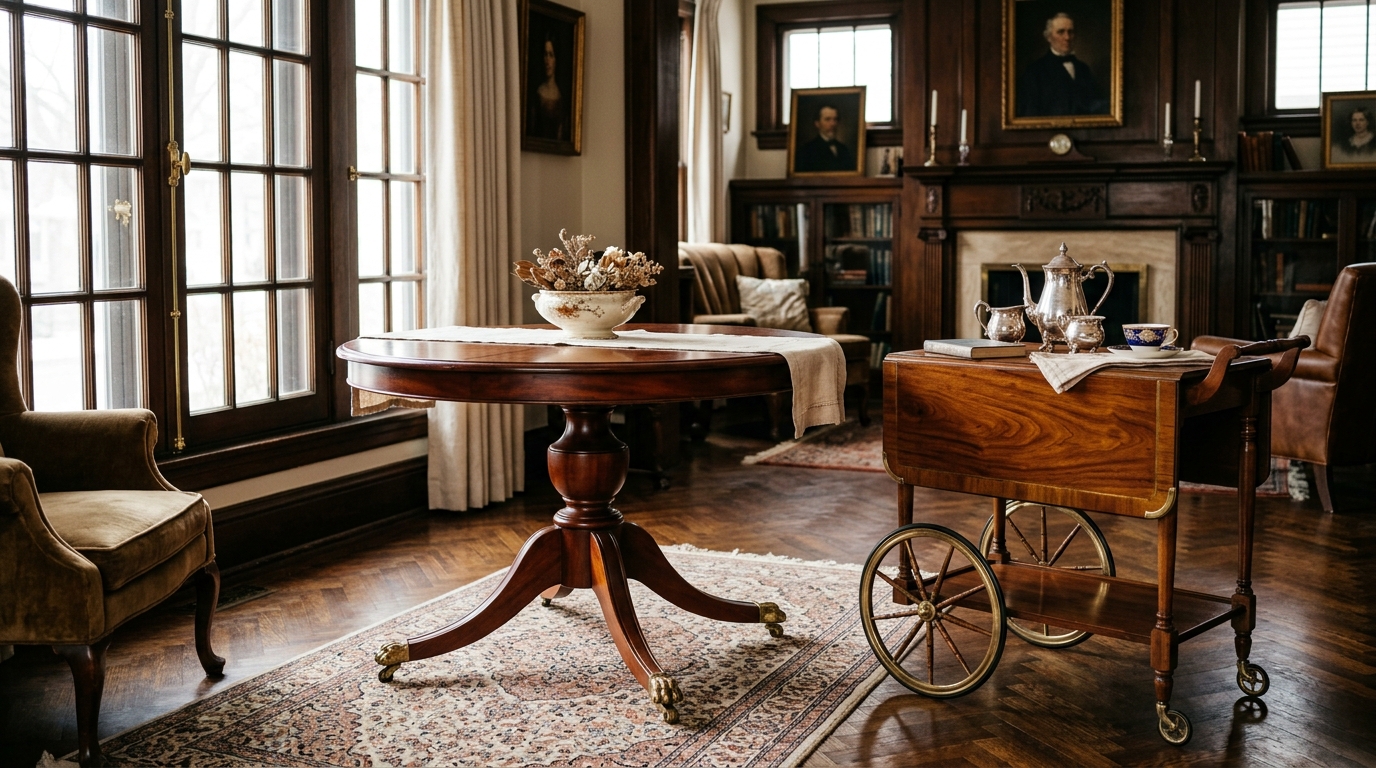
1. The Story of Grand Rapids & The “Tables Only” Revolution
In the late 19th and early 20th centuries, furniture manufacturers typically manufactured full bedroom or dining room “suites.” A customer bought a matching sideboard, china cabinet, table, and eight chairs all bound together by the same carving motifs.
In 1903, furniture visionary F. Stuart Foote (son of E.H. Foote, co-founder of the renowned Grand Rapids Chair Company) broke sharply from industry tradition. Foote recognized that American homeowners frequently wanted specialized, standalone accent pieces to enrich their living rooms without replacing entire suites. He founded the Imperial Furniture Company on Broadway Avenue in Grand Rapids with an audacious singular motto: “We Make Tables Only.”
The Invention of the Coffee Table: In the early 1920s, while visiting a client’s home, Foote noticed that hostess tea services required awkward balancing acts. He took a full-height parlor table into the Imperial design shop, sawed the legs down to approximately 18 inches, and dubbed it the “coffee table.” While low benches existed in European history, Imperial Furniture Company was the first manufacturer to commercially mass-produce and market the modern low-profile coffee table across the United States.
2. Chronological Evolution of Imperial Furniture Marks & Labels
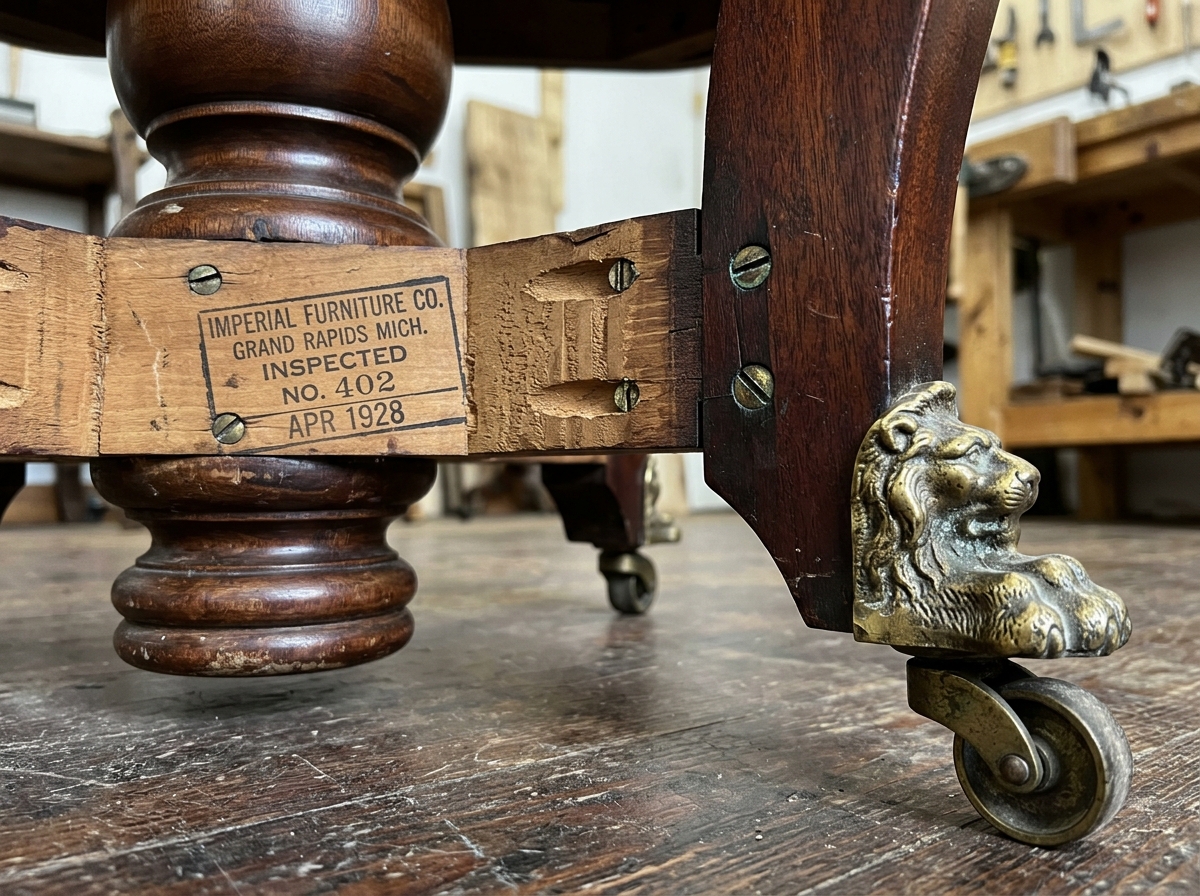
Dating an Imperial table begins by crawling underneath with a flashlight to locate the maker mark, typically placed on the unfinished underside of the tabletop, inside the drawer casing, or on the pedestal mounting cleat:
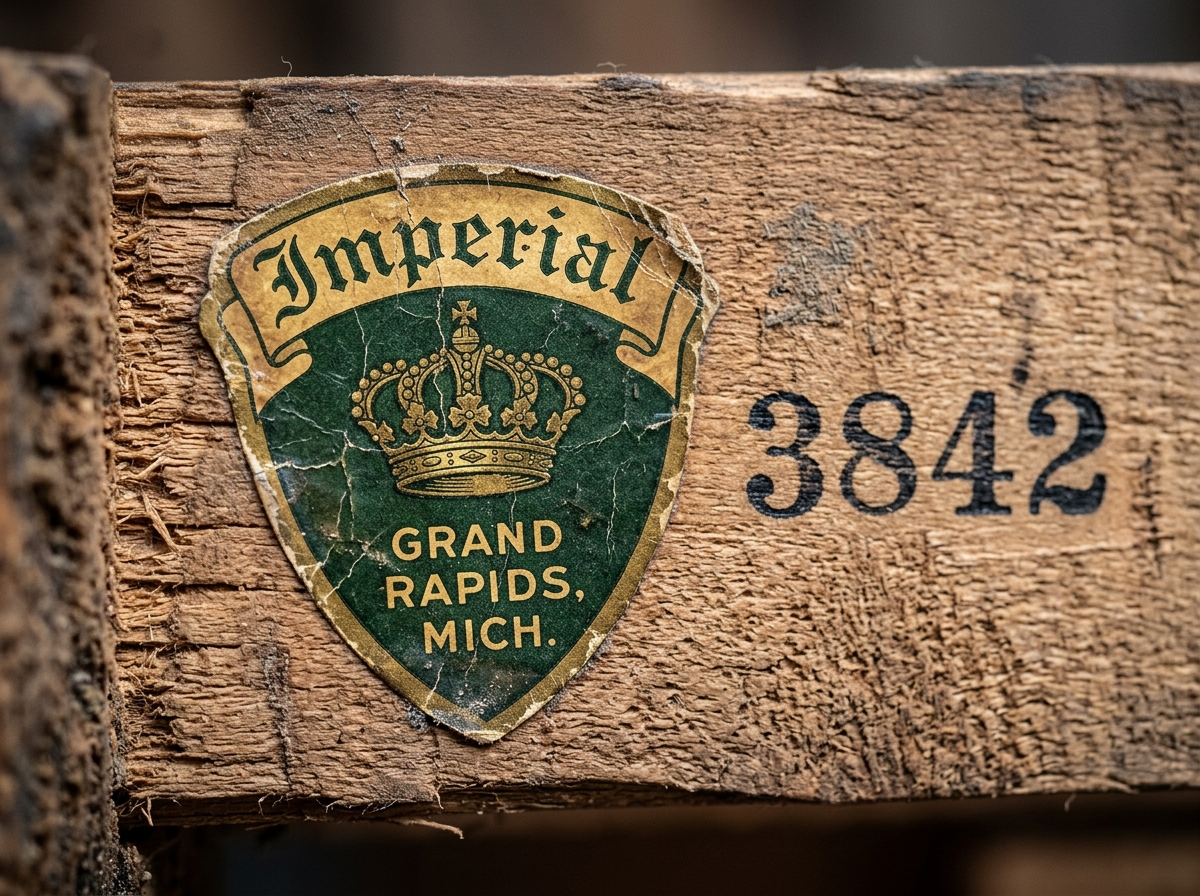
Era 1: The Stamped Brass Crown Tag (1903 – c. 1912)
The earliest Imperial pieces were identified by an embossed rectangular or oval brass plate secured with tiny brass nails. The plate depicted a stylized royal crown over an escutcheon shield with the embossed text: “Imperial / Grand Rapids / Mich.” These metal tags are relatively uncommon today, as brass plates frequently popped off or were removed during past refinishing.
Era 2: The Classic Green & Gold Shield Decal (c. 1912 – 1939)
The quintessential Imperial mark recognized by collectors worldwide. Applied as a varnish-transfer decal, it features:
- Forest Green Shield: A bold medieval heater shield outlined in metallic gold.
- The Imperial Crown: A prominent, ornate gold crown perched atop the upper crest of the shield.
- Text: Rendered in crisp white or gold block lettering: “Imperial / Grand Rapids / Mich.” (Early variants occasionally include “Imperial Furniture Co.” around the border).
- Condition Clues: Original decals display fine spiderweb lacquer craquelure and authentic ambering under aged nitrocellulose lacquer.
Era 3: Streamlined Shield & Mahogany Association Seal (1939 – 1954)
In the late 1930s leading into the post-WWII era, the shield design was streamlined into a cleaner mid-century graphic. During this period, Imperial partnered heavily with the Mahogany Association, Inc. Look for an accompanying round or rectangular paper label in blue and gold:
- “Genuine Mahogany” seal with an official association number (Imperial was assigned Manufacturer Number #101).
- Guaranteed that all exterior show surfaces were authentic Honduras or Cuban mahogany rather than cheap synthetic photo-finishes.
Era 4: The Baker Furniture Acquisition (1954 and Later)
In 1954, luxury Grand Rapids giant Baker Furniture Company acquired Imperial. For a brief period, Imperial operated as a division of Baker, often marked with dual labels or simplified foil tags, before the original Broadway Avenue factory ceased independent production.
3. How to Decipher Imperial Model Numbers & Stencils
In addition to the green shield decal, genuine Imperial tables bear black ink stencils stamped directly into the secondary unfinished timber beneath the top:
- 4-Digit Model Numbers (e.g., #1842, #2154, #3860): These numbers correspond directly to Imperial’s annual sales catalogs. While factory master ledgers were largely lost during the Baker transition, lower numbers (e.g., 1000s–2000s) generally correspond to 1910s–1920s production, while 3000s–4000s correspond to late 1930s through 1950s production.
- Finish & Stain Codes: Often stamped right beside the model number:
MorMAH: Traditional deep red/brown mahogany finish.WAL: American black walnut finish.BorBL: Bleached or blonde modern mahogany (popular in late 1940s and 1950s lines).
- Patent Date Stamps: Specialty items like drop-leaf folding tables or tea carts often display patent dates (e.g., “Patented July 11, 1916”) stamped into the metal hardware or wooden undercarriage.
4. Most Popular & Collectible Imperial Table Styles
1. The Drop-Leaf Mahogany Tea Wagon (Tea Cart)
Imperial’s tea wagons are legendary among Americana collectors. Designed with two large spoke front wheels with rubber tires and two small rear swivel casters, they feature two fold-down leaves and a removable glass serving tray with mahogany handles that nests perfectly over the top.
- Collector Clue: Look for the pull-out silverware drawer concealed under the main handle. Tables with the original glass serving tray intact command a 30%–50% price premium.
2. Duncan Phyfe Lyre & Pedestal Dining Tables
During the 1920s and 1940s Federal Revival booms, Imperial produced extraordinary adaptations of Duncan Phyfe’s classical neoclassical designs. Featuring central turned pedestals, reeded saber legs, and solid cast-brass lion paw casters, these pieces allowed middle-class Americans to own dining tables inspired by early 19th-century masterworks. (See our guide on Duncan Phyfe table identification: original vs reproduction).
3. Tilt-Top Piecrust & Tea Tables
Imperial crafted exquisite tripod-base tilt-top tables with scalloped “piecrust” carved edges and revolving birdcage mechanisms. (For comparison with 18th-century originals, read our antique tilt-top tables history and value guide).
4. Federal Drum Tables & Tiered Dumbwaiters
Round drum tables with inset leather tops, gilded tooling, faux drawer faces, and brass ring pulls are common Imperial staples. They also crafted two- and three-tier “dumbwaiter” dessert tables with turned central columns.
5. Construction Quality: Solid Wood vs. Veneer in Imperial Tables
A frequent question among collectors is: “Are Imperial tables solid mahogany or veneer?”
As explored in our technical guide on how to tell solid wood from veneer in antique furniture, Imperial used both techniques strategically:
- Solid Hardwood Components: The structural chassis—pedestal columns, splayed legs, stretchers, apron frames, and drawer fronts—was crafted from solid American hardwoods (solid Honduras mahogany, black walnut, or rock maple).
- Master-Level Veneering on Tops: To achieve dramatic flame, crotch, and book-matched radial sunburst grain patterns, Imperial applied thick, premium mahogany veneers over a solid, stable secondary core (typically yellow poplar or sweet gumwood). This prevented the wide tabletops from warping or splitting under indoor heating.
- Hardware Standards: Imperial utilized genuine cast brass drawer pulls, brass claw shoes, and high-quality steel machine screws with slotted heads. (Refer to our guide on dating antique furniture by screws and hardware).
6. Imperial vs. Mersman: Comparing the Midwest Furniture Titans
Many vintage shoppers confuse Imperial tables with pieces made by the Mersman Table Company or the Tell City Chair Company. Here is how they compare:
| Feature | Imperial Furniture Co. | Mersman Table Co. |
|---|---|---|
| Factory Location | Grand Rapids, Michigan | Celina, Ohio |
| Market Tier | Mid-to-High Luxury Specialty (Fine furniture boutiques) | Mass-Market Volume (Department stores & catalogs) |
| Primary Woods | Honduras Mahogany, American Walnut, Maple | Poplar/Gumwood stained walnut/mahogany; late laminate |
| Veneer Execution | Exquisite flame & crotch matched veneers; hand-polished | Standard rotary veneers; commercial lacquer spray |
| Typical Resale Value | $150 – $950+ depending on model and condition | $50 – $250 across standard coffee and end tables |
7. Appraisal & Valuation Guide: 2026 Price Realities
Imperial tables enjoy strong demand among vintage decorators, Federal Revival enthusiasts, and Grand Rapids collectors. Here is what to expect in today’s secondary market:
Drop-Leaf Tea Wagons
$250 – $650
Complete with original removable glass serving tray, functional wheel rubber, and untorn green shield decal. Exceptional carved examples reach $800+.
Duncan Phyfe Dining Tables
$350 – $950
Double- or triple-pedestal dining tables with original drop-in leaves and intact brass claw casters. Excellent showroom centerpieces.
Tilt-Top & Piecrust Tables
$175 – $450
Carved piecrust rim, functioning brass catch, and clean tripod legs. Popular as corner accents and reading tables.
Drum & Tiered End Tables
$125 – $300
Standard living room occasional tables. Leather-top versions in good condition with intact gold leaf tooling fetch the top of this range.
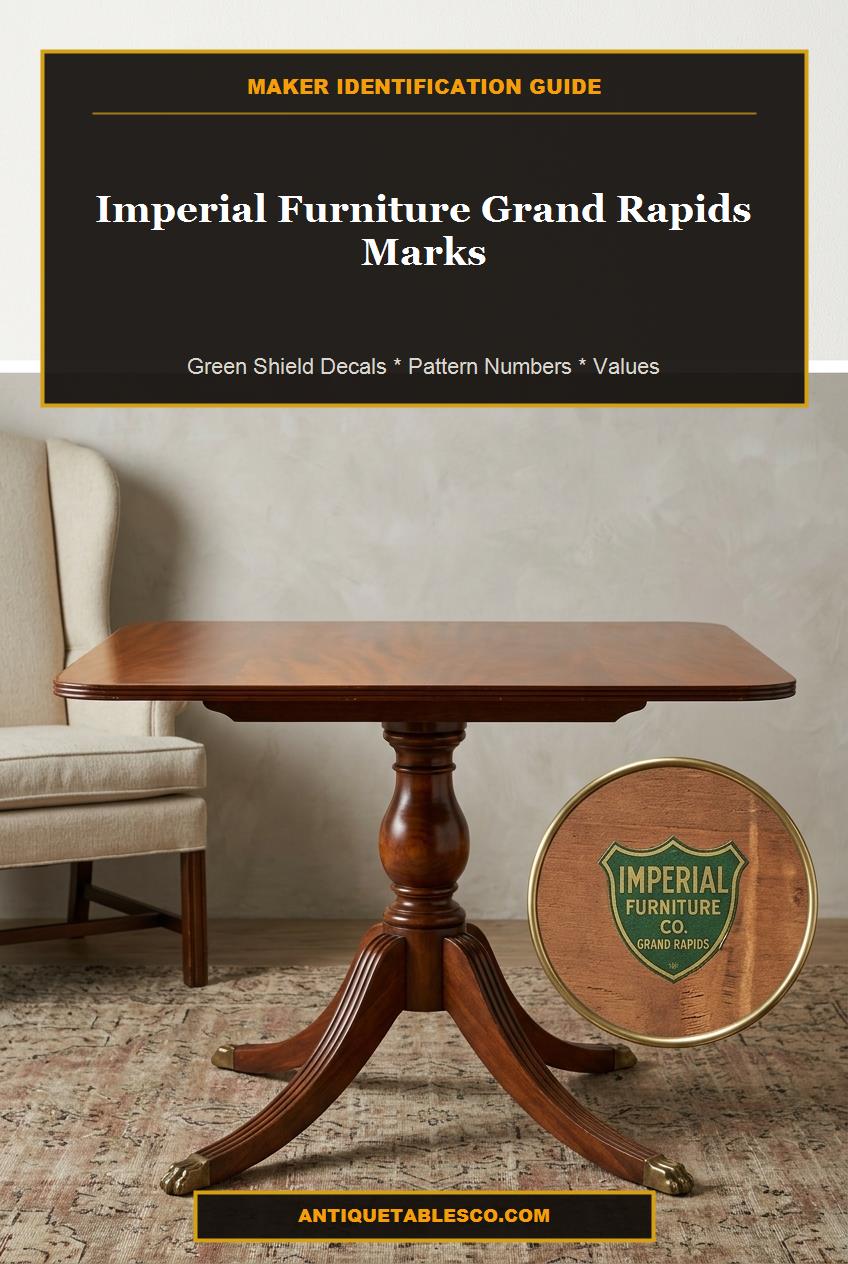
Save This Imperial Furniture Field Guide on Pinterest
Pin our Grand Rapids maker identification guide to your antique furniture appraisal board for instant reference at estate sales and auctions.
Frequently Asked Questions About Imperial Furniture Co.
What does the green shield mark on a table mean?
The green shield with a gold crown is the signature trademark of the Imperial Furniture Company of Grand Rapids, Michigan. Used primarily between approximately 1912 and 1939, this decal confirms the table was manufactured during the factory’s premier era of handcrafted historical revival tables.
Is Imperial Furniture Company still in business?
No. The Imperial Furniture Company operated independently in Grand Rapids from 1903 until 1954, when it was acquired by luxury manufacturer Baker Furniture Company. The original Broadway Avenue factory eventually ceased independent operations.
Did Imperial Furniture Company really invent the coffee table?
Yes, founder F. Stuart Foote is widely credited with inventing and popularizing the commercial modern coffee table in the United States in the early 1920s. By cutting down the legs of a traditional parlor table to sofa seat height (~18 inches), Imperial created an entirely new furniture category designed specifically for serving coffee and cocktails.
What do the stamped numbers mean under an Imperial table?
The stamped 4-digit numbers (such as #1842 or #2154) on the underside of Imperial tables are factory pattern and catalog model numbers. They identify the specific table silhouette, wood combination, and production run. Associated letter codes (like “M” or “WAL”) denote the factory finish stain (Mahogany or Walnut).
How should I clean and care for a vintage Imperial mahogany table?
To protect the original lacquer patina and avoid clouding the rich mahogany grain, avoid modern silicone aerosol sprays. Instead, apply a museum-grade microcrystalline or paste wax once or twice a year (see our recommendations in the best wax for antique mahogany dining tables guide).
Explore More Vintage Maker & Style Guides
Expand your vintage furniture knowledge across our collector archives:
- Mersman Table Markings, Numbers & Value Guide: Decoding Ohio’s most prolific table factory.
- Tell City Chair Company Table Marks & Patterns: Andover and Young Republic maple lines.
- Duncan Phyfe Table Identification: Real vs. Reproduction: Federal masterpieces vs 20th-century revival.
- Solid Wood vs Veneer: How to Tell on Antique Furniture: End-grain tests and veneer thickness.
- Complete Guide to Antique Table Styles: From Queen Anne and Chippendale to Federal and Mid-Century.