
Collector & Reseller Quick Reference: Tell City Table Identification
- Manufacturing Dates: 1865–2011 (Tell City, Perry County, Indiana). Golden production era: 1950s–1980s.
- Primary Stencil Mark: Black industrial ink stencil on the raw tabletop underside or apron reading
TELL CITY CHAIR CO. / TELL CITY, IND.alongside a stamped 4-digit pattern number. - Most Famous Collections: Young Republic (#8000 series) in solid Northern hard rock maple with Andover (#48) or Cimmaron (#28) finishes; Tanbark (#8500 series) in solid American white oak.
- Solid Hardwood Guarantee: Unlike Mersman tables (which utilized thin mahogany or walnut veneers over gumwood cores), Tell City tables are 100% solid hardwood throughout—featuring through-cut end-grain and zero veneer peeling.
- Current Fair Market Value: $150 – $350 for occasional, drop-leaf, and Pembroke tables; $250 – $650 for dining tables with extension leaves; $500 – $1,200+ for complete dining sets with 6 matching Windsor or arrowback chairs.
Few American furniture makers embody 20th-century craftsmanship as definitively as the Tell City Chair Company. Founded by Swiss-German cabinetmakers along the banks of the Ohio River in 1865, the factory spent nearly a century and a half crafting heirloom-grade dining furniture before closing its doors in 2011.
Today, Tell City dining tables, drop-leaf tables, and trestle extension suites are among the most actively sought-after pieces on the secondary vintage market. Because Tell City built their tables exclusively out of heavy, solid American timber—primarily Northern hard rock maple and quartered oak—these pieces survived decades of family dining without structural sagging, veneer buckling, or joint collapse.
However, estate sale shoppers, antique pickers, and family heirs frequently find themselves baffled by the markings stamped underneath: What do the 4-digit model numbers mean? Is an Andover finish different from a Young Republic piece? How can you verify that a table is genuine Tell City if the paper tag is missing? And what is a Tell City table worth today?
In this forensic identification guide, we decode the complete catalog of Tell City Chair Company table marks, examine pattern numbering sequences, inspect underside factory joinery, and establish real-world resale values.
1. The Tell City Legacy (1865–2011): Swiss Roots to American Hardwood Royalty
To identify and date a Tell City table accurately, one must first understand how the company’s manufacturing philosophy evolved across three distinct centuries.
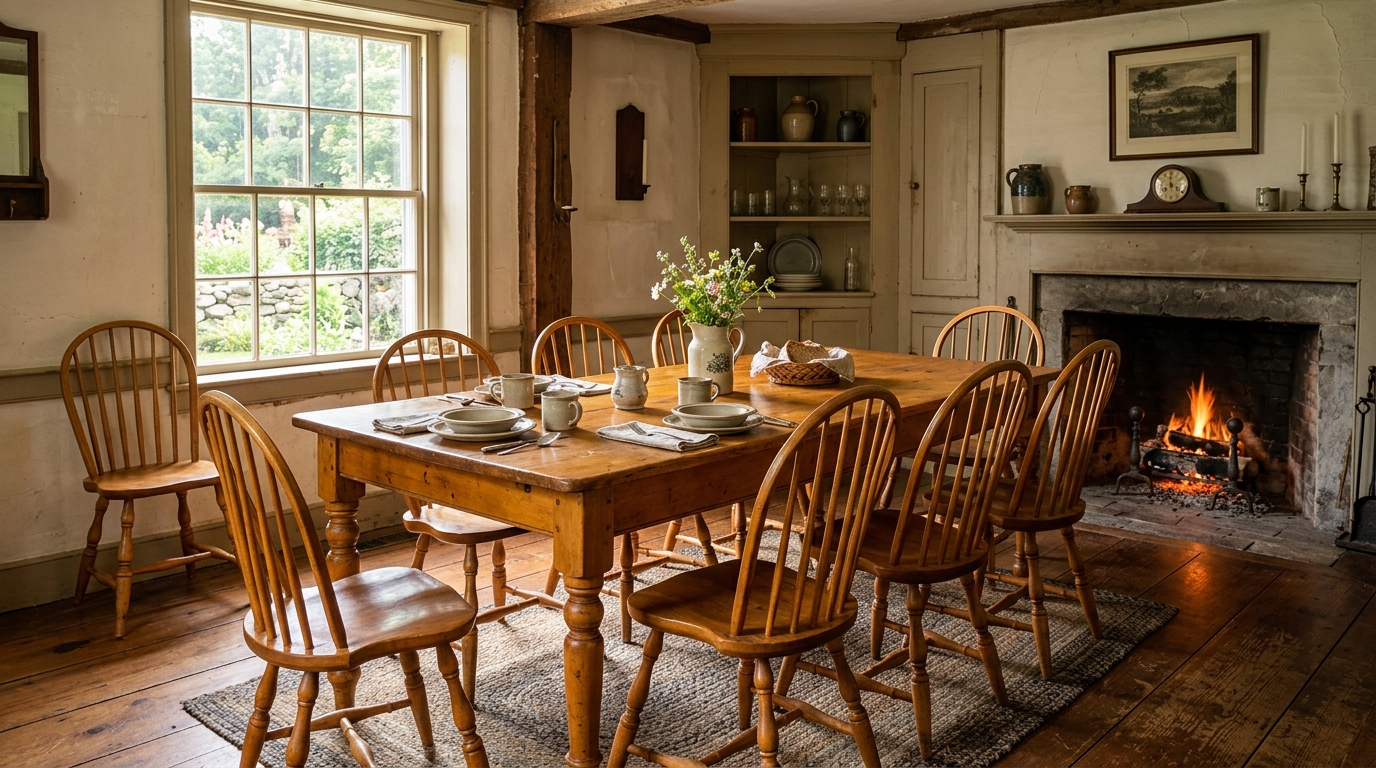
An authentic Tell City Young Republic solid hard rock maple dining table with matching Windsor spindle-back dining chairs, embodying American Colonial Revival design.
In 1858, the Swiss Colonization Society of Cincinnati purchased a tract of forested land along the Ohio River in southern Indiana, naming the settlement “Tell City” in honor of the Swiss folk hero William Tell. Skilled woodworkers, joiners, and turners poured into the region, utilizing the abundant virgin stands of American oak, maple, and walnut.
In 1865, the Chair Makers Union was organized, operating as a workers’ cooperative. By the early 1900s, the company incorporated as the Tell City Chair Company. While they began strictly as manufacturers of wooden chairs (earning a nationwide reputation for virtually indestructible steam-bent rockers and dining chairs), consumer demand soon forced the factory to expand into matching dining tables, hutches, buffets, and occasional occasional furniture.
During the post-World War II suburban housing boom (1950–1980), Tell City became the undisputed premier manufacturer of Colonial Revival furniture in North America. Unlike competitors who cut corners with plywood and synthetic adhesives, Tell City staked its entire brand reputation on solid Northern hard rock maple (while contemporaries like Grand Rapids’ Imperial Furniture Company specialized in fine mahogany veneering). As explored in our comprehensive Guide to Antique Table Styles, Tell City revived Early American, William and Mary, and Federal silhouettes for modern mid-century living.
2. The Tell City Marking Chronology: Stencils, Paper Labels & Burn Marks
Unlike studio craftsmen who hand-carved signatures into drawer boxes, factory-built American furniture makers utilized standardized markings applied on the assembly line. Tell City employed three primary marking systems across different production eras.
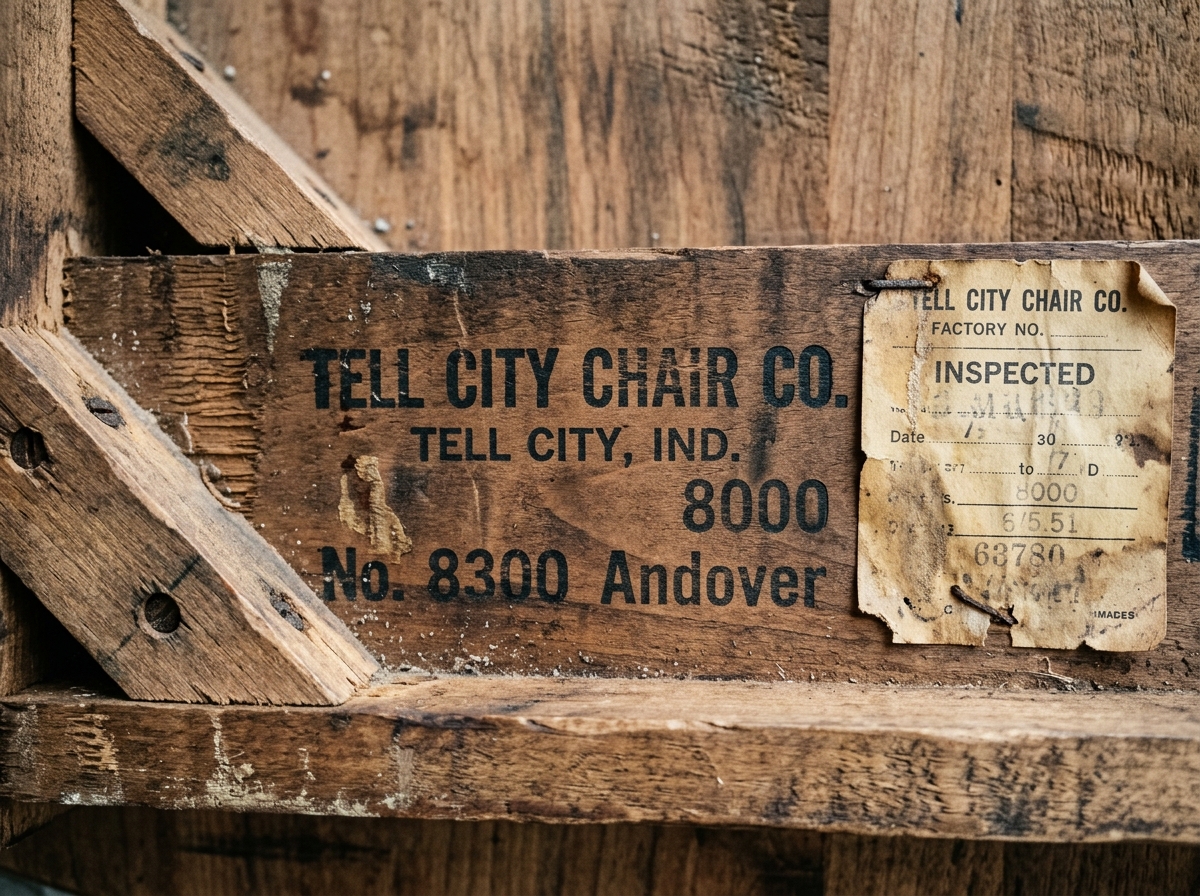
Forensic underside evidence: Black ink industrial stencil reading “TELL CITY CHAIR CO. / TELL CITY, IND.”, stamped pattern number #8000, and original stapled paper inspection tag.
A. The Black Ink Stencil (Most Common, 1940s–1980s)
The definitive maker mark on 90% of Tell City tables found in estate sales today is an indelible black ink stencil applied directly to the unfinished underside of the tabletop, the interior apron, or the cross-stretcher. The mark typically consists of:
- Top Line:
TELL CITY CHAIR CO.in bold, sans-serif uppercase block lettering. - Bottom Line:
TELL CITY, IND.(or occasionallyTELL CITY, INDIANAon earlier pieces). - Accompanying Numerals: A separate ink stamp displaying a 4-digit pattern number (e.g.,
8000or8324) and often the factory finish designation (such asFinish #48).
Expert Authentication Tip: Because Tell City tables were manufactured from solid hard rock maple without synthetic bottom sealers, the ink of authentic factory stencils absorbed deeply into the wood fibers. A genuine stencil will exhibit subtle feathering along open wood pores. Crisp vinyl decals or inkjet-printed underside labels are modern imitations.
B. The Stapled Paper Inspection Label (1930s–1970s)
In addition to the ink stencil, Tell City attached rectangular paper factory tags to the underside using industrial wire staples. These paper labels served internal quality control purposes and contained:
- The company name:
TELL CITY CHAIR CO. FACTORY NO.and inspector identification numbers.- A stamped packing or inspection date (e.g.,
6/5/51orOCT 1964). - The model pattern number and designated wood finish.
Because these paper labels were secured with iron or copper-plated staples, check the paper perimeter: on authentic mid-century pieces, the paper around the staple will show natural oxidation (rust rings) and amber toning from wood lignin contact.
C. Burned Brands & Foil Medallions (1980s–2000s)
In the final decades of production, Tell City introduced hot-iron branding for select high-end collections, stamping the stylized Tell City logo into the timber with heat. Late-production oak and cherry lines (1990s through 2011) also utilized gold foil medallions adhered inside table aprons or under leaf skirts, accompanied by barcoded inventory stickers.
3. Decoding Tell City Pattern & Model Numbers
Every Tell City table features a stamped pattern number on its underside. While novice buyers mistake these for serial numbers or production counts, they are actually precise catalog model codes. Understanding the numbering sequence allows you to instantly determine the furniture collection, original wood species, and intended configuration.
| Pattern Series | Collection Name | Wood Species | Signature Table Styles | Original Era |
|---|---|---|---|---|
| #8000 Series | Young Republic | Solid Hard Rock Maple | Trestle tables, round pedestal extension tables, harvest drop-leaf tables | 1952–1985 |
| #8300 Series | Andover | Solid Hard Rock Maple | Colonial gateleg tables, formal drop-leaf dining tables, tavern tables | 1958–1988 |
| #8500 / #8600 Series | Tanbark | Solid American White Oak | Heavy round pedestal dining tables, thick trestles, pub tables | 1970–1996 |
| #9000 Series | Pioneer / Country | Hard Maple & Solid Cherry | Country French & American farmhouse tables, refectory tables | 1982–2004 |
| #4000 / #5000 Series | Early Production | Oak, Birch, American Walnut | Mission / Arts & Crafts tables, Duncan Phyfe lyre occasional tables | 1920–1949 |
Decoding the Finish Numbers
Alongside the pattern number, Tell City stamped specific finish codes that dictated how the solid timber was stained and glazed at the factory. The two most celebrated finishes in Tell City collector circles are:
- Finish #48 (Andover Finish): A warm, lustrous golden-honey amber stain applied to solid rock maple. This finish highlights the natural curly and bird’s-eye grain figures within the maple while retaining a rich mid-tone glow.
- Finish #28 (Cimarron Finish): A slightly deeper, chestnut-brown maple glaze with hand-distressed edge burnishing, designed to simulate centuries of colonial tavern wear.
- Finish #55 (Natural / Harvest Maple): A lighter, clearer amber-blonde tone popular in mid-1960s suburban homes.
4. Wood & Construction Forensics: Solid Maple vs Veneer
When authenticating vintage mid-century American dining tables, the biggest question collectors ask is: How does Tell City compare to mass-market contemporaries like Mersman?
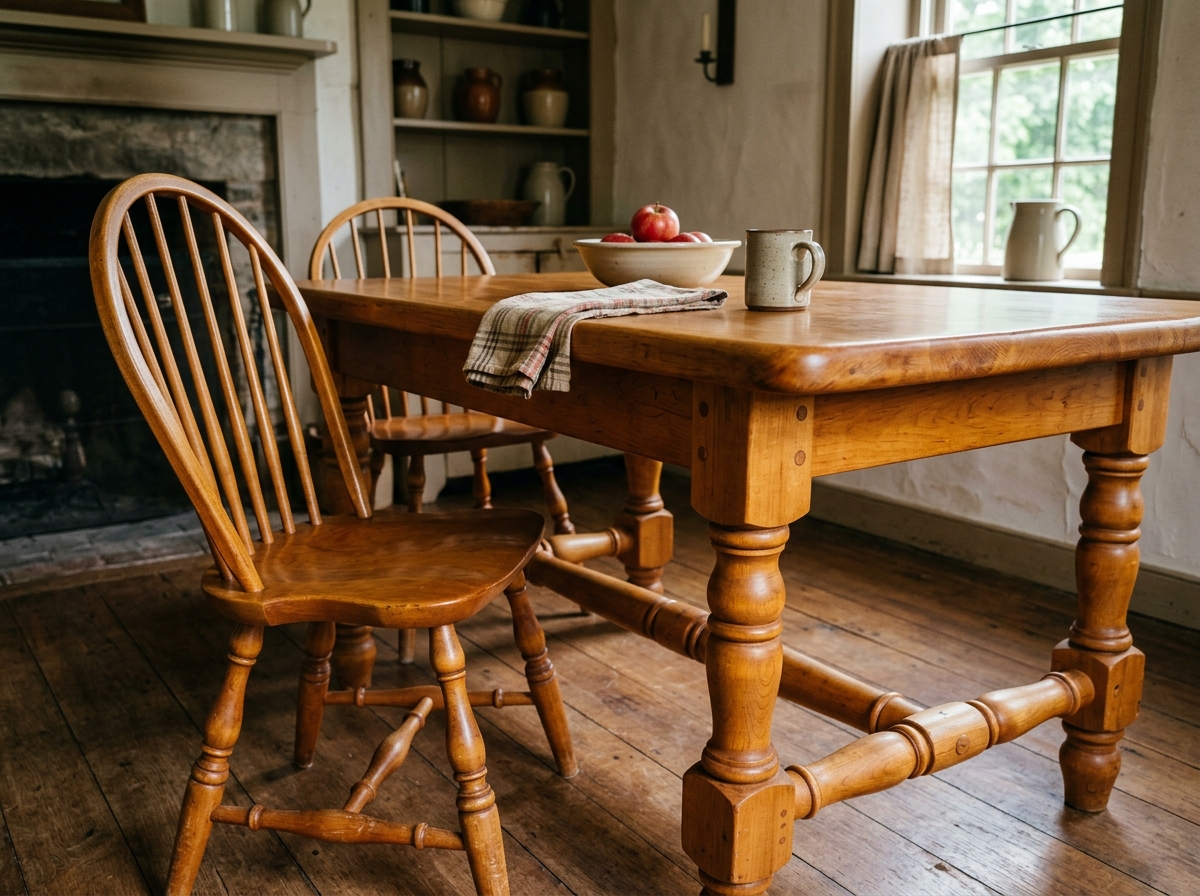
Solid rock maple construction hallmarks: Note the sculpted solid wood edge profile, continuous grain through the plank, and turned legs fitted with internal wooden dowel joinery.
The Tell City vs Mersman Benchmark
While Mersman was the king of living room occasional tables (producing over 30 million tables), Mersman kept prices affordable by gluing paper-thin mahogany and walnut veneers over core substrates of gumwood or yellow poplar (as detailed in our Mersman Table Markings Guide). If a Mersman table got wet, the veneer bubbled and chipped away.
Tell City took the opposite path. A Tell City Young Republic table is solid wood through and through. You can verify this immediately with four physical tests:
- The End-Grain Continuity Test: Inspect the short ends of the tabletop. On a Tell City table, the grain lines visible on the top surface wrap smoothly and continuously over the rounded edge into the end-grain. On a veneered table, you will see a thin sandwich line (veneer seam) where the decorative sheet meets edge banding.
- Weight and Density: Tell City selected Northern hard rock maple (Acer saccharum), which boasts a Janka hardness rating of 1,450 lbf and weighs approximately 44 lbs per cubic foot. A standard 60-inch Tell City trestle table is extraordinarily heavy, requiring two adults to lift comfortably.
- Apron & Corner Block Joinery: Look underneath at the four corners where the legs meet the skirt. Tell City installed triangular solid hardwood corner blocks fastened with heavy, heavy-gauge steel wood screws and diagonal mortise dowels. If you are examining early 20th-century pieces, cross-reference our guide to Dating Antique Furniture by Screws & Hardware to confirm original factory fasteners.
- Table Extension Slides: Tell City dining tables featured heavy, equalized hardwood extension slides crafted from solid rock maple or stamped steel rack-and-pinion mechanisms. When you pull one side of an authentic extension table, the opposing side smoothly glides outward in tandem.
5. Signature Tell City Table Styles to Know
Tell City produced thousands of individual furniture models across its 146-year history, but three iconic silhouettes represent the heart of the collector market today:
1. The Young Republic Trestle Dining Table (#8020 / #8024)
The definitive icon of the American mid-century colonial kitchen. Featuring a thick 1.25-inch solid rock maple top with softened “breadboard” style ends, supported by two massive turned maple baluster trestle posts connected by an arched foot stretcher. These tables typically measured 38″ × 60″ in closed form and expanded to over 84″ or 96″ with two original 12-inch apron-matched extension leaves.
2. The Round Pedestal Split Table (#8030)
A 44-inch or 48-inch round dining table supported by a stout turned center pedestal resting on four arched federal-style cabriole legs. When unlatched, the center pedestal splits into two halves, opening up to receive up to three extension leaves. Tell City also offered a country version featuring solid brass lion paw or eagle claw feet.
3. The Andover Colonial Drop-Leaf & Pembroke Tables (#8310 / #8320)
For smaller dining nooks and living rooms, Tell City crafted exquisite drop-leaf tables utilizing traditional colonial joinery. As explained in our guide to Antique Drop Leaf Tables and Antique Pembroke Tables, Tell City utilized precision wooden swing-out fly brackets and thumb-molded drop leaf rule joints that prevent leaf sagging over decades of use.
4. The Tanbark Solid Oak Pedestal Table (#8520)
Introduced in the 1970s to capture the massive demand for golden oak furniture. Built from solid American white oak with prominent ray flecks (reminiscent of the genuine antique tiger oak discussed in our Antique Oak Identification Guide), these tables are virtually indestructible workhorses.
6. Tell City Table Valuation & Resale Price Guide
Because Tell City manufactured furniture in substantial production volumes, standard individual pieces are not 18th-century museum rarities. However, their extraordinary build quality and timeless solid wood appeal protect them from the steep depreciation that plagues modern flat-pack furniture.
Here is an empirical breakdown of current fair market values on secondary resale channels (Facebook Marketplace, antique malls, Chairish, and LiveAuctioneers):
| Table Style / Configuration | Fair Condition (Wear/Scratches) | Very Good (Original Finish Intact) | Pristine / Complete Set Value |
|---|---|---|---|
| Young Republic Trestle Table (#8020) (Table Only, No Leaves) | $100 – $175 | $225 – $350 | $400 – $550 |
| Young Republic Trestle Table + 2 Original Leaves | $175 – $250 | $350 – $500 | $550 – $700 |
| Round Pedestal Dining Table (#8030 / #8520 Oak) | $125 – $200 | $250 – $400 | $450 – $650 |
| Colonial Drop-Leaf or Pembroke Occasional Table | $75 – $125 | $150 – $250 | $275 – $375 |
| Complete 7-Piece Dining Suite (Table + 6 Windsor/Arrowback Chairs) | $350 – $550 | $650 – $950 | $1,100 – $1,600+ |
Key Factors That Impact Value
- Presence of Matching Original Leaves: Missing extension leaves reduce a dining table’s value by 30% to 50%. Always check inside the table mechanism or ask the seller if leaves are stored in a closet.
- Matching Chairs (The Multiplier Effect): Tell City chairs (such as the #8001 Duncan Phyfe lyre back, #8010 mate’s chair, or #8011 captain’s arm chair) routinely sell for $60 to $120 each on their own. A table sold with its complete matching set of six or eight chairs commands an immediate premium.
- Condition of Factory Finish: While severe white water rings or heat damage decrease value (learn how to fix them in our guide on Removing White Heat Rings from Antique Tables), amateur chemical stripping and polyurethane refinishing destroys the warm antique patina collectors desire. An honest table with mild patina in its original #48 Andover finish will consistently outsell a freshly polyurethaned table.
- Legibility of Underside Stencils: An intact stencil and paper inspection label confirms provenance for buyers and eliminates authenticity disputes.
7. Restoration & Care: Preserving the Factory Patina
Because Tell City tables are solid rock maple or oak rather than veneer, they are extraordinarily forgiving to maintain and restore.
- Avoid Modern Silicone Polishes: Never apply aerosol spray polishes containing silicone oils to a Tell City table. Silicone penetrates deep into the lacquer and prevents future protective coats from bonding, creating a cloudy, gummy smear over time.
- Clean with Mineral Spirits: To remove decades of accumulated kitchen grease, old wax, and grime, wipe down the tabletop with a soft cotton cloth dampened with pure odorless mineral spirits. Mineral spirits dissolves wax and dirt without softening the underlying nitrocellulose factory lacquer.
- Protect with High-Grade Paste Wax: For long-term protection, buff the maple surface with a microcrystalline wax or beeswax-carnauba blend. For detailed application protocols, read our guide on the Best Wax for Antique Dining Tables.
- Repairing Surface Scuffs: Shallow surface scuffs in the #48 Andover finish can be camouflaged using 0000-grade ultra-fine steel wool lubricated with paste wax, rubbed gently in the direction of the wood grain.
Frequently Asked Questions (FAQ)
How can I tell if my Tell City table is solid maple or veneer?
Inspect the edge profile of the tabletop. If you see the natural grain lines continue uninterrupted across the top and down over the end of the board (continuous end-grain), it is solid wood. Furthermore, Tell City tables in the Young Republic and Andover lines were constructed exclusively of 100% solid Northern hard rock maple. They never used synthetic cores or paper-thin face veneers on their tabletop surfaces.
What does the #8000 number mean on a Tell City table?
The number 8000 denotes Tell City’s flagship “Young Republic” line, introduced in 1952. The first two digits (80) designate the solid hard rock maple Early American collection, while specific sub-numbers (such as 8020 or 8030) identify the exact table model (trestle table, pedestal table, or drop-leaf table) within the official factory catalog.
Is Tell City furniture considered valuable antique furniture?
Tell City furniture produced between the 1940s and 1980s is technically classified as mid-century vintage rather than 100-year-old antique furniture. However, because modern factory furniture is overwhelmingly manufactured from engineered particle board, Tell City’s indestructible solid hardwood construction commands consistent demand. Individual tables generally sell between $200 and $650, with complete dining suites reaching $1,000 to $1,600+.
What is Tell City Finish #48?
Finish #48, known officially as the “Andover” finish, is Tell City’s most famous factory stain for their hard rock maple lines. It is a rich, warm golden-amber stain designed to highlight the tight medullary grain of Northern maple while creating an authentic Early American colonial appearance.
Save this identification guide to your Pinterest antique & furniture restoration board:
Pingback: Mersman Table Markings, Model Numbers & Value: Complete Collector’s Guide - Antique Tables
Pingback: Duncan Phyfe Table Identification: How to Spot an Original vs 1940s Reproduction - Antique Tables
Pingback: Solid Wood vs Veneer: How to Tell on Antique Furniture - Antique Tables