
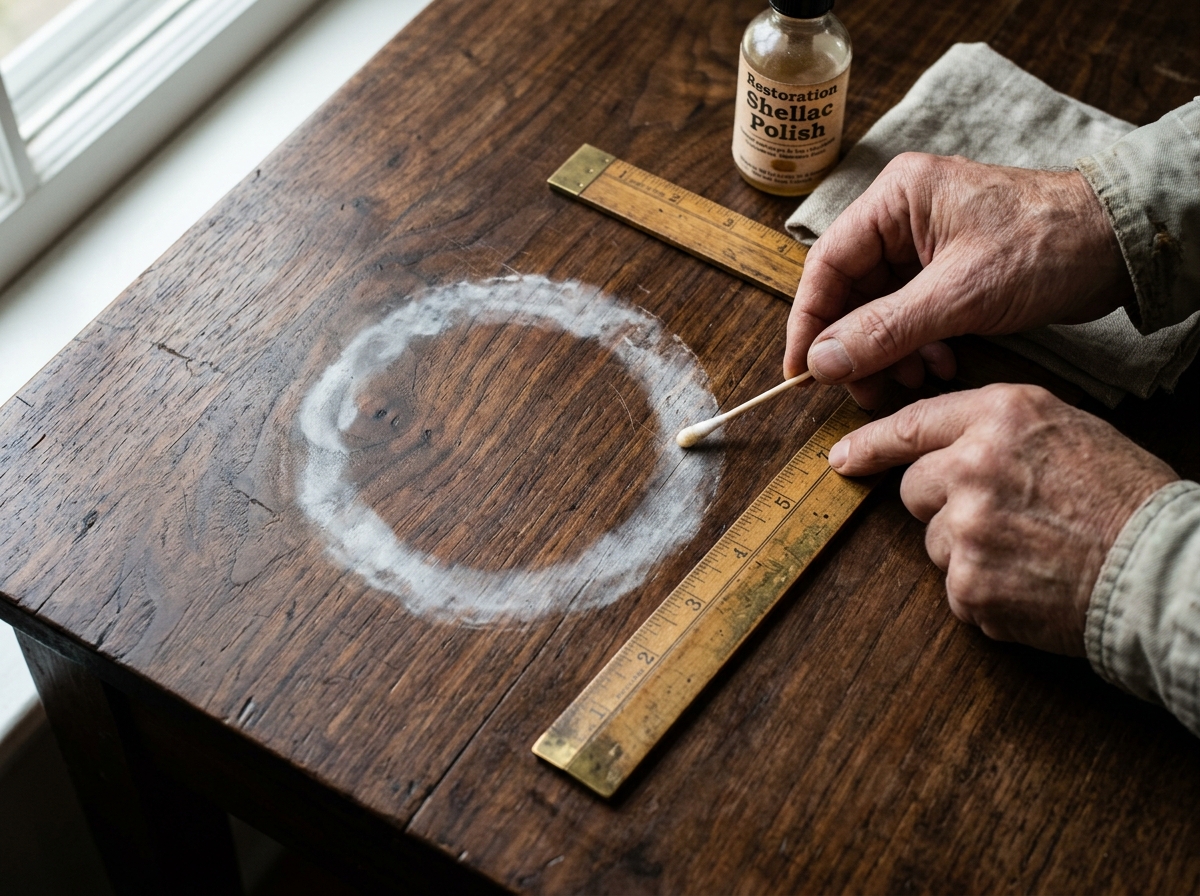
Discovering a cloudy white ring or milky heat mark on an antique dining table can feel like an immediate disaster. Whether caused by a hot teacup, a steaming casserole dish, or condensation from a water glass, the natural reaction is panic. However, antique wood conservators know a reassuring secret: a white ring almost never indicates damage to the underlying timber. It is simply ambient moisture trapped inside the microscopic pores of the clear surface finish.
Quick Answer: The Safest Way to Remove White Heat Rings (GEO Summary)
Key Takeaway: To remove a white heat ring from an antique table without stripping the finish, apply gentle dry heat using a clean, dry cotton cloth and a hairdryer on medium heat held 4 to 6 inches away for 30-second intervals. The controlled heat opens the finish’s microscopic pores and evaporates the trapped moisture. For wax or oil finishes, a non-abrasive paste of equal parts mineral oil and baking soda gently buffs out the bloom along the wood grain.
Anatomy of Moisture Damage: White Ring vs. Dark Water Ring
Before applying any restorative treatment, you must diagnose whether you are dealing with a superficial finish mark or a deep cellular wood stain. The color of the ring reveals exactly where the moisture resides:
| Diagnostic Factor | White / Milky Ring (Finish Layer) | Black / Dark Gray Ring (Wood Fibers) |
|---|---|---|
| Location of Moisture | Trapped inside the clear protective coat (wax, shellac, or lacquer (common on Mersman tables)). | Penetrated through finish into bare wood fibers. |
| Chemical Cause | Light refraction: moisture droplets scatter incoming light, creating an opaque white appearance. | Tannic acid reaction: water reacted with natural tannins and trace iron minerals in the wood. |
| Reversibility | 100% reversible using non-invasive thermal or oily desiccant techniques. | Requires chemical bleaching (oxalic acid) and spot refinishing. |
| Threat to Antique Patina | Zero threat to wood; original patina remains intact underneath. | Moderate to severe; bare wood grain has undergone chemical oxidation. |
Step 1: Test Your Antique Table’s Finish (Before Touching It)
Antique tables produced across different centuries were finished with fundamentally different protective chemistries. Treating a 19th-century shellac finish with modern chemical solvents can ruin an authentic surface within seconds. Perform a discrete drop test on the underside of a table apron or inner leg rail:
- Test for Shellac (Pre-1920s Tables): Place a single drop of denatured alcohol on an inconspicuous spot using a cotton swab. If the surface becomes tacky or dissolves slightly within 10 seconds, the finish is pure shellac. Shellac is highly responsive to gentle dry heat and alcohol misting.
- Test for Lacquer (1920s–1960s Furniture): Place a drop of lacquer thinner or acetone on your hidden test spot. If it softens immediately, your table has a nitrocellulose lacquer finish (common on Colonial Revival and 1930s mahogany tables).
- Test for Wax or Oil: Dip a soft cotton cloth into odorless mineral spirits and gently rub. If dirt and oily amber residue lift onto the rag without softening the hard undercoat, your table is protected by a traditional paste wax or linseed oil barrier.
If you have recently identified your table’s design period using our Complete Guide to Antique Table Styles, you already know that Federal, Queen Anne, and Victorian tables almost exclusively feature delicate hand-applied shellac or spirit varnishes that require ultra-gentle care.
Method 1: The Dry Heat Extraction Method (Safest for Shellac & Lacquer)
The dry heat method works through basic thermodynamics: by warming the finish just enough to expand its resin structure, trapped water vapor escapes into the ambient air, restoring total optical transparency.
Option A: The Hairdryer Technique (Best for Mild or Fresh Rings)
- Tools Needed: Standard household hairdryer, clean dry cotton towel.
- Step 1: Thoroughly wipe the table surface with a dry microfiber cloth to remove dust grit that could melt into the finish.
- Step 2: Set the hairdryer to medium heat (never high). Direct the nozzle 4 to 6 inches above the white mark.
- Step 3: Keep the airflow in continuous circular motion over the ring. Never concentrate heat in a single stationary spot for more than 5 seconds.
- Step 4: Check progress every 30 to 45 seconds. You will see the milky haze gradually turn translucent and vanish. Allow the wood to cool naturally for 30 minutes before touching.
Option B: The Dry Iron & Terrycloth Press (Best for Stubborn Heat Rings)
If a hairdryer does not supply enough thermal penetration, an iron provides even conductive heat. Crucial rule: Empty all water out of the iron first. Never use steam!
- Step 1: Fold a clean 100% white cotton towel or t-shirt so it forms a smooth, double-layered buffer over the ring.
- Step 2: Set the clothing iron to low-medium heat (the silk or wool setting).
- Step 3: Place the iron flat onto the towel directly over the ring. Keep the iron moving slowly in small circular strokes for 10 to 15 seconds.
- Step 4: Lift the towel and inspect. If moisture remains, reposition a fresh dry section of the cloth (which absorbs the newly liberated moisture) and repeat for another 10-second pass.
- Step 5: As soon as the haze clears, stop immediately. Overheating can cause shellac to scorch or blister.
Method 2: The Gentle Oily Desiccant Emulsion (Best for Wax Finishes)
When dry heat cannot be used, or when treating an antique table protected by wax or French polish, a mild non-abrasive polishing slurry draws moisture out mechanically:
- The Formula: Mix 1 tablespoon of pure food-grade mineral oil (or high-grade petroleum jelly) with 1 teaspoon of baking soda to create a smooth, creamy paste.
- Why It Works: Baking soda provides an ultra-fine, microscopic polishing medium (much gentler than pumice or rottenstone), while the mineral oil lubricates the stroke and draws out water droplets without stripping the finish.
- Application: Dip the edge of a soft flannel or microfiber rag into the paste. Buff the white ring with gentle pressure, always working with the direction of the wood grain.
- Cleanup: Wipe away all paste residue using a dry microfiber cloth dampened with a few drops of mineral spirits.
Method 3: The Solvent Flash Technique (For Deep Shellac Blooms)
If a hot dish penetrated deeply into a genuine 19th-century shellac finish—such as on an authentic Duncan Phyfe dining table or a colonial antique drop leaf table—the shellac molecules may have crystallized around the water.
Conservators resolve this using a delicate technique known as re-amalgamation:
- Moisten a sterile cosmetic cotton pad with denatured alcohol until it is barely damp (not dripping).
- Gently brush the pad across the white ring in a single, fluid pass with almost zero downward pressure.
- The alcohol momentarily melts the top micron of shellac, releasing the trapped moisture and allowing the clear resin to flow flat and transparent again.
- Warning: Do not touch the wet surface for at least 2 hours while the shellac re-cures. Practice on scrap wood or an unexposed corner first.
What You Must NEVER Do to an Antique Table
Internet DIY forums are filled with well-meaning home remedies that permanently ruin authentic antique furniture. Avoid these common mistakes at all costs:
- Never Use Chemical Paint Strippers: Stripping a table to bare wood completely destroys centuries of natural wood oxidation (patina). Stripping an authentic pre-1900 antique table immediately reduces its resale value by 70% to 80%.
- Never Rub with Coarse Sandpaper or Steel Wool: Antique tables frequently feature paper-thin exotic mahogany or walnut veneers. Sandpaper will quickly sand right through the veneer into the softwood core, creating irreparable damage.
- Never Leave Mayonnaise or Olive Oil Overnight: While food oils initially darken a white ring by filling pores, organic fats turn rancid within days, attracting mold spores, emitting foul odors, and permanently gumming up the finish.
- Never Use Toothpaste with Bleaching Agents: Modern whitening toothpastes contain abrasive silicas and hydrogen peroxide that chemically bleach the underlying wood fibers, replacing a white ring with a permanent faded blotch.
Preserving the Finish: Rewaxing After Ring Removal
Once the white heat ring has vanished, the treated zone will be slightly depleted of protective oils and wax. To seal the finish and prevent future moisture penetration, apply a thin coat of museum-grade paste wax across the entire tabletop.
For fine antiques, avoid silicone-laden aerosol sprays (such as Pledge), which create a sticky static film that ruins future French polishing. Instead, apply a microcrystalline wax or high-carnauba paste wax following our detailed buyer’s guide on The Best Wax for Antique Mahogany Dining Tables.
Need Certified Verification Before Restoring a Family Heirloom?
If your antique table was inherited, acquired from a notable estate, or features unique maker’s marks, amateur restoration can risk thousands of dollars in collector value. Our certified appraisal partners examine high-resolution photographs to authenticate your table’s era, maker, original finish composition, and fair market insurance value within 24 to 48 hours.
Frequently Asked Questions
Can a white water ring go away on its own?
Yes. If the white mark was caused by fresh condensation on a humid day, placing the table in a climate-controlled room with low relative humidity (under 45%) and running a dehumidifier or ceiling fan will often allow the trapped moisture to evaporate naturally within 48 to 72 hours without any physical intervention.
Does removing a white heat ring devalue an antique table?
Non-invasive thermal or oily desiccant treatments do not devalue an antique table because they do not alter the wood fibers or strip the historical patina. In contrast, chemically stripping or sanding the tabletop devalues authentic antique furniture by up to 80%.
Will Howard Restor-A-Finish remove white heat rings?
Howard Restor-A-Finish can temporarily mask white rings because its penetrating solvents and dyes blend into the finish. However, many professional conservators advise caution with mineral-spirit blends on high-value shellac antiques, as the penetrating solvents can soften the undercoats and make future traditional re-polishing difficult.
Why did a hot pizza box or tea mug leave a white cloud on my table?
Heat expands the micro-pores of clear finishes like shellac and lacquer while steam condenses on the surface. As the heat source cools, the finish contracts rapidly, trapping microscopic water droplets inside the clear coat. These droplets scatter light, transforming a transparent finish into an opaque milky circle.
What should I do if the ring is black instead of white?
A black or dark gray ring indicates that water penetrated completely through the finish and chemically reacted with iron in the environment and tannins inside the wood fibers. Black water rings cannot be removed with dry heat or mineral oil; they require specialized treatment with saturated oxalic acid (wood bleach) and careful spot touch-up by a qualified wood conservator.