
To date antique furniture by screws, examine the head symmetry, slot centering, and thread tip. Pre-1812 screws are completely handmade with blunt tips, irregular hand-filed threads, and off-center slots. Between 1812 and 1846, early lathe machinery produced uniform cylindrical shanks, but slots were still cut by hand hacksaws. In 1846, Thomas J. Sloan patented the modern gimlet point and slotting machine, establishing mass-produced, centered-slot screws by 1856. Paired with forged rose-head nails and saw kerf patterns, hardware offers definitive chronological proof of when an antique table was built.
Key Forensic Hardware Takeaways
- Pre-1812 (Handmade Screws): Completely flat, blunt tip (pointless); hand-hacksawed slot is noticeably off-center; threads are uneven and shallow.
- 1812–1846 (Early Lathe-Cut): Uniform cylindrical shank, but still lacks a sharp gimlet point; slots often remain hand-finished with minor asymmetry.
- 1846–1856 (The Sloan Transition): First true machine-made screws; Sloan’s patent introduced pointed tips and uniform factory-milled slots.
- Post-1856 (Modern Machine Screws): Perfectly centered slots, sharp gimlet points, and uniform machine threading across all fasteners.
- The Tannin Oxidation Ring: Authentic antique iron hardware reacts with wood tannins, leaving a permanent black or dark brown stain surrounding original screw and nail holes.
The 4 Eras of Wood Screws: A Collector’s Chronology
While cabinetmakers often planed, sanded, and varnished show surfaces to perfection, the underside of an antique table reveals its true, untouched history. Examining the screws securing tabletop cleats, drop-leaf hinges, and drawer runners is one of the most reliable forensic methods in antique appraisal. Hardware establishes a strict “terminus post quem”—the earliest possible date an item could have been assembled.
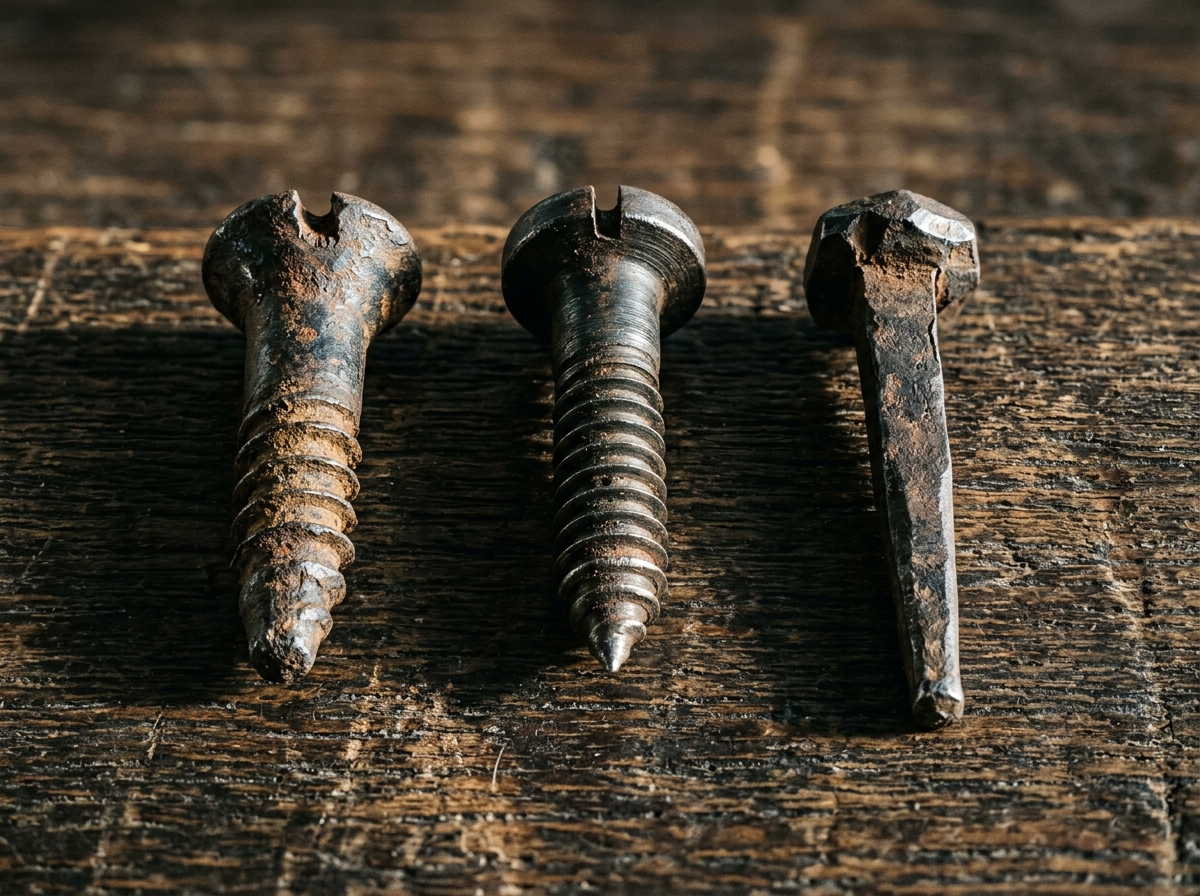
1. Pre-1812: Completely Hand-Forged Screws
Before the Industrial Revolution, screws were individually fabricated by blacksmiths and gunsmiths. A craftsman forged a square iron nail rod, rounded the shank by hand, filed shallow threads into the cylinder, and manually cut the head slot using a cold chisel or hand hacksaw.
Physical Characteristics to Look For:
- Blunt, Pointless Tip: Handmade screws never have a sharp point. Craftsmen had to pre-drill a pilot hole with a gimlet auger to thread them into hardwoods like mahogany or oak.
- Off-Center Head and Slot: Because heads were hand-hammered and slots were cut by eye, the slot is almost never perfectly centered across the diameter.
- Unmatched Threads: If you remove three original screws from an 18th-century table hinge, no two will have identical thread pitch or shank thickness.
- Square Remnants: You will frequently see a subtle flat or square facet on the unthreaded neck near the head—a remnant of the original square nail rod stock.
2. 1812–1846: Early Lathe-Turned Machine Screws
Between 1810 and 1812, inventors like John and Joseph Wilkinson patented water-powered screw-cutting lathes. While these machines produced cylindrical shanks with consistent diameters, the slotting process was still separate and largely manual.
During the American Federal and Classical Empire periods—the golden age of Duncan Phyfe tables—screws exhibited more uniform body proportions. However, they still possessed blunt tips and variable hand-sawn slots. Screws were relatively expensive compared to wooden pegs, so furniture makers used them sparingly, reserving them for high-stress connections like tilt-top table pivots and drop-leaf rule joints.
3. 1846–1856: The Sloan “Slotless” Transition
In 1846, American inventor Thomas J. Sloan received landmark patents for an automated machine that formed screw threads and cut sharp points (gimlet screws). However, early machine factories produced screws in bulk without pre-cut slots. Many regional cabinetmakers purchased these blanks and manually sawed slots in their workshops. If you encounter a screw with machine-turned threads and a sharp point, but with an uneven or off-center slot, it almost certainly dates to this pivotal decade of 1846–1856.
4. Post-1856: Fully Automated Modern Machine Screws
By 1856, fully integrated factories produced screws with uniform machine-cut slots and sharp, self-starting gimlet points. Victorian furniture makers (such as Eastlake, Golden Oak, and prolific 20th-century makers like Mersman Tables) utilized these screws in large quantities. If a piece claiming to be 18th-century Chippendale contains uniform, centered-slot screws with razor-sharp points throughout its frame, it is either an extensively repaired original or a 20th-century Colonial Revival reproduction.
Chronological Hardware Identification Matrix
| Era | Screw Type | Head & Slot Features | Point Type | Typical Furniture Era |
|---|---|---|---|---|
| Pre-1812 | Hand-forged blacksmith iron | Hand-hammered head, off-center hacksaw slot, flat neck spots | Blunt (flat bottom) | Queen Anne, Chippendale, William & Mary |
| 1812–1846 | Early lathe-machined shank | Uniform shank diameter, hand-finished slots | Blunt (flat bottom) | Federal, Empire, Duncan Phyfe, Biedermeier |
| 1846–1856 | Sloan patent transition | Machine-threaded, hand-cut workshop slots | Early gimlet point | Early Victorian, Rococo Revival |
| 1856–1890s | Fully automated machine | Centered machine slots, uniform dome/flat heads | Sharp gimlet point | Eastlake, Renaissance Revival, Aesthetic Movement |
| 1930s+ | Robertson (square) / Phillips (cross) | Cross-head recess (Phillips 1936) or square recess (Robertson 1908) | Modern tapered point | Mid-Century Modern, 20th-c. reproductions, repairs |
Dating Antique Tables by Nails: Rose-Head, Cut & Wire
While screws held moving assemblies like table leaves, nails were used extensively for drawer bottoms, back panels, corner blocks, and under-table stretchers. Like screws, nail manufacturing underwent three clear technological phases:
1. Hand-Wrought Rose-Head Nails (Pre-1800)
Blacksmiths forged these nails individually from square iron rods. The blacksmith struck the head three to four times with a hammer while the iron was glowing red, creating a distinctive faceted, blossom-like head known as a “rose-head”. Hand-wrought nails taper on all four sides to a sharp rectangular point. If you find square-shank nails with hand-hammered rose heads, the piece strongly dates before 1800.
2. Machine-Cut Nails (1790s–1890s)
Invented in New England in the late 18th century, machine-cut nails were sliced from flat wrought-iron sheets. Because they were sheared from a sheet, they taper on only two sides, leaving two parallel edges. Early cut nails (1790s–1820s) had hand-hammered heads; by the 1830s, machine-formed heads became standard. Cut nails remained the dominant fastener across Victorian America until round wire nails took over at the turn of the century.
3. Round Wire Nails (1890s to Present)
Modern nails drawn from cylindrical steel wire appeared in the late 1880s and dominated construction by 1895. Any piece containing original round-shank wire nails was manufactured after 1890. If an “18th-century” table has round wire nails in its underlying framing, those joints were either rebuilt in modern times or the piece is a modern fantasy reproduction.
The “Tannin Halo” Clue in Antique Oak & Chestnut
When ungalvanized historic iron reacts with natural tannic acid present in woods like oak and chestnut, it forms ferric tannate—the chemical basis of historical iron gall ink. Over 100+ years, this creates an indelible black or purple-black ring (halo) deep in the wood fiber around the nail or screw shank. Modern zinc-coated replacement screws will not produce this black oxidation halo; they either leave bare wood or develop bright orange rust flakes.
Dating by Saw Marks: Reading the Kerf on Table Undersides
To determine how timber was milled, turn the table upside down or inspect the underside of drop leaves, expansion rails, and drawer bottoms. These hidden utility areas were rarely hand-planed smooth, preserving the mill blade’s original kerf pattern.
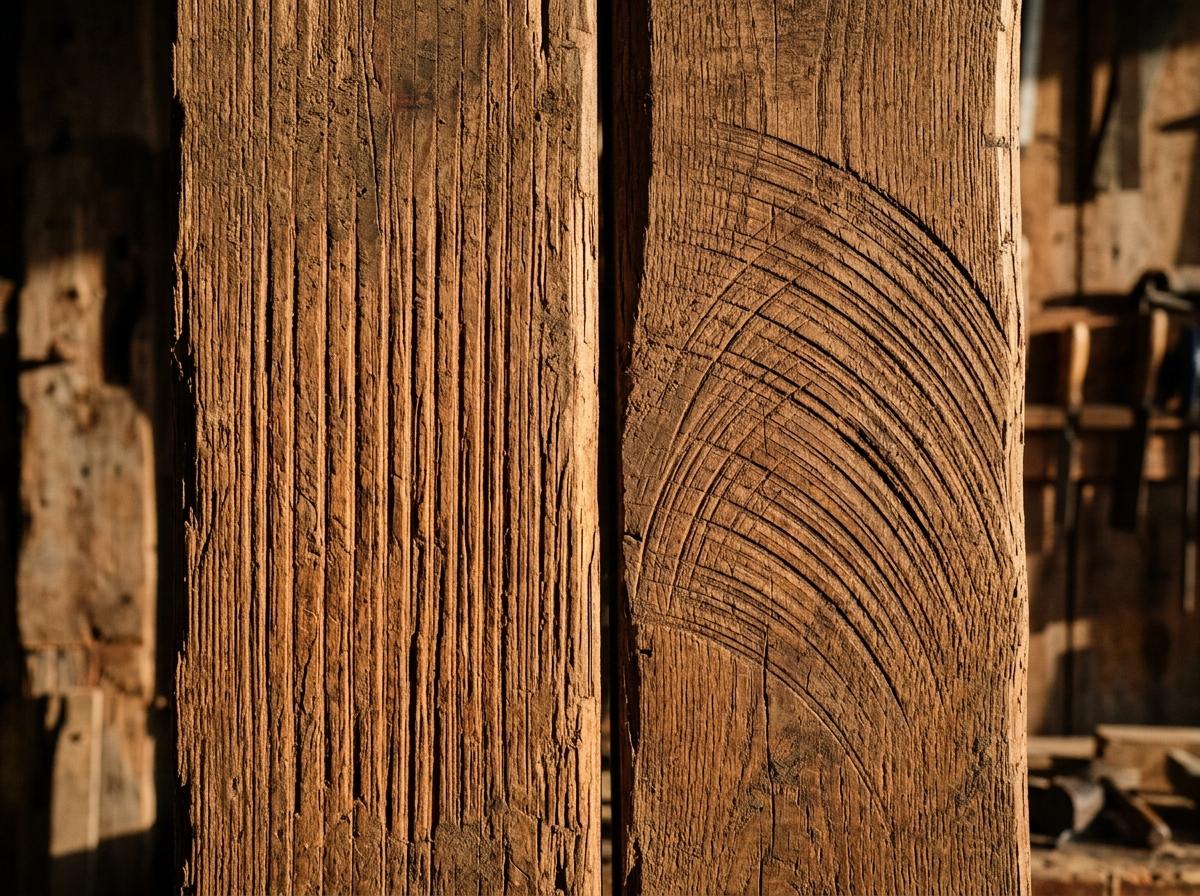
1. Pit Saw Marks (1600s–1750)
Manually operated by two men (the “top sawyer” standing on the log and the “pitman” in the pit below), pit saws produced coarse, irregular, diagonal cut lines. The marks vary widely in angle and depth across the board face, reflecting human fatigue and stroke variation.
2. Up-and-Down Sash Saw Marks (1700–1860s)
Water-powered sawmill blades operated with a rhythmic vertical reciprocating stroke. These blades left crisp, straight, vertical parallel lines perpendicular to the grain of the wood. The spacing between kerfs is generally uniform (often 1/8 to 1/4 inch apart) as a waterwheel-driven carriage advanced the log with each stroke. You will frequently find these marks on early antique drop-leaf tables and gateleg dining tables.
3. Circular Saw Marks (circa 1840 to Present)
The introduction of steam-powered circular saw mills revolutionized timber preparation in the 1840s. Circular saw blades leave distinct curved or arc-shaped lines across the board. If the underside of a tabletop or the interior drawer bottom displays curved saw arcs, the lumber was sawn in 1840 or later. Finding curved saw marks on a table claimed to be an authentic 1810 Duncan Phyfe is an immediate warning of a reproduction.
Where to Inspect an Antique Table: 5 Critical Forensic Zones
Do not rely on screws located in easily accessible, exposed areas—these were the first to be replaced when a joint loosened. Instead, focus your magnifying glass on these five undisturbed inspection zones:
- Drop-Leaf Rule Joint Hinges: On drop-leaf and gateleg tables, look closely at the long iron rule hinges set into the underside. Check if the screws securing the hinge leaves have blunt tips and off-center slots, and ensure the screw heads sit flush within countersunk hinge holes.
- Tabletop Pocket Screws & Cleats: On solid wood dining and library tables, cabinetmakers used angled pockets or wooden buttons to fasten the top to the apron while allowing wood movement. Inspect the pocket holes for hand-cut screws versus modern drywall screws. Review our complete guide to how to tell if a table is antique oak for detailed illustrations of tabletop pocket joints.
- Brass Claw Feet & Casters: Examine the mounting screws holding brass paw casters on Federal and Regency tables. Genuine 1810–1830 casters are held by hand-filed blunt screws. Modern reproductions use machine-threaded pan-head screws.
- Drawer Runners and Underside Glue Blocks: Pull drawers completely out and inspect the nails holding the drawer bottom to the back panel. Look for hand-cut Rose-head nails or early machine-cut nails, rather than wire brads.
- Table Leaves & Extension Mechanisms: On pedestal dining tables, examine the wooden slides. If original screws remain in the geared or timber slide stops, their construction date will match the table’s assembly era. Check our cornerstone guide to antique table styles for a comprehensive timeline of American and European table construction.
Red Flags: Spotting Modern Repairs vs. Reproduction Forgeries
Finding modern hardware does not automatically mean a table is a fake. Tables are functional furniture pieces that endure heavy daily use over centuries. A loose hinge may have been repaired by a homeowner in 1965 using contemporary steel screws. Here is how to distinguish an honest repair from an intentional reproduction:
1. The “Ghost Hole” Clue: If an original screw stripped out or broke, a repairer often moved the hinge by 1/4 inch or filled the old hole with wood putty. Look for empty screw holes or dark oxidation rings without screws—this proves original antique hardware was once present.
2. Uniformity Across All Hinges: In a genuine repair, you might find one or two modern Phillips screws alongside four original hand-cut slotted screws. However, if every single screw on all hinges, casters, and cleats is completely uniform and modern, the piece is likely a 20th-century reproduction.
3. Artificial Antiquing Chemicals: Forgers sometimes soak modern brass and iron screws in acid (like muriatic acid or liver of sulfur) to darken them. However, chemically aged screws only have surface oxidation—they lack the deep ferric tannate blackening embedded into the wood grain that takes decades of natural aging to create.
Frequently Asked Questions
Can screws alone definitively prove a table is authentic?
No single hardware element should be evaluated in isolation. Screws establish a strict date ceiling (a table cannot be older than its original fasteners), but they must be evaluated in context with drawer joinery (hand-cut dovetails or Knapp joints), wood species grain, natural shrinkage, and tool marks. Always cross-reference hardware with overall stylistic proportions.
What does an off-center screw slot mean?
An off-center screw slot indicates the slot was cut manually with a hand hacksaw or cold chisel rather than by automated machinery. This is a primary diagnostic hallmark of screws manufactured prior to 1856, providing strong evidence of late 18th-century or early 19th-century fabrication.
When were pointed screws invented?
Pointed screws (technically called gimlet-point screws) were patented in the United States in 1846 by Thomas J. Sloan and perfected by the American Screw Company in Providence, Rhode Island. Prior to 1846, virtually all wood screws had blunt, flat ends requiring fully pre-drilled pilot holes.
Why are there dark black stains around old table screws?
The dark black discoloration surrounding original iron screws is caused by a chemical reaction between the unplated iron fastener, moisture, and tannic acid naturally present in wood species like oak, chestnut, and walnut. This forms ferric tannate over generations and is a key physical indicator of authentic, unmolested antique joinery.
Pingback: How to Tell if a Table is Antique Oak: Quartersawn, Tiger Oak & Joinery Clues - Antique Tables
Pingback: Antique Drop Leaf Table Identification & Value Guide (With Dating Marks) - Antique Tables