
The Antiques Roadshow Nightmare:
Every antique collector has watched the heartbreaking television appraisal scene: an excited owner presents a rare 18th-century American table, expecting a $40,000 valuation, only for the appraiser to deliver the crushing news: “In its untouched original condition, this was worth $40,000. But because someone took a chemical stripper and sandpaper to it in 1975, its value today is barely $4,000.” In the world of fine antique furniture, untouched original finish is between 50% and 80% of the piece’s total market value. Here is how professional conservators and auction appraisers tell whether an antique retains its original historic skin or has been fatally refinished.
To a novice collector or DIY decorator, a freshly stripped, mirror-smooth table coated in clear gloss polyurethane looks “clean” and “restored.” But to serious collectors, museums, and high-end auction houses, that modern finish represents catastrophic cultural and financial destruction. The surface of an antique—known as its patina—is not merely dirt or old varnish. It is a complex, irreproducible micro-ecosystem composed of oxidized wood lignins, centuries of hand-applied beeswax, micro-abrasions from historical daily life, and the natural crystallization of historical shellac resins. Once stripped away with harsh methylene chloride chemicals or aggressive sandpaper, that history is erased forever.
How to Tell if Antique Furniture Has Been Refinished: Quick Forensic Summary
Direct Forensic Answer: To tell if antique furniture has been refinished, check texture, micro-fracturing, chemical reactivity, and ultraviolet fluorescence: Original finishes (pre-1850 shellac/copal) display microscopic “alligatoring” craquelure, sharp hand-carved edges, soft wax accumulation in crevices, and fluoresce with a warm amber-orange glow under 365nm UV blacklight. Refinished furniture exhibits a cold, plastic-like polyurethane sheen, rounded sanded moldings, chemical residue in corners, and fluoresces with a harsh milky greenish-white or dull non-reactive glow under UV light.
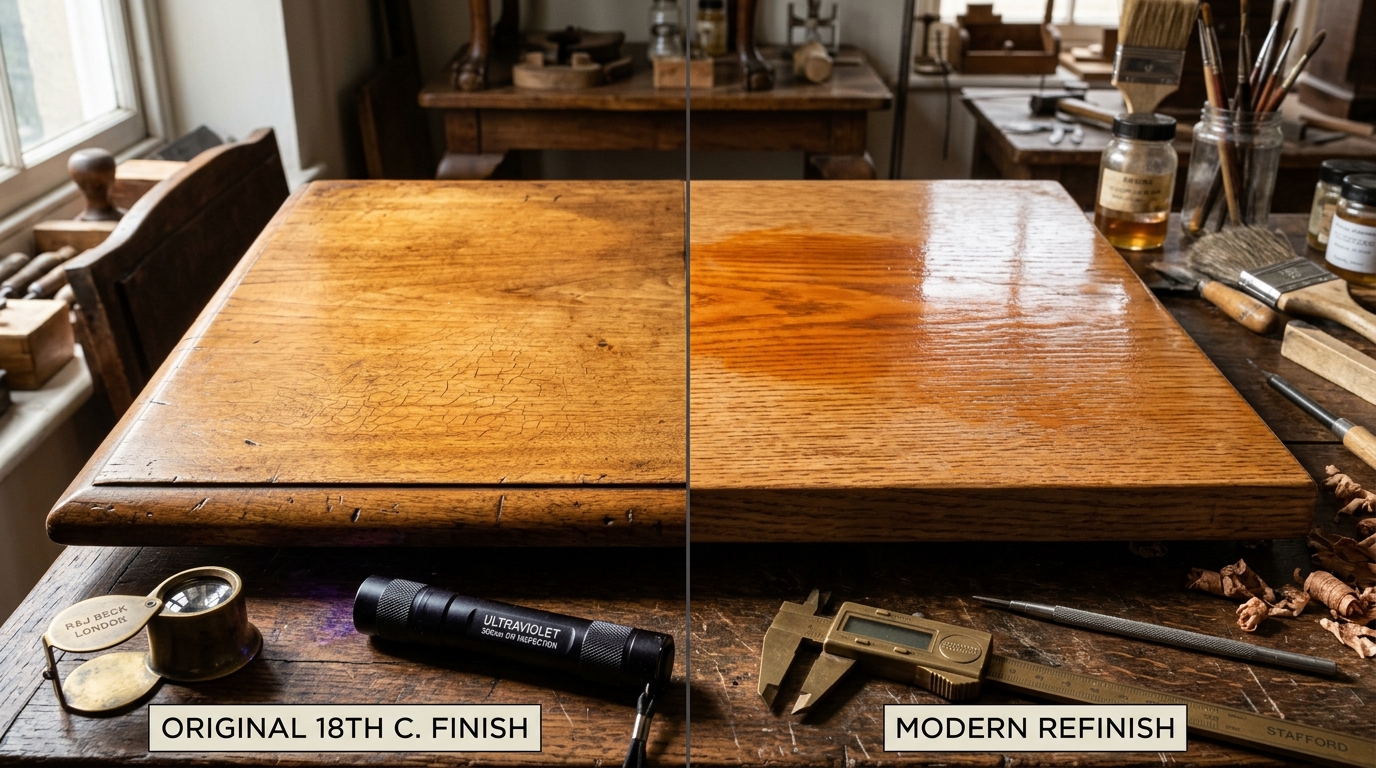
The 6 Forensic Diagnostic Tests for Original Finish vs. Refinished
When evaluating an antique table, desk, or chest at an estate sale, auction preview, or antique gallery, perform these six non-destructive forensic inspections:
1. The 365nm Ultraviolet (Blacklight) Fluorescence Test
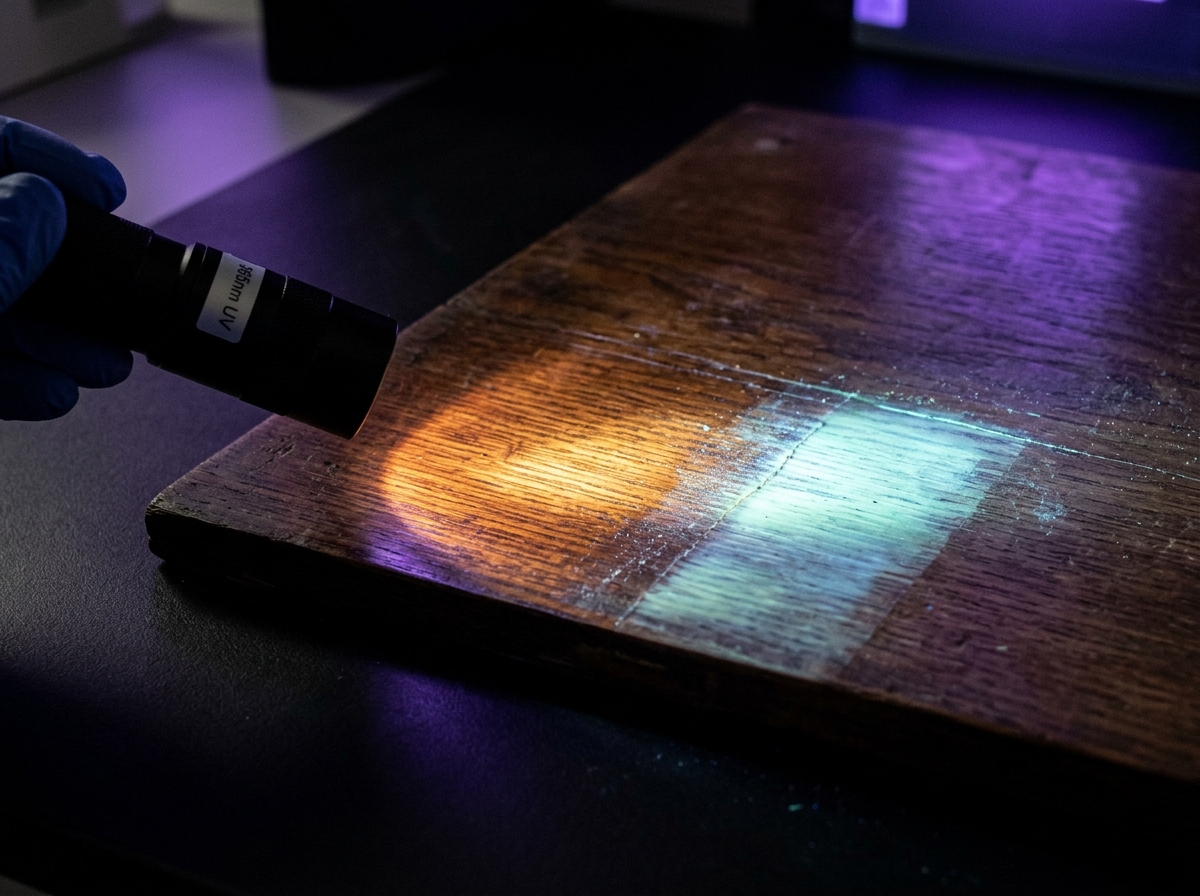
The single most powerful, objective scientific tool in furniture conservation is a pocket 365nm UV blacklight torch. In a darkened room, pass the ultraviolet light across the wood surface:
- Original Historic Shellac (1700–1860): The natural secretions of the Kerria lacca insect (shellac) and historic tree resins (copal, amber) absorb UV radiation and emit a distinctive, soft warm orange to amber-green fluorescence. If the entire table glows with an even, warm amber luminescence, the finish is original and intact.
- Modern Polyurethane & Synthetic Varnish (Post-1950): Synthetic modern polymers lack natural organic resin chemistry. Under 365nm UV light, polyurethane either appears completely dead and non-reactive (a dull dark purple) or fluoresces with a harsh, cloudy milky greenish-white sheen.
- Spot Repairs & Partial Touch-ups: If an antique table has a refinished top but original legs, the blacklight will reveal the deception instantly. The legs will glow warm amber, while the top will look milky white or pitch dark, highlighting the exact boundary where the refinisher stopped.
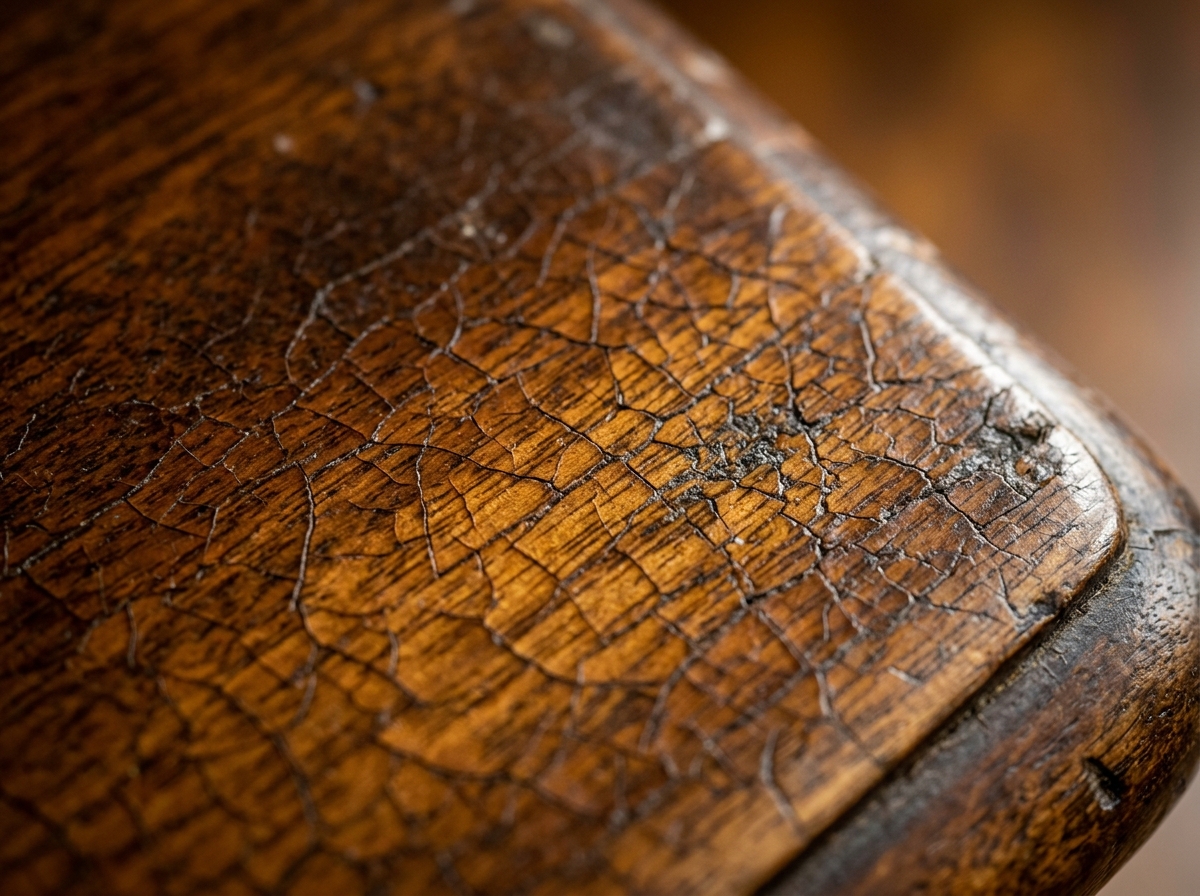
2. The Craquelure & “Alligatoring” Micro-Web Test
As organic shellac, spirit varnishes, and linseed oil finishes age over 100 to 200 years, they undergo continuous slow oxidation and lose volatile plasticizers. Because wood expands and contracts across seasons while old brittle varnish cannot, the finish develops a tight, microscopic web of hairline surface fractures. In the antique trade, this pattern is called craquelure or alligatoring.
Inspect the surface at a raking angle under a 10x jeweler’s loupe. In an untouched antique, you will see a subtle, uniform spiderweb network of micro-checks that allows the deep wood grain to breathe. Modern polyurethane never alligators. Polyurethane is a plastic resin designed to flex with wood movement. If a purported 18th-century table top looks as smooth, glossy, and pore-free as a sheet of kitchen cling wrap, it has been modernly refinished.
3. The Chemical Solvent Swab Test (Denatured Alcohol vs. Acetone)
Different historical eras utilized completely different finishing chemistries. If the seller allows, or on an unexposed underside test spot (such as the back of a table leg or inside a drawer runner), you can identify the exact finishing chemistry with a cotton swab:
- The Shellac Test (Denatured Alcohol): Dip a cotton Q-tip in denatured alcohol and gently touch it to an unexposed drop of finish for 5 seconds. If the finish softens, dissolves, and leaves a sticky residue on the swab, the finish is 100% authentic shellac. Shellac was the universal fine furniture finish from 1700 to roughly 1920.
- The Lacquer Test (Acetone): If alcohol has no effect, touch a fresh swab dipped in acetone or lacquer thinner. If acetone quickly dissolves the finish, it is nitrocellulose lacquer, which was invented in the 1920s and proves the piece was made or refinished after World War I.
- The Polyurethane Test: If neither alcohol nor acetone softens the finish after 15 seconds, you are dealing with modern cured polyurethane or conversion varnish (post-1960). It cannot be removed without toxic chemical paint strippers.
4. The “Soft Edge” & Sanding Inspection
One of the most irreversible side effects of refinishing is over-sanding. In the 18th and early 19th centuries, cabinetmakers hand-carved molding profiles, tabletop chamfers, fluted reeding, and acanthus leaves with razor-sharp steel carving gouges. Original pieces retain crisp, knife-sharp 90-degree transitions between carved planes.
When an amateur refinisher or commercial dip-and-strip shop refinishes an antique, they use orbital power sanders and rotary discs to cut through old varnish. This rounded off the crisp architectural edges. If the fluting on a Duncan Phyfe table leg feels soft, rounded, and melted like a candle left in the sun, the piece has been aggressively sanded and refinished.
5. The “Crevice Grime” & Chemical Residue Check
Take a strong flashlight and inspect the deepest crevices: the carved scrolls, the tight junctions where legs meet the table apron, and the underside corner blocks:
- Untouched Originals: Over 150+ years, airborne dust, oxidized beeswax, soot from oil lamps, and handling oils accumulate in deep recesses. The finish in the crevices will naturally be darker, thicker, and softer than on the exposed, wiped-down top surfaces.
- Chemically Stripped Pieces: Chemical paint strippers pool in recesses. When washed off with water or mineral spirits, the chemicals leave behind a telltale white, powdery, chalky residue deep in the wood grain and carved recesses. Furthermore, the wood in the crevices often looks artificially bleached, lighter in color than the surrounding flat timber.
6. Tactile Temperature, Friction & Scent
Your hands and nose are sensitive forensic tools:
- Thermal Conductivity: Close your eyes and lay the palm of your hand flat on the tabletop. Authentic old shellac and natural oil finishes are porous and feel warm and organic to the touch, quickly adapting to your body temperature. In contrast, modern polyurethane creates an impermeable plastic thermal barrier that feels cold, slick, and synthetic.
- Scent Inside Drawer Pockets: Open the drawers of an antique table or desk and smell the interior secondary wood. Untouched pieces have a deep, dry, sweet scent of oxidized pine, cedar, or oak combined with dried beeswax. A refinished piece—even one stripped decades ago—often retains a lingering sharp, sour chemical odor of mineral spirits, lacquer thinner, or petroleum solvents. Cross-reference our guide on dating antique furniture by dovetails to verify whether drawer boxes were spared during exterior refinishing.
Historical Finishes Comparison Matrix (1700–Present)
Understanding which finishes existed during each historical decorative era prevents anachronistic collector mistakes:
| Finish Type | Historical Period | Chemical Composition | Surface Texture & Sheen | UV Light Reaction | Reversibility |
|---|---|---|---|---|---|
| Beeswax & Linseed Oil | Pre-1720 (Jacobean, William & Mary) |
Boiled flaxseed oil, raw beeswax, turpentine. | Low satin matte, open natural wood pores, deep tactile warmth. | Dull greenish-brown. | 100% Reversible with mineral spirits. |
| Shellac / French Polish | 1720 – 1920 (Queen Anne, Chippendale, Federal, Victorian) |
Natural lac insect resin dissolved in ethanol. | High optical chatoyancy, semi-gloss luster, fine craquelure with age. | Bright warm amber-orange. | 100% Reversible with denatured alcohol. |
| Copal & Oil Varnish | 1780 – 1900 (Late Georgian, Victorian Dining Tops) |
Fossil copal tree resin cooked with drying oils. | Tough, water-resistant, deep amber tone, pronounced heavy alligatoring. | Dull yellowish-green. | Moderately reversible with solvent alcohol/acetone blends. |
| Nitrocellulose Lacquer | 1920 – Present (Art Deco, Mid-Century, Grand Rapids) |
Nitrated cotton cellulose dissolved in butyl acetate. | Hard, glassy, uniform industrial sheen, spray-applied. | Pale milky white. | Reversible with lacquer thinner/acetone. |
| Polyurethane & Acrylic | 1960 – Present (Modern Commercial / DIY Refinishing) |
Petrochemical urethane polymers. | Cold, thick plastic film, perfectly flat, impervious to water, zero pore breathability. | Milky greenish-white or non-reactive dark. | Irreversible without destructive chemical strippers. |
Conservation vs. Refinishing: When Is Restoration Acceptable?
In museum-grade conservation, there is a fundamental distinction between restoring/reviving a finish and stripping a piece:
Acceptable: Finish Revival & Waxing
Cleaning away old dirt with mineral spirits, amalgaming dry crazed shellac with a light alcohol pad, and nourishing the wood with microcrystalline paste wax preserves 100% of historical value.
Read Paste Wax Application Guide →Surface Spot Repairs
Removing isolated white heat blooms or water rings without stripping the entire tabletop retains collector integrity. Never strip an entire table top for a single minor water mark.
Read Heat Ring Removal Guide →Catastrophic: Dip-and-Strip Chemical Baths
Submerging an antique in caustic lye tanks or aggressive chemical strippers dissolves historic animal hide glues, bleaches wood grain, and permanently erases up to 80% of auction value.
Read Drop Leaf Value Guide →To understand the structural joinery beneath the finish across different historical periods, explore our guide to the diverse types of antique tables across American and British decorative eras.
How Refinishing Impacts Antique Furniture Valuation (2026 Price Benchmarks)
Auction houses like Christie’s and Sotheby’s, along with regional appraisal societies, grade antique furniture according to finish integrity:
- Untouched Virgin Patina (100% Value Baseline): An 18th-century Queen Anne or Chippendale table retaining untouched, crazed original shellac, dark oxidized patina in carvings, and original secondary timbers. An untouched mahogany drop-leaf table valued at $8,000 to $15,000.
- Museum-Conserved French Polish (80% – 90% Value): The piece was professionally revived by an accredited conservator who cleaned the surface, consolidated loose shellac, and applied a light over-polish of period-accurate seedlac without stripping original timber. Value: $6,500 to $12,000.
- Competent Historical Refinish (35% – 50% Value): Stripped and refinished 50 to 80 years ago (e.g., in the 1930s or 1950s) using spirit varnish or early lacquer, which has itself begun to age and mellow. Value: $3,000 to $6,000.
- Modern Amateur Polyurethane / Power Sanded (10% – 25% Value): Aggressively power-sanded, stripped with chemical wash, and coated in modern glossy polyurethane. Architectural edges rounded; wood grain bleached. The same table drops to $800 to $1,500, valued strictly as functional decorative furniture rather than an authentic antique investment asset.
Frequently Asked Questions About Refinished Antique Furniture
Does refinishing an antique table completely ruin its value?
Yes, refinishing a high-value 18th- or early 19th-century antique table typically erases 50% to 80% of its market value. Serious collectors and museums pay premium prices specifically for untouched historical patina, craquelure, and natural oxidation. However, on common mid-20th-century vintage production furniture (worth under $300), a tasteful refinish can enhance functional utility without major financial loss.
How does a blacklight show if furniture has been refinished?
Under a 365nm ultraviolet blacklight, organic natural shellac and historic resins naturally fluoresce with a warm amber-orange or golden glow. In contrast, modern synthetic finishes like polyurethane and modern plastic repair compounds either fluoresce bright milky greenish-white or appear completely dead and non-reactive, instantly revealing modern refinishing and hidden repairs.
What is craquelure on antique furniture?
Craquelure (also called “alligatoring”) is a fine, microscopic spiderweb network of hairline surface cracks that naturally forms in antique shellac and oil varnish over 100+ years. It occurs because wood expands and contracts with atmospheric humidity while brittle aged varnish cannot. Modern polyurethane never develops true craquelure because it forms an elastic plastic film.
Can you restore an antique finish without stripping it?
Yes, professional conservators rarely strip antique finishes. Instead, they gently clean the surface with odorless mineral spirits to remove accumulated grime, amalgamate dry, cracked shellac using light denatured alcohol padding, and buff the surface with a high-grade paste wax. This revives the finish’s optical luster while preserving 100% of its historical patina and value.
Pingback: The Best Wax for Antique Mahogany Dining Tables (Preserve Patina Without Build-Up) - Antique Tables