
Whether you are an aspiring antique collector, an estate sale treasure hunter, or someone who recently inherited a family heirloom, identifying the era and design origin of an old table can feel overwhelming. From the graceful curved cabriole legs of the 18th century to the solid quartersawn oak of the Arts & Crafts movement, understanding antique table styles is the key to unlocking a piece’s history, authenticity, and true market value.
🏛️ Quick Summary: How to Identify Antique Table Styles
The easiest way to date and identify an antique table is by examining its legs and feet. S-curved cabriole legs with pad feet indicate Queen Anne (1720–1760); ball-and-claw feet define Chippendale (1760–1790); straight, square tapering legs denote Federal/Hepplewhite (1790–1820); reeded saber legs and brass claw feet represent Sheraton & Duncan Phyfe (1795–1840); heavy turned or spool legs point to Victorian (1840–1900); and rectilinear quartersawn oak signifies Mission / Arts & Crafts (1895–1920).
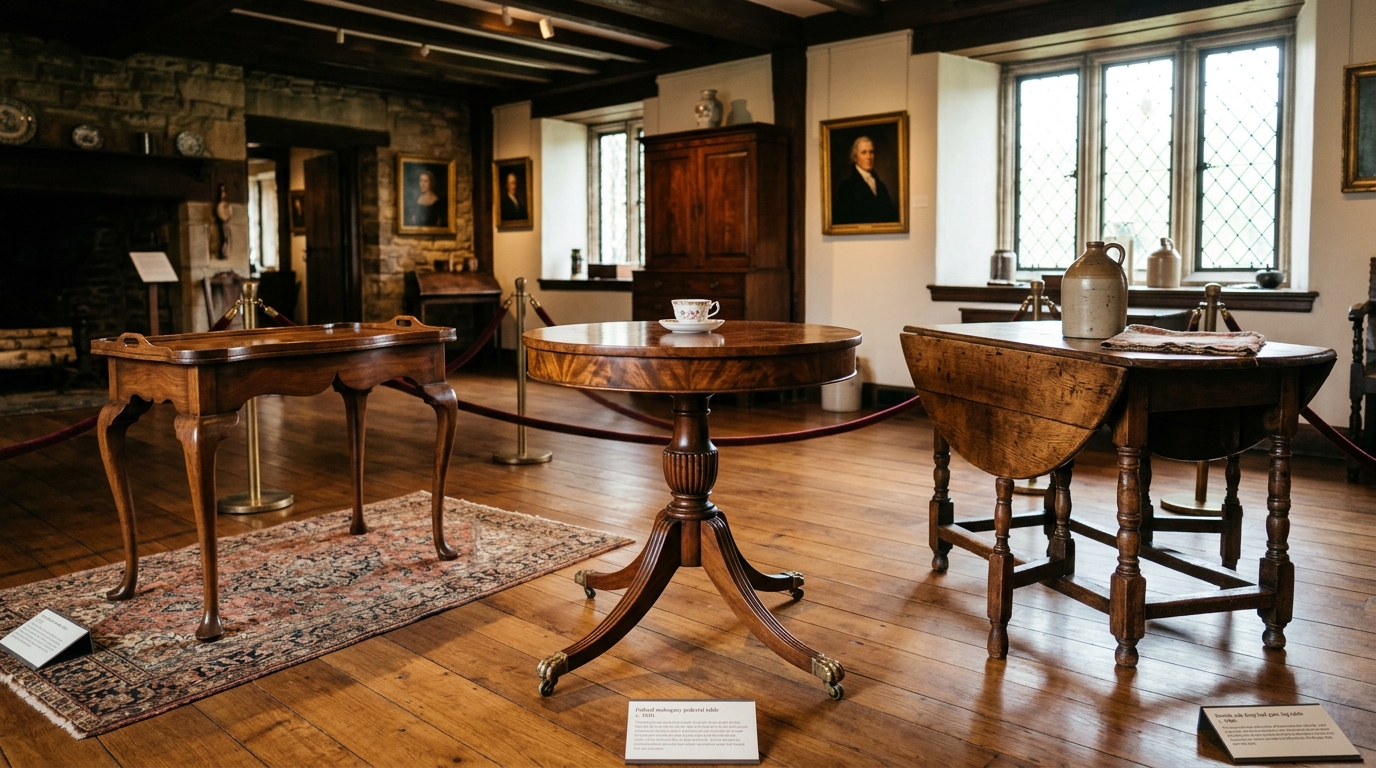 antique gateleg table” class=”wp-image-393″ srcset=”https://antiquetablesco.com/wp-content/uploads/2026/10/antique-table-styles-identification-guide.jpg 1376w, https://antiquetablesco.com/wp-content/uploads/2026/10/antique-table-styles-identification-guide-300×167.jpg 300w, https://antiquetablesco.com/wp-content/uploads/2026/10/antique-table-styles-identification-guide-1024×572.jpg 1024w, https://antiquetablesco.com/wp-content/uploads/2026/10/antique-table-styles-identification-guide-768×429.jpg 768w, https://antiquetablesco.com/wp-content/uploads/2026/10/antique-table-styles-identification-guide-600×335.jpg 600w” sizes=”(max-width: 1376px) 100vw, 1376px” />
Master Comparison Table: Antique Table Eras & Key Features
| Period & Style | Era Dates | Signature Leg / Foot Design | Dominant Woods | Common Table Forms | Typical Value Range |
|---|---|---|---|---|---|
| Queen Anne | 1720 – 1760 | Graceful S-curved cabriole legs; pad, slipper, or trifid feet; scalloped aprons. | Walnut, Cherry, Maple | Tea tables with tray tops, lowboys, gateleg dining tables. | $2,500 – $12,000+ |
| Chippendale | 1760 – 1790 | Sturdy cabriole legs ending in ball-and-claw feet; straight square Marlborough legs. | Cuban Mahogany, Walnut | Pie-crust tilt-top tables, card tables, drop leaf dining tables. | $2,000 – $15,000+ |
| Federal / Hepplewhite | 1790 – 1820 | Slender square tapering legs ending in spade feet; delicate satinwood stringing inlays. | Mahogany, Satinwood, Birch | Pembroke tables with drawers, card tables, multi-part D-end dining suites. | $1,500 – $6,500 |
| Sheraton & Duncan Phyfe | 1795 – 1840 | Round reeded legs, curved saber sweep legs, brass paw casters, lyre harp pedestals. | Santo Domingo Mahogany | Double pedestal dining tables, sofa tables, drop leaf breakfast tables. | $1,000 – $25,000+ |
| American Empire | 1820 – 1845 | Massive heavy pillars, scrolled brackets, animal paw feet; architectural symmetry. | Flame Crotch Mahogany veneer | Center parlor tables, pier tables, drop leaf consoles with thick plinths. | $450 – $2,200 |
| Victorian (Rococo & Eastlake (famous for its Knapp pin-and-cove joinery)) | 1840 – 1900 | Spool turned legs, geometric incised carvings, cast iron/porcelain casters. | Rosewood, Walnut, White Oak | Marble-top parlor tables, country farmhouse drop-leaf tables, library desks. | $200 – $1,200 |
| Mission / Arts & Crafts | 1895 – 1920 | Straight massive square legs, exposed mortise-and-tenon joints, through-tenons. | Quartersawn White (Tiger) Oak | Trestle dining tables, library tables with book racks, round pedestal dining. | $600 – $5,500+ |
In-Depth Breakdown: Major Historical Table Eras
1. Queen Anne Tables (1720–1760): The Era of the Cabriole Leg
Named after the reign of Britain’s Queen Anne, this period marked a dramatic departure from the heavy, rectilinear Jacobean and William & Mary furniture of the 17th century. Queen Anne tables emphasize delicate curved lines, unadorned surfaces, and functional grace.
- The Signature Leg: The seamless S-curved cabriole leg, inspired by Chinese furniture forms, is the primary identifier. In high-style American colonial tables (particularly from Boston, Newport, and Philadelphia), these legs terminate in smooth, rounded pad feet, pointed slipper feet, or webbed trifid feet.
- Signature Table Types: Queen Anne tea tables with tray tops (raised, moulded rims designed to prevent expensive imported tea sets from sliding off) and elegant swing-leg dining tables.
2. Chippendale Tables (1760–1790): Ball-and-Claw Mastery
Inspired by English cabinetmaker Thomas Chippendale’s landmark 1754 design book, The Gentleman and Cabinet-Maker’s Director, Chippendale tables blended Queen Anne curves with dramatic Rococo, Gothic, and Chinese motifs.
- The Ball-and-Claw Foot: The most celebrated feature of American Chippendale tables is the hand-carved ball-and-claw foot—representing a dragon or eagle’s talon gripping a jewel or sphere. Regional carving styles (e.g., Philadelphia’s vigorous muscular talons vs. New York’s squarish claws) allow appraisers to pinpoint a table’s exact colonial workshop.
- Pie-Crust Tilt-Top Tables: A classic Chippendale design featuring a scalloped, carved rim resembling a crimped pie crust, resting on a tripod base with a birdcage mechanism that allows the top to tilt and swivel.
3. Federal & Duncan Phyfe Tables (1790–1840): Neoclassical Symmetry
Following the American Revolution, furniture design shifted toward the Neoclassical ideals of ancient Greece and Rome, popularized by designers George Hepplewhite, Thomas Sheraton, and America’s premier cabinetmaker, Duncan Phyfe.
- Federal / Hepplewhite (1790–1820): Celebrated for slender, straight tapering legs (often ending in spade feet), geometric contrasting string inlays, and elegant drop-leaf Pembroke tables with single drawers.
- Sheraton & Duncan Phyfe (1795–1840): Identified by curved saber legs, hand-carved reeding, solid brass hairy paw feet with rolling casters, and central pedestals carved into classical lyre (harp) shapes. If you believe you have a Federal-style table, be sure to read our detailed guide on how to spot an original Duncan Phyfe table vs. 1940s reproductions.
4. The Drop Leaf & Gateleg Family (1650–1900+)
Drop leaf tables transcend multiple design eras, spanning early English gateleg tables with turned baluster stretchers to versatile 19th-century American farmhouse dining tables. The key to identifying authentic antique examples lies in the hand-milled rule joint along the hinge line and hand-cut iron antique screws underneath. For complete dating markers, inspect our in-depth antique drop leaf table identification and value guide.
5. Victorian Era Tables (1840–1900): Industrialization & Revivals
The Victorian era coincided with the Industrial Revolution, transitioning furniture from hand-tool craftsmanship to mechanized factory production. Major Victorian sub-styles include:
- Rococo Revival (1840–1870): Elaborate naturalistic rose, grape, and floral carvings; dark rosewood and black walnut; white or grey Carrara marble slab tops.
- Eastlake (1870–1890): Named after Charles Eastlake; rejected excessive curves in favor of straight lines, shallow geometric incised carvings (“spoon carving”), and chamfered edges.
- Oak Farmhouse & Kitchen Tables (1880–1900): Sturdy turned spool and trumpet legs, often with circular saw marks on the unexposed undersides and iron or porcelain wheel casters.
6. Arts & Crafts and Mission Tables (1895–1920)
Led by Gustav Stickley, Elbert Hubbard’s Roycrofters, and Charles Limbert, the Arts & Crafts movement rebelled against Victorian mass-produced ornament in favor of honest, handcrafted simplicity.
- Signature Features: Massive rectilinear legs, heavy solid tops, exposed mortise-and-tenon joints with visible wooden through-keys, and dark fumed finishes that highlight the dramatic ray flecks of quartersawn white oak (tiger oak).
🔍 Unsure Which Style Your Table Belongs To?
Many vintage tables blend elements from multiple historical periods (such as 1920s Colonial Revival (such as iconic vintage Mersman tables) or late Victorian Chippendale reproductions). If you need certified identification, period dating, and fair market appraisal for an estate or insurance, professional antique appraisers can verify your table from photos.
Request an Online Antique Appraisal →
(Fast certified results within 48 hours)
How to Determine if Your Antique Table is Authentic
When authenticating any antique table style, check these four forensic checkpoints:
- Tool Marks on Underside Wood: Pre-1840 tables show straight, slightly irregular saw marks from manual pit saws or reciprocating sash saws. Perfectly curved, arced saw lines prove the wood was cut after 1845–1850 using circular saw mills.
- Screws & Hardware: Hand-filed single-slot screws with off-center heads and blunt tips indicate pre-1846 craftsmanship. Sharp-pointed gimlet screws appeared after 1846, while cross-slot (Phillips) screws conclusively date from 1930 onward.
- Natural Wood Shrinkage: Because antique solid wood shrinks across its grain over centuries, authentic circular tabletops will measure 1/4" to 1/2" out-of-round when measured along and across the grain.
- Preserve the Historical Patina: Never strip the original finish of an authentic period table! Stripping away 200 years of aged shellac can destroy up to 80% of its resale value. Read our guide to the best wax for antique mahogany tables to learn how to clean, nourish, and protect historical wood safely. If your table has suffered milky water damage, follow our tutorial on how to remove white heat rings from antique wood without stripping.
Frequently Asked Questions
What is the most valuable antique table style?
Authentic 18th-century American colonial tables from the Queen Anne (1720–1760) and Chippendale (1760–1790) periods—particularly pieces crafted in major cabinetmaking centers like Newport, Philadelphia, or Boston with documented provenance—regularly command between $10,000 and $100,000+ at major auction houses.
What is a pie crust table?
A pie crust table is a classic Chippendale tilt-top tea table characterized by a raised, carved, scalloped outer edge resembling a crimped pastry pie crust. It typically rests on a turned central pedestal with three cabriole legs terminating in ball-and-claw feet.
What is the difference between Federal and Victorian tables?
Federal tables (1790–1820) emphasize lightweight classical symmetry, delicate tapering legs, geometric wood inlays, and understated elegance. Victorian tables (1840–1900) are heavier, more ornate, featuring dark walnut or rosewood, elaborate carvings, turned spool legs, and often heavy marble tops.
How do I know what wood my antique table is made of?
Examine the grain and color in natural light: dark reddish-brown with luminous feathering indicates mahogany; rich chocolate brown with tight grain indicates American black walnut; coarse open grain with golden ray flecks indicates quartersawn white oak; and warm amber-red with dark mineral streaks indicates black cherry (see our guide to telling cherry from mahogany).
Pingback: How to Remove White Heat Rings from Antique Tables (Without Stripping the Finish) - Antique Tables
Pingback: Antique Drop Leaf Table Identification & Value Guide (With Dating Marks) - Antique Tables
Pingback: Duncan Phyfe Table Identification: How to Spot an Original vs 1940s Reproduction - Antique Tables
Pingback: Antique Gateleg Tables: Complete Style, Era & Value Identification Guide - Antique Tables
Pingback: The Best Wax for Antique Mahogany Dining Tables (Preserve Patina Without Build-Up) - Antique Tables
Pingback: The Knapp Joint: How Pin-and-Cove Joinery Dates Antique Furniture (1870–1900) - Antique Tables