
Among all historical furniture investments, the antique drop leaf dining table represents the ultimate convergence of functional domestic engineering and master cabinetmaking virtuosity. Engineered to solve the spatial challenges of colonial and Georgian living, a fine drop leaf table could rest discreetly against a parlor wall as a slender console, yet swing open in moments to seat eight to twelve banquet guests.
Today, the market for antique drop leaf dining tables spans a dramatic valuation spectrum—from humble $250 Victorian family heirlooms to documented $45,000+ Philadelphia Chippendale masterpieces. Whether you are appraising a family inheritance, preparing for an auction bid, or evaluating a purchase, accurately establishing antique drop leaf dining table value requires a forensic understanding of swing-leg mechanics, rule joint integrity, single-plank timber breadth, and structural condition.

Quick Reference: 2026 Antique Drop Leaf Dining Table Valuation Matrix
In the current 2026 decorative arts marketplace, drop leaf dining table values are dictated by historical era, leg design, timber species, and original surface preservation:
| Historical Style & Era | Date Range | Typical Valuation Range (2026) | Distinguishing Features & Authenticity Markers |
|---|---|---|---|
| Chippendale Ball-and-Claw Dining Table | 1755–1785 | $4,500 – $28,000+ | Vigorous hand-carved ball-and-claw feet; single-slab Cuban mahogany; dual swing legs with wooden knuckle hinges; hand-filed blunt screws. |
| Queen Anne Cabriole Pad Foot Dining Table | 1725–1760 | $2,500 – $9,500 | Graceful cabriole legs ending in pad or slipper feet; dense walnut or mahogany; hand-cut rule joints; hand-planed underside tool marks. |
| Jacobean / Country Gateleg Dining Table | 1680–1730 | $1,800 – $6,500 | Barley-twist or baluster-turned legs; dual perimeter box stretchers forming full swinging “gates”; massive oak or walnut framing. |
| Federal / Sheraton Reeded Leg Dining Table | 1790–1820 | $1,400 – $4,800 | Slender cylindrical reeded legs; satinwood or ebony edge stringing; modular banquet D-end clips; Santo Domingo mahogany. |
| Victorian Empire & Extension Dining Table | 1840–1890 | $450 – $1,400 | Heavy turned spool or pedestal base; mechanical telescoping slides for center leaves; dark walnut or quartersawn oak; original casters. |
| 20th-Century Colonial Revival Reproduction | 1920–1960 | $150 – $450 | Thin sliced rotary veneer over composite core; factory machine screws; stamped metal braces; uniform spray lacquer (e.g., Mersman, Tell City). |
1. The Three Primary Drop-Leaf Dining Mechanics Explained
To accurately appraise a dining drop-leaf table, one must first identify its mechanical leaf-support system. While our master guide on antique drop leaf table identification covers all occasional forms, large dining tables rely on three distinct structural designs:
A. The Swing-Leg (Fly Leg) Drop Leaf Table
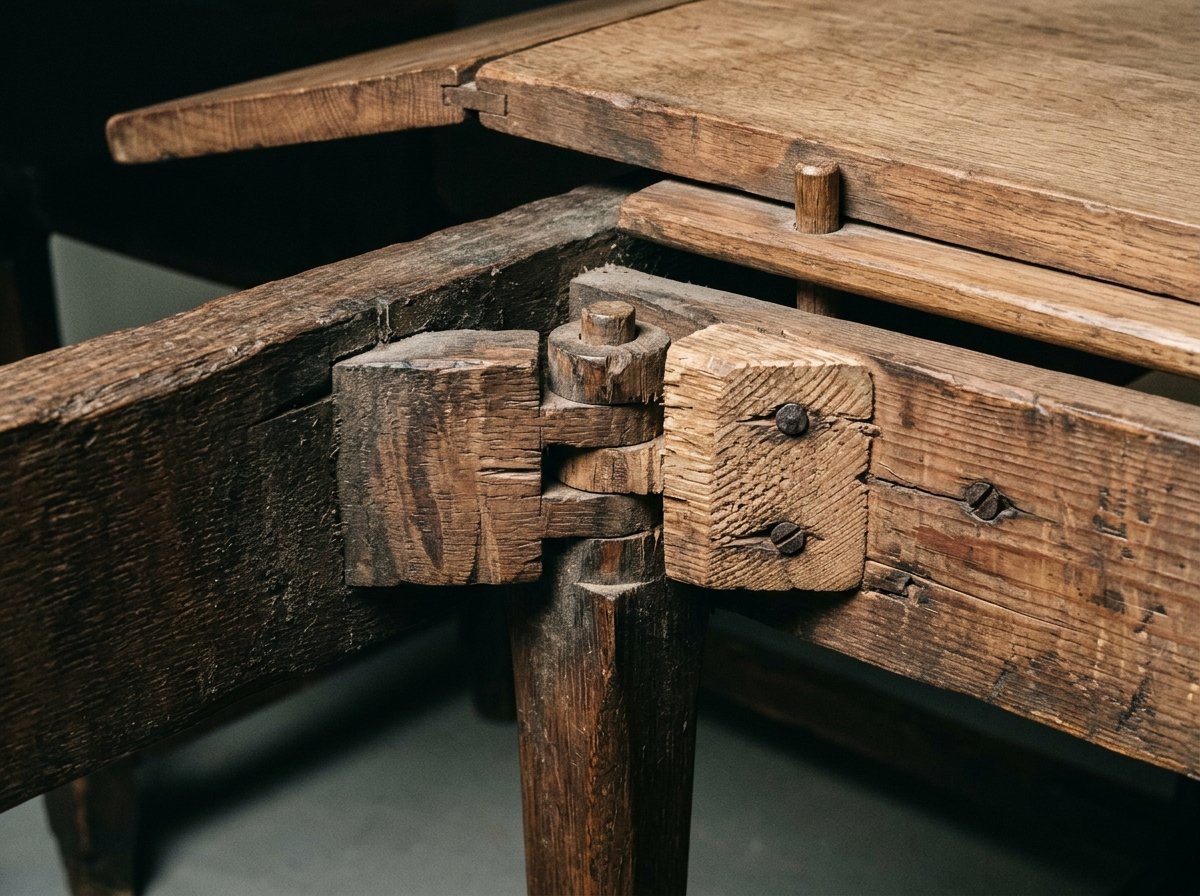
The classic 18th-century solution. A stationary rectangular frame contains four primary legs. To support the heavy drop leaves, an additional fifth and sixth leg (the “swing” or “fly” legs) are hinged directly into the apron rails via interlocking wooden knuckle joints. When closed, the fly legs fold flush against the inner frame. When extended, they swing outward 90 degrees to support the leaf. Because swing legs lack low stretchers, they offer superior knee clearance for dining guests.
B. The Gateleg Dining Table
Originating in the 17th century, antique gateleg tables support their leaves using an entire pivoting sub-frame (the “gate”). The pivoting leg is connected to an upper rail and a lower stretcher, forming a rigid wooden rectangle that swings outward on iron or wooden pivot pins. While gatelegs provide immense structural stability for heavy oak leaves, the low floor stretchers can restrict chair placement and guest legroom.
C. The Telescoping Extension Drop Leaf Table
Developed during the early 19th century, extension drop leaf tables combine hinged perimeter leaves with an interior telescoping accordion mechanism. The central table frame pulls apart on interlocking oak or maple slide runners, allowing one to four auxiliary leaf boards to be inserted in the middle. When fully opened with leaves inserted and drop leaves raised, these tables can expand from a 42-inch compact console to an expansive 10-foot banquet table seating fourteen people.

2. The 5 Physical Benchmarks That Dictate Resale Value
When an antique appraiser examines a drop leaf dining table, they evaluate five specific physical benchmarks that separate high-ticket investment pieces from decorative filler:
1. Rule Joint Integrity & “Butterfly Sag”
The rule joint is the crowning hallmark of 18th-century drop-leaf joinery. It features a convex quarter-round profile on the central table plank that articulates into a concave cove on the drop leaf, concealing the hinge gap whether the leaf is raised or lowered. Test the joint: lift both leaves into the dining position. They must form a perfectly level, continuous plane without dipping or creating a V-shaped “butterfly gap” down the center line. If the leaves sag by more than 1/4 inch, the underlying wooden knuckle hinges or rule joints are worn or broken, reducing value by 30% to 50%.
2. Timber Rarity & Single-Plank Width
In 18th-century cabinetmaking, virgin-growth timber was harvested in colossal dimensions. Premium dining tables feature top planks and drop leaves cut from single solid planks of Cuban mahogany or black walnut measuring 20 to 26 inches wide without longitudinal glue joints. Multi-board pieced tops (where leaves are glued together from three or four narrow strips) represent cheaper country construction or later repairs, commanding 40% to 60% less at auction.
3. Leg Architecture & Foot Carving Virtuosity
The design of the legs accounts for over 60% of a table’s value multiplier:
- Ball-and-Claw Feet: Tables featuring authentic antique claw feet with high-relief knuckle tendons and pierced talons represent the pinnacle of Chippendale cabinetry ($8,000–$35,000+).
- Cabriole Pad Feet: Clean, uncarved S-curved cabriole legs ending in disk or pad feet signify high-style Queen Anne craftsmanship ($2,500–$8,500).
- Turned / Reeded Sheraton Legs: Cylindrical reeded legs denote Federal Neoclassical elegance ($1,400–$4,500).
- Victorian Turned Spool Legs: Factory-turned bulbous legs from the 1870s–1890s are the most common in the secondary market ($350–$950).
4. Hardware Forensics: Cast Brass Hinges & Hand-Cut Screws
Crawl underneath the table and inspect the drop-leaf hinges with a flashlight. Genuine 18th-century hinges are heavy, cast brass with irregular hand-filed bevels and unequal screw hole spacing. Crucially, apply our forensic guide on dating antique furniture by screws: authentic pre-1846 table hinges are held in place by hand-filed blunt screws with off-center slots and flat, point-less tips. Modern replacement hinges or Phillips screws indicate altered hardware.
5. Original Shellac Patina vs. Dipped & Stripped Timber
An untouched 18th- or 19th-century finish displays natural micro-crazing (hairline checking), amber depth, and dark wax accumulation in the rule joint crevices. During the 1970s refinishing craze, thousands of antique dining tables were dipped in caustic lye tanks, which chemically stripped the patina, bleached the wood, and washed out the rich natural oxidation. A table retaining its original surface commands an immediate 80% to 120% valuation premium over a chemically stripped example.
3. Drop Leaf vs. Gateleg vs. Pembroke: Understanding Scale and Function
Many collectors confuse drop leaf dining tables with gateleg and Pembroke tables. Here is how to distinguish them by architectural scale and purpose:
| Table Typology | Standard Fully Extended Length | Primary Function & Placement | Leaf Support Mechanism |
|---|---|---|---|
| Drop Leaf Dining Table | 48″ to 96″+ (Seating 6 to 12) | Primary banquet and family dining room centerpiece. | Independent swing legs (fly legs) pivoting on wooden knuckle joints. |
| Gateleg Dining Table | 42″ to 72″ (Seating 4 to 8) | Country dining, taproom, or multi-purpose living hall. | Dual framed leg gates connected by top and bottom perimeter stretchers. |
| Pembroke Table | 28″ to 40″ (Seating 2 at breakfast) | Bedside, tea service, or parlor breakfast accent table. | Small wooden pivoting fly brackets (flaps); stationary corner legs. |
| Demilune Table | 36″ to 54″ (Semicircular) | Pier console or folding card/game table against walls. | Rear swinging gate leg on knuckle hinge supporting 180° folding top. |
4. Real-World 2026 Auction Pricing & Condition Adjustments
When reviewing auction comps, adjust baseline market values using these standard decorative arts appraisal multipliers:
- Documented Provenance / Cabinetmaker Attribution (+50% to +300%): Tables with documented provenance (e.g., bills of sale, branded stamps, or documented attribution to Townsend-Goddard, Duncan Phyfe, or Benjamin Randolph) transcend decorative value and enter museum-grade territory ($25,000–$75,000+).
- Complete Dining Suite with Original Matching Chairs (+40% to +80%): An 18th-century table accompanied by its original set of matching Queen Anne or Chippendale dining chairs is extraordinarily rare and commands top auction results.
- Cracked or Replaced Leaves (-30% to -60%): If a drop leaf has cracked along the grain and been repaired with metal butterfly keys, or if one leaf is a modern replacement, value drops precipitously.
- Replaced Rule Joint Hinges (-15% to -25%): Replacement modern hinges or stripped screw holes indicate structural repairs.
Frequently Asked Questions About Antique Drop Leaf Dining Tables
How much is an antique drop leaf dining table worth?
In 2026, authentic 18th-century Queen Anne and Chippendale mahogany drop leaf dining tables typically sell between $2,500 and $8,500 at auction. Rare American colonial museum-quality examples with ball-and-claw feet command $15,000 to $45,000+. 19th-century Victorian turned-leg dining tables average $450 to $1,200, while 20th-century reproductions trade between $150 and $450.
What is the difference between a drop leaf, gateleg, and Pembroke dining table?
A drop leaf dining table uses independent pivoting swing legs to support large leaves seating 6 to 10 guests. A gateleg table supports leaves using a framed ‘gate’ of legs connected by upper and lower stretchers. A Pembroke table is a much smaller accent or breakfast table with shallow drop leaves supported by small wooden fly brackets.
How can you tell if an antique drop leaf dining table is real mahogany?
Authentic antique mahogany exhibits open vascular pore lines filled with dark silica, deep reddish-brown oxidation, and remarkable weight (Cuban mahogany averages 45–53 lbs/cu ft). Unfinished undersides remain dark chocolate-red, unlike stained poplar or gumwood substitutes that show pale yellowish-green raw lumber beneath the stain line.
Why do antique drop leaf dining table leaves sag or warp?
Drop leaves sag or warp due to centuries of gravity pulling on unsupported hanging planks, combined with differential moisture absorption. The top finished surface breathes differently than the raw unfinished underside. Sagging also occurs when internal wooden knuckle hinges or rule joints wear down from heavy use.
Final Field Checklist: 5-Point Physical Inspection Before Buying
Before purchasing or insuring an antique drop leaf dining table, perform this 5-point physical inspection:
- Raise Both Leaves and Check Levelness: Extend the table fully. Sight down the length of the table at eye level. Both leaves must form a flat, continuous plane with the center plank. If leaves sag or bow downward, inspect the knuckle hinges and rule joint moldings.
- Inspect the Rule Joints Under Light: Lower the leaves and inspect the mating profiles. Look for chipped quarter-round lips, replaced wood splines, or shaved edges that indicate botched repairs.
- Examine the Underside Swing-Leg Knuckle Joints: Confirm that the swing legs pivot on authentic hand-chiseled wooden knuckle joints with iron or wooden pins, rather than modern stamped metal hinges.
- Audit Screws and Drop Leaf Hinges: Verify that the leaf hinges are cast brass secured with blunt-tipped, hand-filed Georgian screws, rather than modern gimlet-point hardware.
- Measure the Single-Plank Breadth: Measure the width of the top center plank and leaves. Single-plank boards exceeding 20 inches in width without glue seams confirm top-tier virgin-growth timber.
By applying these forensic appraisal standards, you can confidently identify high-value Georgian and colonial drop leaf dining tables—investing in a world-class heirloom that combines historical beauty with everyday dining functionality.