
Antique hunt table identification relies on examining one of the most distinctive sporting and social furniture designs of the 18th century—specifically a monumental horseshoe- or crescent-shaped dining table constructed from dense Cuban mahogany, engineered with an open concave interior well, curved drop leaves, and specialized decanter rails designed for post-hunt revelry. Originating in Georgian Ireland and England (c. 1750–1820) for country estates and foxhunting clubs, authentic period hunt tables (also known as Irish drinking tables or social tables) feature precision-milled curved rule joints, eight to twelve square molded Marlborough or turned tapering gatelegs, and rolling brass-wheeled mahogany decanter carriages designed to circulate vintage port and whiskey across the fireside.
Key Takeaways: Identifying & Valuing Antique Hunt Tables
- The Horseshoe Geometry: An authentic hunt table forms a broad semicircle or horseshoe with a hollow center well. This layout was deliberately engineered so the table could encircle a roaring hearth, allowing seated hunters to warm their chilled limbs while a host or servant operated from the central opening without reaching over seated guests.
- The Decanter Wagon & Brass Rail: High-style Irish hunt tables incorporate an interior brass gallery rail or felted track along the concave inner curve, accompanied by a wheeled mahogany “decanter coaster” (wagon). Guests pushed the coaster effortlessly across the inner perimeter, adhering to the strict Georgian tradition of circulating fortified wine clockwise.
- Dual Dining & Drinking Modes: Many hunt tables feature hinged outer drop leaves and removable center filler leaves. With leaves extended and the center bridged, the horseshoe converts into a monumental banquet table seating 12 to 16 guests; with leaves dropped, it reverts to a streamlined drinking horseshoe.
- Irish Cuban Mahogany Forensics: Authentic 18th-century Irish examples were built almost exclusively from dense, heavy “Spanish” Cuban mahogany (*Swietenia mahagoni*) imported through Cork and Dublin. The wood exhibits intense chocolate-red chatoyancy, hand-adzed underside scallops, and single-slab leaf breadth.
- 2026 Auction Valuation Spectrum: 1920s–1950s Colonial Revival reproduction hunt tables bring $1,200 to $3,500; early 19th-century English Regency examples realize $4,500 to $12,500; while verified 18th-century Irish Georgian mahogany masterworks with documented country estate provenance command $18,000 to $65,000+ at international decorative arts sales.
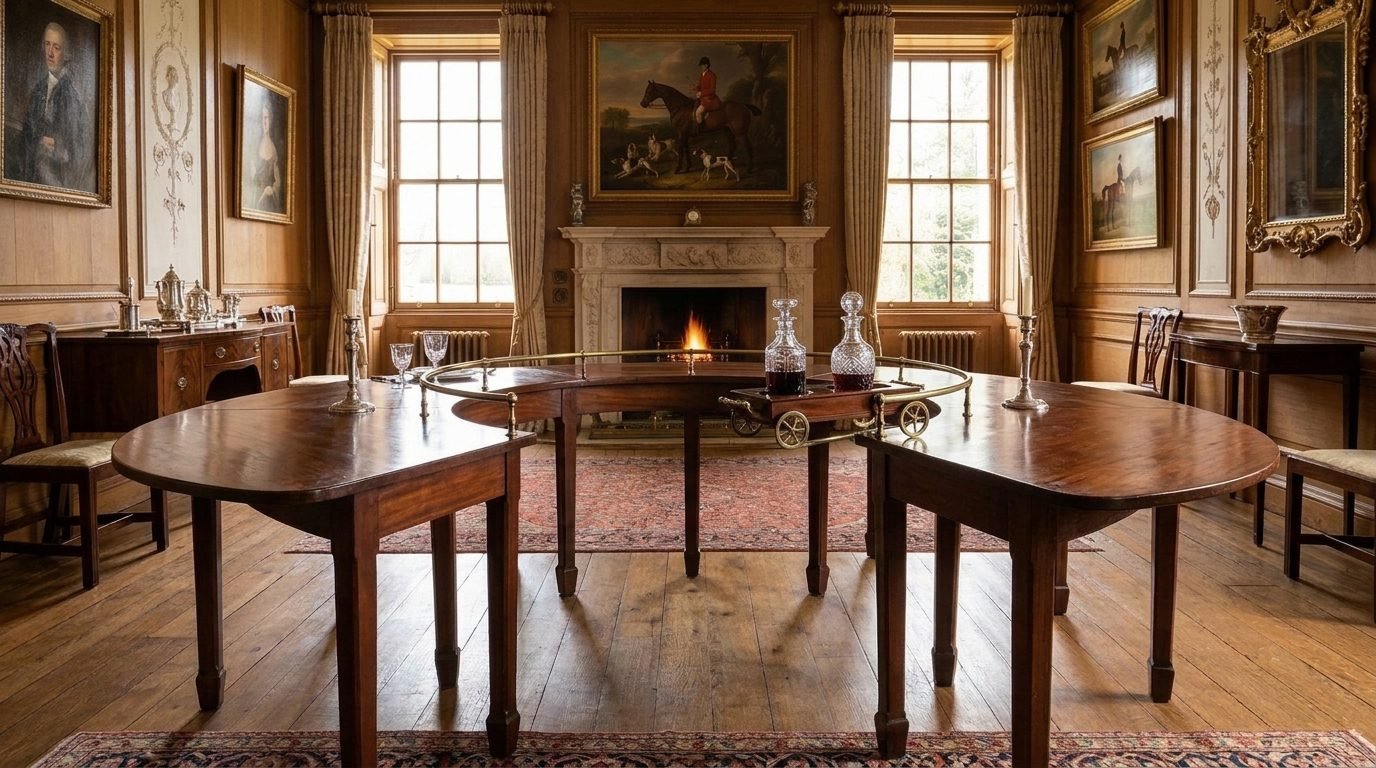
The Historical Origin: Georgian Foxhunting & The Irish Country House
In 18th-century Ireland and Georgian Britain, foxhunting was far more than an aristocratic pastime; it was the central social ritual of the landed gentry. Prominent hunting clubs—such as the Kildare Hunt in Ireland and the Quorn Hunt in Leicestershire—dictated the rhythm of country house life throughout the autumn and winter months. For broader historical context on Georgian dining traditions, consult The Complete Guide to Antique Table Styles.
After spending six to eight rigorous hours in the saddle enduring biting winter rain and leaping stone ditches, hunters returned to the manor hall exhausted, mud-spattered, and freezing. Standard formal dining tables, such as monumental antique refectory dining tables or rectangular banquet suites, were unsuited for post-hunt celebrations: they forced diners away from the open fireplace and created awkward barriers for passing decanters.
Dublin and provincial Irish cabinetmakers solved this architectural challenge by inventing the hunt table (often referenced in historic inventories as a “social table,” “drinking table,” or “horseshoe table”):
- The Hearthside Horseshoe: Built in a curved crescent or horseshoe configuration, the table was rolled directly in front of the cavernous stone fireplace. Every seated guest enjoyed direct, unobstructed radiant heat from the blazing peat or log fire while remaining within intimate conversational distance of every other hunter.
- The Open Service Well: The concave interior opening allowed a host or servant to stand in the center and serve punch, replenish meats, or carve roast game without having to squeeze behind chairs.
- Communal Equality: In a horseshoe table, there was no hierarchical “head of the table.” Every huntsman sat in equal proximity to the hearth and the punch bowl, fostering boisterous camaraderie.

Architectural Anatomy: Leaves, Gatelegs & The Decanter Wagon
An authentic antique hunt table is a masterpiece of complex joinery, requiring sophisticated curved framing and mobile support systems:
1. The Semicircular Top & Curved Rule Joints
The main body of the table consists of a fixed, semicircular or horseshoe mahogany framework. On expandable models, two large drop leaves extend along the outer straight ends. The joint between the central frame and the folding drop leaves is a precision-cut curved rule joint: a continuous convex rounded bullnose profile that interlocks seamlessly with a corresponding concave cove on the leaf. When the drop leaves are raised, the joint creates a continuous, unbroken surface without visible hinge gaps. Compare this with drop-leaf mechanics in our guide to antique drop leaf table identification and values.
2. The Decanter Track & Wheeled Coaster Wagon
The single most celebrated mechanical hallmark of a true high-style Georgian hunt table is its specialized beverage transport system:
- The Inner Brass Gallery: A raised, curved brass gallery rail is mounted along the inner concave lip of the horseshoe, preventing heavy cut-glass decanters from sliding off the edge into the central well.
- The Decanter Wagon: Fitted to this track was a boat-shaped or circular mahogany “decanter coaster” resting on two or three miniature cast-brass casters with bone or brass wheels. Holding two or three cut-crystal decanters of Madeira, Port, or Irish whiskey, the coaster was gently pushed along the inner arc from guest to guest, ensuring that wine flowed continuously clockwise without requiring diners to reach across the table.
- The Suspended Bottle Sling: Some rare 18th-century examples incorporated a net or green baize sling suspended beneath the central opening by brass hooks, used to hold empty bottles, soiled napkins, or corkscrews.
3. Multi-Leg Gateleg Undercarriage Architecture
Because an extended hunt table can measure between 7 and 12 feet across, the undercarriage requires substantial structural support:
- 8 to 12 Supporting Legs: The fixed central crescent rests on six to eight stationary legs, while two to four additional legs are mounted to pivoting wooden gate assemblies that swing outward to support the outer drop leaves. For comparison with standard multi-leg tables, review how to identify antique gateleg tables.
- Leg Styling Evolution: Early Georgian tables (c. 1740–1760) feature round tapering legs terminating in pad or Dutch feet. Mid-Georgian Chippendale-era hunt tables (c. 1760–1785) favor sturdy square Marlborough legs with delicate inner chamfers. Late Georgian and Regency tables (c. 1790–1820) utilize slender vertically reeded or turned legs ending in brass cup casters, similar to those found on fine antique breakfast tables.
5 Forensic Checkpoints: Authenticating an Antique Hunt Table
Because authentic 18th-century Irish hunt tables command premium prices at auction, reproduction tables from the 1920s to 1950s—as well as altered semicircular conference tables—frequently masquerade as period antiques. Use these 5 forensic checkpoints to confirm genuine period construction:
Checkpoint 1: Curved Rule Joints & Drop-Leaf Table Hinges
Inspect the underside of the table along the curved hinge line where the drop leaves meet the center crescent:
- Hand-Mortised Brass Hinges: Authentic 18th-century drop-leaf hinges are heavy, sand-cast brass with irregular file marks on their knuckles and beveled leaf straps. Each hinge is mortised flush into the secondary timber beneath the tabletop. Modern reproductions use stamped steel, zinc die-cast hinges, or bright extruded brass with perfectly machine-beveled screw holes.
- Pre-1846 Fasteners: The screws securing the hinges on period originals must have hand-filed single slots that are slightly off-center, with completely flat, blunt tips (gimlet points were not introduced until 1846). If you encounter Phillips-head screws or modern machine threads, the hardware was replaced or the table is modern. Review diagnostic fastener benchmarks in our guide to dating antique furniture by screws and fasteners.
- Wear Along the Rule Joint: Examine the rule joint bullnose under raking light. Over two centuries of folding and extending, natural friction creates gentle polishing along the mating edges. A joint that is razor-sharp with no micro-rounding or finish softening was cut recently.

Checkpoint 2: Irish Cuban Mahogany Forensics & Underside Tooling
Turn the table over or crawl beneath the frame with a strong inspection light to evaluate the raw timber:
- Dense Cuban Mahogany (*Swietenia mahagoni*): Irish cabinetmakers in Dublin and Cork had direct access to premium Caribbean mahogany through maritime trade. Authentic 18th-century hunt tables were built from solid, dense Santo Domingo or Cuban mahogany planks displaying deep chatoyancy, rich dark chocolate-red tones, and tight vascular pores filled with dark oxidized grain filler. Confirm timber diagnostics with our guide on how to identify real antique Cuban mahogany.
- Hand-Adze Scallop Marks: The unpolished underside of the tabletop boards should exhibit gentle, undulating hand-adze or scrub plane scallops. Modern machine-planed boards are dead-flat or display parallel rotary cutter ripples.
- Pit Saw vs. Circular Saw Kerfs: Examine the apron framing and gateleg bearers: authentic pre-1840 timber exhibits straight, slightly irregular, roughly parallel pit-saw marks. If you detect curved, concentric arc lines, the wood was processed on a mechanized circular saw (post-1840). Learn more in our study of straight saw marks vs. circular saw marks on antique furniture.
Checkpoint 3: The Decanter Track & Inner Well Wear Patina
Carefully scrutinize the inner concave perimeter where the decanter wagon traveled:
- Authentic Friction Grooves: On genuine Georgian tables that saw decades of post-hunt use, the miniature brass or bone wheels of the decanter wagon left subtle, silky-smooth twin track depressions worn into the mahogany surface along the inner curve. These tracks are impossible to replicate convincingly with artificial distressing.
- Brass Patination: The inner brass gallery rail and mounting screws should display soft, dark olive-gold patination, slight oxidation around the screw collars, and minute casting irregularities. Bright, shiny, un-oxidized brass or modern lacquered metal indicates recent replacement.
- Checking for Married Center Planks: Some dealers take semicircular conference tables and cut out a central well to create a fake hunt table. Inspect the inner rim: the grain, finish, and edge molding of the inner well must match the outer perimeter perfectly. Any fresh saw cuts, modern stain stain-bleeding, or mismatched secondary woods beneath the inner lip indicate a composite or altered table.
Checkpoint 4: Gateleg Knuckle Joints & Iron Pivot Pins
Examine the mechanical hinges that allow the swinging gatelegs to pivot:
- Hand-Carved Wooden Knuckles: High-style 18th-century Irish hunt tables utilize interlocking hand-cut wooden knuckle joints to hinge the swing gates to the main frame. The rounded wooden fingers were chiseled by hand, displaying subtle variations in finger width, pinned vertically by an early hand-forged iron rod. Modern reproductions rely on cheap metal butt hinges screwed directly to the frame.
- Natural Leaf Sag & Joint Play: Because the heavy mahogany drop leaves exert tremendous leverage on the gatelegs, 200+ years of usage typically cause the wooden knuckles to wear slightly, resulting in a gentle 1/8- to 1/4-inch downward slope at the outer leaf edge. A table that sits 100% laser-level with zero joint play after two centuries warrants careful verification.
Checkpoint 5: Original Wax Patina vs. Modern Chemical Stripping
Evaluate the finish layer and wear patterns across the tabletop:
- Historic Alcohol Stain Blushing: Hunt tables were subjected to heavy drinking sessions where port, Madeira, and whiskey were spilled frequently. On tables retaining their original 18th-century shellac-and-wax surface, you will observe faint, historic micro-blushing or mellowed spirit halos in the finish.
- Detecting Harsh Refinishing: If a table was stripped with caustic modern chemicals in the 20th century, the dark, rich oxidation inside the open grain pores is stripped away, leaving the Cuban mahogany looking flat, pale orange, or muddy. Check for finish authenticity using our diagnostic checklist on how to tell if antique furniture has been refinished, and preserve genuine surfaces with The Best Wax for Antique Tables.
2026 Valuation Spectrum & Auction Comps
Valuing an antique hunt table depends heavily on geographical origin (Irish pieces commanding a substantial premium over English examples), documented country house provenance, original decanter carriage preservation, timber quality, and the integrity of the rule joints. Here are 2026 auction benchmarks from international sales:
| Style / Origin | Distinguishing Architecture | Primary Timber | 2026 Auction Range |
|---|---|---|---|
| Colonial Revival Reproduction (1920–1950) | Machine-cut rule joints, circular saw marks underneath, modern screws, artificial distressing, lack of decanter track. | Honduran Mahogany, Birch | $1,200 – $3,500 |
| English Regency Hunt Table (c. 1800–1825) | Turned and reeded legs, brass cup casters, fixed crescent shape, drop leaves on brass knuckle hinges. | Cuban Mahogany | $4,500 – $12,500 |
| Irish Georgian Hunt Table (c. 1760–1785) | Ten square chamfered Marlborough legs, wooden knuckle gates, curved rule joints, rich untouched red-amber wax patina. | Dense Spanish Cuban Mahogany | $18,000 – $38,000 |
| Masterpiece Irish Table with Decanter Carriage | Documented Irish country estate provenance, original rolling decanter wagon, brass gallery rail, untouched 18th-century surfaces. | Premium Cuban Mahogany | $35,000 – $65,000+ |
Need Expert Verification for an Antique Horseshoe or Hunt Table?
Because 18th-century Irish hunt tables represent significant financial investments and 20th-century American and English reproductions abound, confirming whether your table is a period Irish Georgian masterpiece or a vintage revival piece requires assessing timber species, hinge screw threading, and underside tool kerfs. To have your table evaluated by accredited antique appraisers with formal written valuation certificates, explore our vetted guide to online antique furniture appraisals.
Frequently Asked Questions: Antique Hunt Tables
What is an antique hunt table used for?
An antique hunt table was originally designed for post-foxhunt celebrations and informal dining in 18th-century Irish and British country houses. Its curved horseshoe geometry allowed guests to sit around a roaring hearth while an open center well enabled the host or servants to serve punch, pass meats, and circulate decanters of port effortlessly without reaching over guests.
Why are so many antique hunt tables Irish?
While hunt tables were used across the British Isles, the form achieved its highest architectural and social refinement in 18th-century Ireland. Irish country gentleman embraced foxhunting passionately, and master cabinetmakers in Dublin and Cork developed the specialized horseshoe format with wheeled decanter wagons to accommodate the lively, egalitarian drinking culture of Irish hunting lodges.
What is a decanter wagon on a hunt table?
A decanter wagon (or coaster carriage) is a specialized mahogany tray resting on small brass caster wheels or felt runners, designed to roll smoothly along an interior brass rail or channel mounted inside the concave well of the hunt table. It held two or three cut-crystal decanters of port, claret, or whiskey, allowing guests to pass wine continuously clockwise along the curve.
How can you tell an authentic 18th-century hunt table from a 1920s reproduction?
Check four specific forensic markers: First, look at the screws securing the drop-leaf hinges: period 18th-century screws have hand-filed, off-center single slots and flat, blunt tips, whereas reproductions use pointed screws or Phillips heads. Second, examine the raw underside: genuine tables exhibit hand-adzed scallops and straight pit-saw kerfs rather than circular saw arcs. Third, evaluate the timber: originals are made of heavy, dense Cuban mahogany with deep chatoyancy, while reproductions use lighter Honduran mahogany or birch. Fourth, inspect the gateleg hinges: period tables utilize hand-carved wooden knuckle joints rather than modern brass butt hinges.
How much is an antique Irish hunt table worth?
In 2026, 20th-century Colonial Revival reproduction hunt tables in good condition generally sell between $1,200 and $3,500. Authentic early 19th-century English Regency hunt tables bring $4,500 to $12,500. Rare, verified 18th-century Irish Georgian Cuban mahogany hunt tables with untouched original surfaces and documented provenance routinely realize between $18,000 and $65,000+ at premier decorative arts auctions.
Pingback: Antique Refectory Dining Table Identification & Value (2026 Guide)
Pingback: Antique Breakfast Table Identification & Value (2026 Guide)
Pingback: Antique Gateleg Table Identification & Value (Jacobean to Victorian)