
Antique refectory dining table identification requires examining early architectural timber joinery—principally massive multi-plank English oak or European walnut tops, pinned mortise-and-tenon breadboard ends, low perimeter foot-rail stretchers, and sculptural leg turnings ranging from monumental Elizabethan “cup-and-cover” bulbous melons (c. 1570–1603) to slender Jacobean balusters and mechanical draw-leaf extension runners. Originating in medieval monasteries where silent brotherhoods dined in communal halls, authentic period refectory tables (c. 1580–1700) display hand-whittled polygonal oak drawbore pegs (treenails) standing 1/16-inch proud due to centuries of radial timber shrinkage, hollowed asymmetrical boot wear along the foot stretchers, and coarse hand-adze ripples beneath the surface boards.
Key Takeaways: Identifying & Valuing Antique Refectory Tables
- The Architectural Definition: A refectory table is a long, narrow communal dining table constructed with a heavy framed base (the “table dormant”), four to six robust turned legs, and a continuous low box or H-pattern stretcher designed to elevate diners’ feet above freezing stone and rush-strewn floors.
- Elizabethan vs. Jacobean Legs: Elizabethan refectory tables (1558–1603) are famed for monumental, swollen “cup-and-cover” melon legs embellished with gadrooning, acanthus leaf carvings, and Ionic capitals. Jacobean examples (1603–1688) transitioned to more restrained turned baluster columns, vase-and-ring turnings, or square section posts.
- Drawbore Peg Protrusion (Proud Treenails): Hand-whittled oak pegs driven through mortise-and-tenon joints stand 1/16 to 1/8 inch above the tabletop and aprons. Because timber shrinks across its width and thickness but never lengthwise, the surrounding planks shrink inward around the stationary peg, leaving the peg head elevated. Modern flat-sanded pegs or flush dowels indicate a modern reproduction.
- The Draw-Top Mechanism: Introduced in Elizabethan England and Renaissance Europe, the “draw-leaf” or “draw-top” table conceals two extension leaves beneath the central tabletop on tapered oak runners. Pulling the leaves outward causes them to automatically ride up angled ramps and drop flush with the central plank.
- 2026 Auction Valuation Spectrum: 1920s Tudor Revival factory oak dining sets realize $650 to $2,200; 19th-century Victorian Gothic Revival refectory tables command $2,500 to $6,800; while authentic 16th- and 17th-century Elizabethan and Jacobean period tables with untouched patina command $12,000 to $55,000+ at premier decorative arts sales.
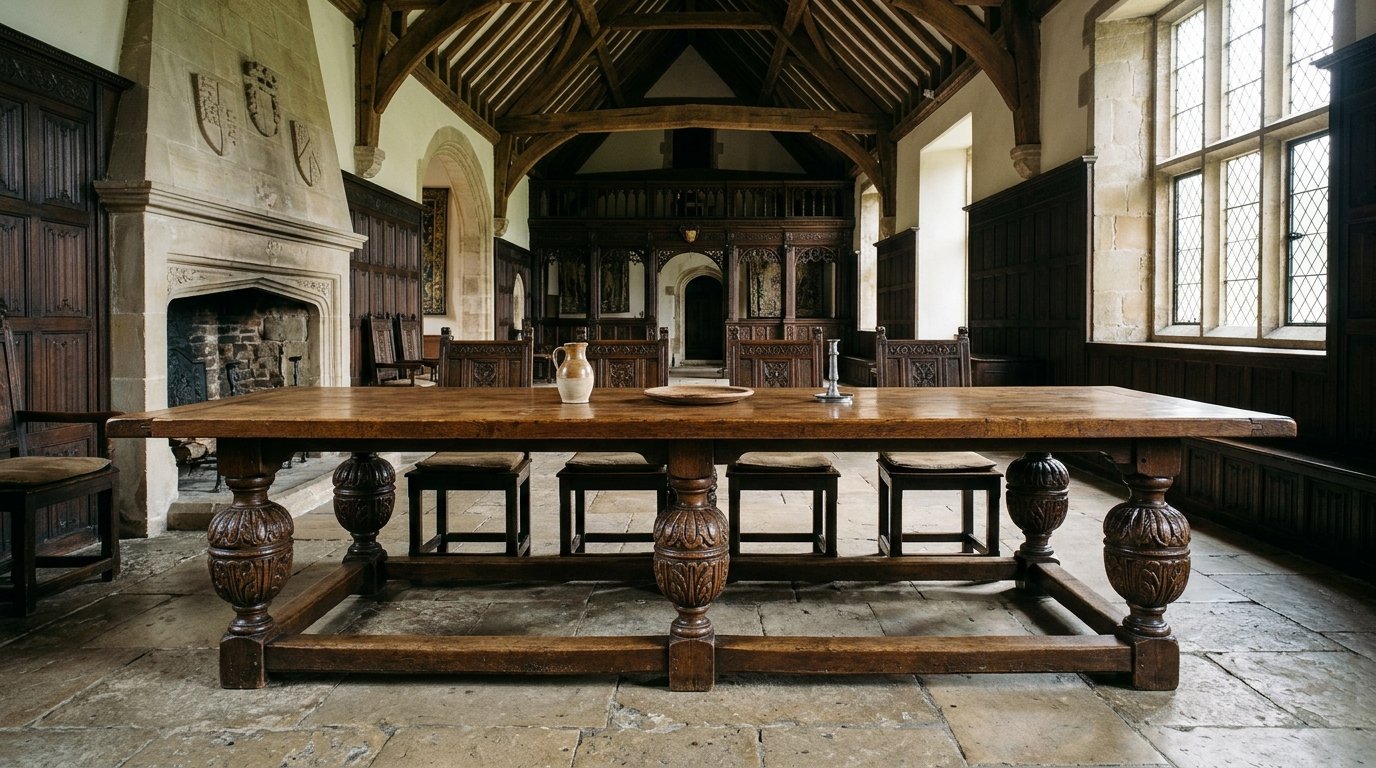
The Historical Evolution: From Monastic Abbey Halls to Baronial Manors
Before the 16th century, dining furniture in Western Europe was ephemeral. In both royal castles and religious abbeys, diners sat at portable “trestle tables” consisting of loose wooden planks laid across folding wooden sawhorses. When the banquet concluded, the boards were cleared and stacked against the stone walls to make room for sleeping or defense—giving birth to the ancient phrase “to clear the board.” For the full structural transition of demountable furniture, consult our collector guide to antique trestle table identification and value (and for specialized sporting banquets, explore antique hunt tables).
The permanent “refectory table” (originally termed a “table dormant” or standing table by Geoffrey Chaucer in The Canterbury Tales) was born inside monastic dining halls—the refectorium. Monks gathered in complete silence to eat communal meals while listening to scripture read from an elevated pulpit. Because diners sat strictly along one side of the long board facing into the hall (the wall side remained open for serving brothers), early monastic tables were exceptionally narrow—often measuring just 24 to 28 inches wide, but extending 12 to 20 feet in length.
Following King Henry VIII’s Dissolution of the Monasteries (1536–1541), monastic estates and their furnishings were seized by the Crown and redistributed to English aristocrats. Secular cabinetmakers quickly adapted the monastic table for the great halls of Tudor and Elizabethan country estates, initiating three centuries of stylistic evolution:
1. The Elizabethan Period: The Age of the “Cup-and-Cover” (c. 1558–1603)
During the golden age of Queen Elizabeth I, English architecture celebrated prosperity, national pride, and exuberance. Refectory tables became monumental status symbols positioned atop the dais of the Great Hall:
- The “Cup-and-Cover” Melon Leg: The defining hallmark of high-style Elizabethan tables is the colossal bulbous leg turning, measuring 8 to 14 inches in diameter. Modeled after contemporary silver and pewter drinking vessels, the lower section forms a rounded gadrooned “cup,” crowned by an inverted fluted “cover,” frequently finished with carved acanthus foliage and Corinthian or Ionic capitals.
- Carved Frieze Aprons: The perimeter rails connecting the legs were deeply gouged with Renaissance arabesques, running scrollwork, gadrooning, and heraldic crests.
- Six-Leg Architecture: Due to lengths often exceeding 10 to 14 feet, massive Elizabethan refectory tables incorporate six or eight monumental legs joined by a continuous low box stretcher resting directly above the flagstone floor. For historical context across early English furniture periods, explore The Complete Guide to Antique Table Styles.
2. Jacobean & Carolean Refectory Tables (c. 1603–1688)
Under King James I and King Charles I, English furniture design transitioned toward Neoclassical discipline and geometric restraint:
- Turned Baluster Columns: The swollen melon legs of the Elizabethan era gave way to elegant turned balusters, ring-and-vase columns, and slender Doric pillars. During the Carolean Restoration (1660–1685), barley-twist (solomonic spiral) legs made their debut.
- Geometric Strapwork: Table aprons featured shallow, repetitive chip-carved motifs, particularly the guilloche (interlocking circular ribbons), overlapping lunettes, and fluted arches.
- Stretcher Configurations: Box stretchers (running along all four sides) were frequently replaced by an “H-stretcher” pattern, which eliminated the center outer rail to grant seated diners greater legroom.

3. The Mechanical Draw-Top Refectory Table (c. 1580–1660)
One of the most brilliant mechanical achievements of Renaissance joinery was the draw-top table (also called the draw-leaf table). Engineered to expand dining capacity without requiring separate loose leaves or leaf storage:
- Stepped Runner Mechanics: The central main tabletop rests unattached or guided by vertical pins directly above two nested extension leaves. Each extension leaf is mounted to two long, tapered wooden runners (bearers) that slide through notches cut into the table’s cross-stretchers.
- Automatic Leveling: As an extension leaf is pulled outward from the end, the tapered profile of the wooden runners lifts the leaf upward. Once pulled fully clear of the central plank, the central board drops down by its own gravity, creating a perfectly continuous, rock-solid dining surface exactly double the original length.
- Zero Metal Hinges: Authentic 17th-century draw-top tables contain zero metal hinges or gears; the entire mechanism operates purely on hand-planed oak friction and gravity.
4. Continental Monastic Refectory Tables: Italian & French Walnut
While English refectory tables were almost universally built from massive native oak, Continental European monasteries and châteaux favored European black walnut (*Juglans regia*):
- Italian Renaissance Fratino Tables: Italian monastery tables (known as tavoli a fratino, or “little brother” tables) favor end trestle standards shaped like lyres or urns, connected by hand-wrought iron diagonal bracing rods (*ferro battuto* or *fiadores*).
- French Monastic Walnut: French 17th-century Louis XIII and Haute Époque refectory tables feature rich, dark chocolate walnut with sculptural openwork scrolled stretchers and vase-turned legs joined with heavy through-tenons.
5. 19th-Century Gothic Revival & 1920s Tudor Revival Reproductions
Because monumental oak refectory tables evoke ancient castle grandeur, they experienced two massive revival movements:
- Victorian Gothic Revival (c. 1840–1885): Championed by architects Augustus Welby Pugin and Charles Eastlake, Victorian Gothic tables celebrate ecclesiastical trefoils, pointed arch tracery, and chamfered edges. They were constructed using modern circular saws and steam-powered shapers, visible as uniform concentric tool marks on unpolished undersides.
- The 1920s Tudor Revival Boom: In the 1920s, American and English suburban homeowners furnished Tudor-style stone and stucco homes with factory-produced oak dining suites. These tables feature stamped “distressed” chain marks, artificially rounded edges, modern wire nails, and synthetic chemical finishes. Compare these with traditional early farm tables in our analysis of antique farmhouse dining tables.
5 Forensic Checkpoints: Authenticating an Antique Refectory Table
Because authentic 16th- and 17th-century refectory tables command tens of thousands of dollars, unscrupulous dealers have married old church timbers to modern bases, artificially distressed 1920s reproductions, or cut down long communal tables into domestic dining sizes. Use these 5 forensic checkpoints to verify original period construction:
Checkpoint 1: Breadboard End Joinery & Protruding Drawbore Pegs (Treenails)
Examine the joint where the end caps (the “breadboard ends”) attach to the long tabletop planks:
- The “Proud Peg” Phenomenon: In authentic 16th- and 17th-century joinery, breadboard ends and frame mortises are secured with hand-whittled, polygonal oak wooden pegs (treenails). Over 300 to 450 years of seasonal humidity cycling, the table boards shrink significantly across their width (tangentially) and thickness (radially), but wood undergoes virtually zero shrinkage along its grain length. Because the peg is inserted through the grain, the surrounding board surface shrinks inward, leaving the peg head protruding approximately 1/16 to 1/8 inch above the surface. Rub your bare palm across the joint: if the peg is dead-flush or sunken, it was either machine-sanded recently or is a modern reproduction. Review complete treenail dating criteria in our guide to how to date antique furniture by wooden pegs and treenails.
- Transverse “Shrinkage Ears”: On original tables, the long tabletop boards shrink across their width, while the breadboard end grain runs perpendicular and does not shrink in length. Consequently, the breadboard end will extend past the edge of the table planks by 1/8 to 3/8 inch on each side, forming distinct protruding “shrinkage ears.”
- Slotted Drawbore Joinery: Master period joiners knew oak would shrink and deliberately cut elongated slots into the tenons of the outer boards, allowing the wood to move seasonally without splitting along the glue lines.

Checkpoint 2: Foot Stretcher Ergonomics & Asymmetrical Boot Wear
Get down onto the floor and inspect the perimeter box stretchers or center H-stretcher:
- The Function of the Stretcher: In medieval and Renaissance halls, floors were made of freezing, damp stone or bare earth covered in straw rushes. The continuous low stretcher of a refectory table was not merely structural; it served as an ergonomic foot rail, allowing seated diners to rest their heavy leather boots off the freezing floor.
- Forensic Foot-Rest Concavities: Over 400 years of communal dining, diners’ boots gently abraded the oak. Authentic wear appears as shallow, asymmetrical, dished hollows along the upper and inner edges of the stretcher rail, centered directly where diners’ heels naturally rested. The wood in these hollows is polished silky-smooth from centuries of friction against woolen socks and leather soles.
- Detecting Artificial Distress: Forgers frequently attempt to replicate foot wear using rasps, wire wheels, or coarse sandpaper. Fake wear is characterized by sharp edge transitions, uniform parallel scratching, or abraded areas in anatomically unnatural spots (such as underneath the rail or tight against the table legs where human feet cannot reach).
Checkpoint 3: Underside Tool Marks & Early Saw Kerfs
Turn the table over or crawl beneath the undercarriage with an angled raking flashlight to inspect the unexposed faces of the tabletop boards and apron rails:
- Hand-Adze Scallop Ripples: The undersides of pre-1750 refectory table planks were leveled using a curved hand-adze or scrub plane. Look for gentle, irregular, hollowed scallops (often 2 to 4 inches wide) across the timber face. Machine-planed modern timber is perfectly flat or marked by microscopic rotary cutter ripples.
- Pit Saw vs. Circular Saw Marks: Before steam-powered lumber mills in the 1840s, heavy oak timbers were ripped by hand using two-man vertical pit saws. Authentic period undersides exhibit straight, slightly irregular, roughly parallel saw kerfs angled at 45 to 80 degrees across the grain. If you detect curved, concentric arc marks, the timber was cut on a mechanized circular saw (post-1840). Review our photographic identification guide comparing straight saw marks vs. circular saw marks on antique furniture.
- Scribing Gauge Marks: Authentic 17th-century joiners scribed knife or awl lines directly into the oak to guide mortise chisel placement. These razor-thin layout lines remain crisply visible extending past the mortise corners.
Checkpoint 4: Leg Architecture, Cup-and-Cover Turnings & Apron Tenons
Carefully examine the sculptural carving and joinery of the four to six table legs:
- Hand-Turned Pole Lathe Nuances: Elizabethan and Jacobean legs were turned on human-powered spring-pole lathes. Because speed was irregular, the profiles of the legs exhibit subtle diameter variations (typically 1/8 to 1/4 inch variance) between individual legs. Modern factory-copied legs are mathematically identical down to the millimeter.
- Chisel-Gouged Gadrooning: On genuine Elizabethan “cup-and-cover” melon legs, the decorative flutes and gadrooned lobes were cut by hand with woodcarving gouges. The termination points of each petal show minute variations in depth and contour, accompanied by micro-faceting inside the concave hollows.
- Through-Tenons & Apron Pinning: The top aprons are connected to the square upper blocks of the legs via deep mortise-and-tenon joints, secured with two or three polygonal oak pins driven from the outside face. In period pieces, the mortise holes were hand-drilled with a spoon auger, resulting in non-circular peg holes that deformed slightly as the wooden treenails were hammered tight.
Checkpoint 5: Timber Forensics, Tannin Oxidation & Historical Wax Patina
Assess the wood species, color depth, and finish layer:
- English Brown Oak (*Quercus robur*): Authentic early English tables were constructed from slow-grown European pedunculate or sessile oak. This timber features tight, dense growth rings and prominent quartersawn medullary ray ribbons (“tiger flecks”). Confirm wood species markers with our guide to how to identify real antique quartersawn oak.
- Natural Tannin Oxidation & Peat Fuming: Oak is naturally packed with tannic acid. Over 300+ years of exposure to wood smoke, airborne coal dust, and domestic animal fats in historic manor halls, the tannins oxidize into an unmistakable deep, rich “nut brown” or warm amber hue with greyish-black undertones in recessed carvings. Modern stains applied to fresh oak appear muddy, flat, or artificially reddish.
- Scrubbed Top vs. Waxed Base: In genuine domestic usage, the tabletop was scrubbed weekly with sand, lye, and water to sanitize it after meals, keeping the top timber lighter and soft-textured with raised winter wood grain. In contrast, the undercarriage and legs were periodically rubbed with beeswax and turpentine, resulting in a dark, luminous, hard-caked antique wax patina. Review proper conservation wax protocols in The Best Wax for Antique Tables, and verify that the finish has not been ruined by modern chemical lacquers using our checklist on how to tell if antique furniture has been refinished.
2026 Valuation Spectrum & Auction Comps
Valuing an antique refectory table requires analyzing period authenticity, timber species, architectural carving caliber, provenance, and the degree of structural modification (such as married tops, replaced stretchers, or cut-down legs). Here are 2026 auction benchmarks from documented decorative arts and English manor sales:
| Style / Era | Distinguishing Architecture | Primary Timber | 2026 Auction Range |
|---|---|---|---|
| 1920s Tudor Revival Dining Table | Factory-turned bulbous legs, stamped artificial distress marks, machine circular saw marks on underside, modern screws. | American Red Oak, Ash | $650 – $2,200 |
| Victorian Gothic Revival (1845–1885) | Ecclesiastical trefoil openwork, chamfered balusters, pegged stretchers, high-grade cabinetmaker joinery. | English Oak, Walnut | $2,500 – $6,800 |
| Continental Monastic Walnut (1650–1750) | Italian or French lyre/urn trestle standards, hand-wrought iron diagonal bracing struts (*fiadores*), rich chocolate patina. | European Walnut (*Juglans*) | $4,500 – $16,500 |
| Jacobean Period Oak Refectory (1603–1660) | Turned column or baluster legs, guilloche-carved frieze, protruding drawbore pegs, natural foot-rest stretcher wear. | English Brown Oak | $8,500 – $28,000 |
| Elizabethan “Cup-and-Cover” Masterpiece (c. 1580–1603) | Six monumental gadrooned melon legs, deep acanthus leaf carvings, untouched 4-board pegged top, museum-documented provenance. | English Brown Oak (*Quercus robur*) | $25,000 – $65,000+ |
Need Expert Verification for an Early Oak or Walnut Table?
Because 17th-century oak timbers are frequently reused by modern restorers to construct composite “married” tables, confirming whether your refectory dining table is an authentic Elizabethan original, a 19th-century Gothic Revival work, or a 1920s Tudor reproduction requires analyzing tool kerfs, treenail drawbore distortion, and timber age. To have your table evaluated by accredited decorative arts appraisers with written valuation certificates, explore our vetted guide to online antique furniture appraisals.
Frequently Asked Questions: Antique Refectory Tables
What is the difference between a refectory table and a trestle table?
While both forms served communal dining in medieval halls, their architectural frames differ fundamentally. A trestle table rests upon two or three separate vertical uprights (trestles) positioned along the center axis, joined by a single central stretcher key-pinned with wooden wedges, allowing the top and supports to be dismantled easily. A refectory table (or table dormant) is a permanently framed structure with four to eight legs positioned at the outer perimeter corners, joined by mortised aprons and low perimeter box stretchers that cannot be knocked down.
Why do antique refectory tables have stretchers so close to the floor?
The low stretchers on early refectory tables served a vital dual purpose: structurally, they braced the heavy legs against the racking stresses of massive multi-plank oak tops. Functionally, in medieval and Elizabethan great halls where floors were cold, damp flagstone or packed earth strewn with dirty straw rushes, the low stretcher served as an elevated foot rail, keeping diners’ leather boots and woolen garments off the freezing ground.
What are “cup-and-cover” legs on an antique table?
“Cup-and-cover” (or bulbous melon) legs are a signature architectural feature of English Elizabethan (c. 1558–1603) and early Jacobean furniture. The massive turning features a bulbous swollen melon shape divided into two distinct sections: a lower gadrooned bowl (the “cup”) and an upper carved dome (the “cover”), crowned by a classical capital. The motif was inspired by contemporary Renaissance silver and pewter covered drinking goblets.
How does an antique draw-top (draw-leaf) table work?
A draw-top refectory table conceals two nested extension leaves directly beneath the center tabletop. Each leaf is fixed to two long, angled wooden runners that slide through slots in the table frame. When a user pulls a leaf outward from the end, the tapered profile of the runners lifts the leaf upward. Once pulled completely clear, the center tabletop drops down by gravity between the two extended leaves, creating an unbroken, level dining surface without requiring separate leaf storage or metal mechanical hinges.
How do I tell if an oak refectory table is 17th century or 1920s Tudor Revival?
Inspect four specific construction indicators: First, look at the wooden pegs (treenails): authentic 17th-century pegs are hand-whittled and stand slightly proud (1/16″) due to cross-grain shrinkage, whereas 1920s pegs are flat, round factory dowels. Second, examine the table underside: early tables display hand-adze scallops and straight pit-saw marks, while 1920s tables have circular saw marks and machine planer ripples. Third, check the foot stretcher: authentic boot wear is asymmetrical and silky-smooth, unlike mechanical rasp or wire-wheel distress. Fourth, check for fasteners: 17th-century tables rely entirely on mortise-and-tenon joints, whereas 1920s reproductions contain modern wire nails, machine-slotted screws, or factory corner glue blocks.
Pingback: Antique Farmhouse Dining Table Identification & Value (2026 Guide)
Pingback: The Complete Guide to Antique Table Styles: Eras, Identification & Values - Antique Tables