
Collector & Appraiser Quick Reference: Nail Dating Chronology
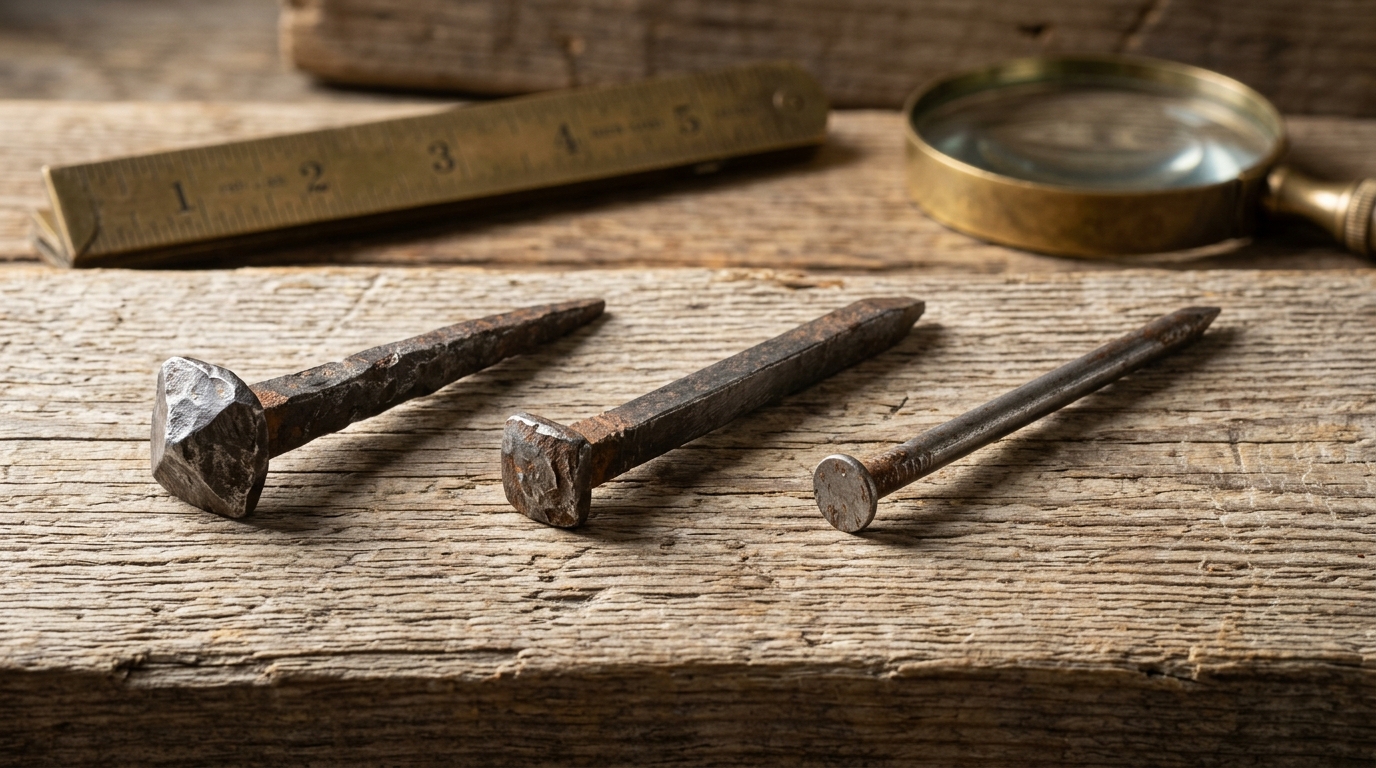
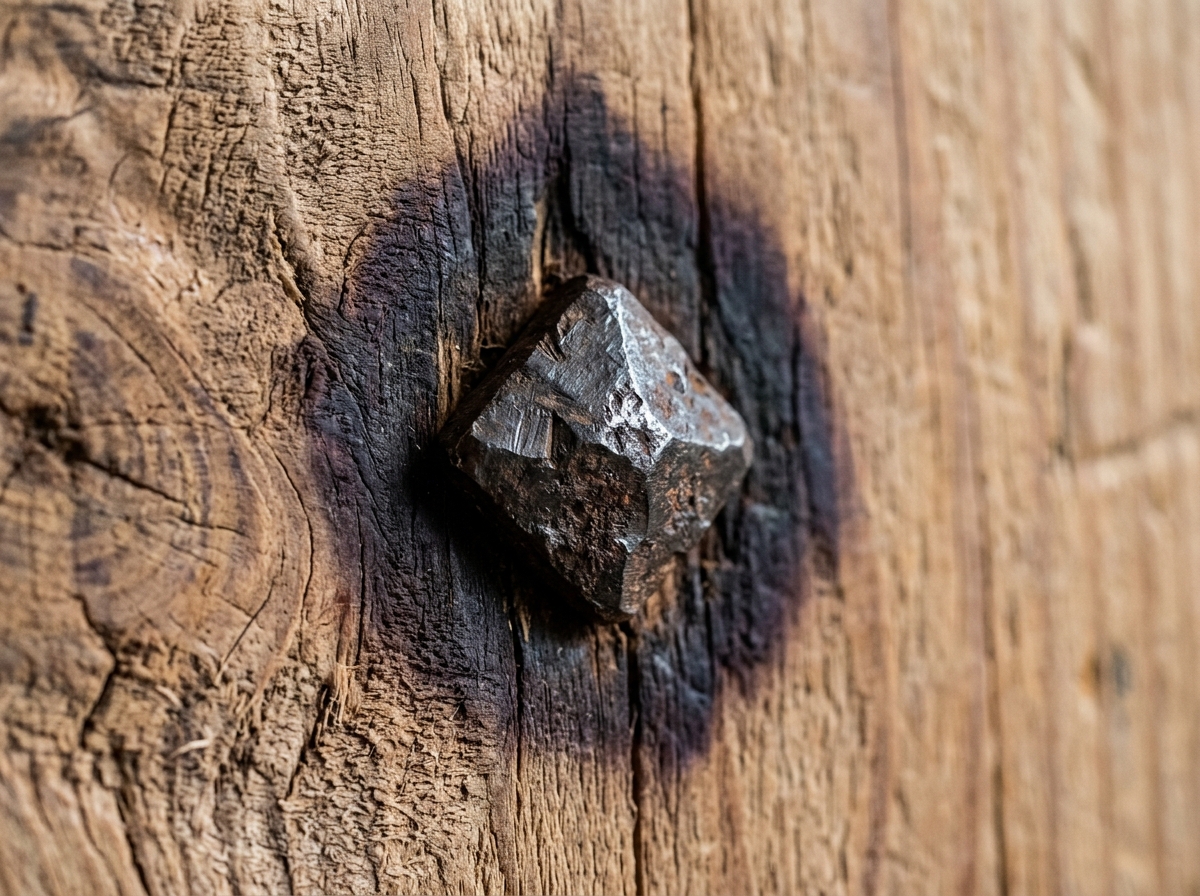
- Pre-1790 (Hand-Forged Wrought Nails): Individual blacksmith-hammered fasteners. Tapered on all four sides of the shank. Heads are multifaceted (the classic four-blow “rosehead”, L-head, or flat T-clout). Always accompanied by a deep, black chemical iron-tannin halo in aged wood fibers.
- 1790–1830s (Early Machine-Cut Nails / Type A): Cut from rolled iron plate using guillotine shears. Two sides of the shank are parallel, while the other two sides taper to a blunt point. Heads were still hammer-struck by hand or early mechanical headers, leaving irregular burrs on diagonally opposite corners.
- 1830s–1880s (Mature Machine-Cut Nails / Type B): Entirely machine-cut and machine-headed in a single automated stroke. Uniform rectangular cross-section, sharp rectangular head, and consistent mechanical thickness. Universal in Victorian, Empire, and Eastlake furniture.
- 1880s/1890s+ (Modern Drawn Wire Nails): Extruded from continuous steel wire coils. Perfectly round cylindrical shank, circular stamped head with crosshatch gripping marks, and diamond point. If original to primary carcase construction, the piece was manufactured after 1885–1890.
- Key Inspection Hotspots: Table drawer bottom grooves, backboards, perimeter corner glue blocks, and underside apron cleats.
When examining a fine piece of antique furniture, pristine show surfaces can deceive you. Finishes can be reapplied, wood can be aged with potassium dichromate, and maker labels can be forged. But deep within the structural anatomy of an antique table or carcase, the humble iron nail tells an unvarnished metallurgical truth. Learning how to date antique furniture by nails provides appraisers and collectors with an airtight chronological timeline spanning over two centuries of industrial evolution.
Together with our companion guides on dating antique furniture by screws and hardware and reading straight saw marks vs circular saw marks, nail forensics forms the foundational “holy trinity” of non-destructive antique authentication. Whether you are inspecting an 18th-century antique drop-leaf table or verifying the authenticity of an antique tilt-top tea table, this definitive guide details the metallurgy, tooling scars, and chemical halos that separate authentic colonial relics from Victorian reproductions and modern fakes.
1. The Chemistry of the “Iron-Tannin Halo”: The Marker Counterfeiters Cannot Fake
Before analyzing nail shanks and head shapes, an appraiser looks for the presence of the iron-tannin halo.
All wood contains naturally occurring organic polyphenols called tannic acids (concentrations are especially high in antique white oak, chestnut, walnut, and antique yellow pine). When iron is driven into wood, moisture and atmospheric oxygen trigger a slow, centuries-long chemical reaction:
$$ ext{Iron (Fe)} + ext{Tannic Acid} + ext{Atmospheric Moisture} longrightarrow ext{Ferric Tannate (Insoluble Black Pigment)}$$
Over 100 to 250 years, this chemical reaction creates a permanent, deep blue-black or purple-black discoloration that migrates radially outward from the nail shaft along the longitudinal wood capillary fibers.
- Genuine Century-Old Halos: The black ferric tannate penetrates deep into the cellular lumen of the wood. Even if the nail is gently extracted or the wood surface is lightly scraped, the black ring remains permanently embedded in the cellular structure.
- The Modern Fake (Chemical Aging): Counterfeiters often soak modern or reproduction nails in muriatic acid or vinegar to create surface rust, then drive them into new wood. While this creates surface orange rust, it creates zero deep black cellular tannin penetration. The wood around modern fake nails remains bright and unstained beneath the surface crust.
2. Pre-1790: Hand-Forged Wrought Nails (Rosehead, Clasp & Clout)
Prior to the 1790s, every single nail utilized in American, British, and continental European furniture was produced individually by hand at a blacksmith’s forge or in a dedicated “nailery” (such as the historic nailery operated by Thomas Jefferson at Monticello).
Blacksmiths heated rectangular square iron rods (called nail rod) in a coal forge. With a series of rapid hammer blows on an anvil, the smith tapered the end on all four sides to a sharp point, cut the shank to length over a hardie tool, slipped the hot nail into a specialized swage tool (a nail header), and struck the protruding hot metal several times to forge the head.
Diagnostic Characteristics of Hand-Forged Wrought Nails:
- Four-Sided Taper: The shank tapers continuously from the head down to the point on all four sides. Under magnification, you will see subtle hammer flat marks and slight irregularities along the shank length.
- The “Rosehead” Crown: The most prized collector fastener. Formed by striking the hot iron head with four distinct downward glancing hammer blows, leaving a faceted, pyramidal dome resembling the petals of a stylized rose.
- The “Clasp” or “T-Head”: For fine interior cabinetwork where the head needed to be driven flush or countersunk, blacksmiths struck the head on two opposing sides, creating a narrow spatula-like head that aligned with the wood grain without splitting the plank.
- Fibrous Wrought Metallurgy: True 18th-century wrought iron contains microscopic strands of silicate glass slag. If an extracted nail is broken or heavily rusted, it fractures with a fibrous, woody grain texture rather than snapping cleanly like cast or mild steel.
- Furniture Eras: Universal in William & Mary, Queen Anne, Chippendale, and Early American Federal cabinetry, dining tables, corner cupboards, and chests made prior to 1790.
3. 1790–1830s: Early Machine-Cut Nails (Type A Cut Nails)
The late 18th century witnessed an explosive industrial race in the young United States to mechanize nail production. Because hand-wrought nails were expensive and labor-intensive, American inventors—notably Jeremiah Wilkinson of Rhode Island (1777), Ezekiel Reed of Massachusetts (1786), and Jacob Perkins of Massachusetts (patented 1795)—developed guillotine-style shearing machines.
In these early cut nail machines, sheets of rolled iron plate (rolled to the desired nail thickness) were fed into a reciprocating guillotine blade. The plate was mechanically flipped over 180 degrees after every stroke, producing tapered triangular wedge blanks with minimal scrap metal.
Diagnostic Fingerprints of Type A Cut Nails (1790–1830s):
- Two Parallel Sides, Two Tapered Sides: Unlike wrought nails that taper on all four faces, cut nails have two strictly parallel sides (determined by the uniform thickness of the iron sheet) and two opposing tapered sides (created by the shear angle).
- Hand-Hammered or Crude Stamped Heads: Early machines could only shear the shank blanks; workers still had to place each blank into a foot-vise and hand-hammer the head with one or two blows. As a result, Type A heads are often off-center, irregular, or roughly flattened.
- Opposing Shear Burrs: The guillotine shearing action produced distinct cutting burrs along diagonally opposite edges of the shank.
- Furniture Associations: High Federal, Sheraton, and Classical Empire furniture crafted between 1795 and 1830.
4. 1830s–1880s: Mature Machine-Cut Nails (Type B Cut Nails)
By the 1830s, American machinery achieved total automation. Advanced cutting machines sheared the blank from plate iron and instantly engaged a mechanical hammer die that upset the top of the shank to form a crisp, uniform head in a single stroke.
Diagnostic Fingerprints of Type B Cut Nails (1830s–1880s):
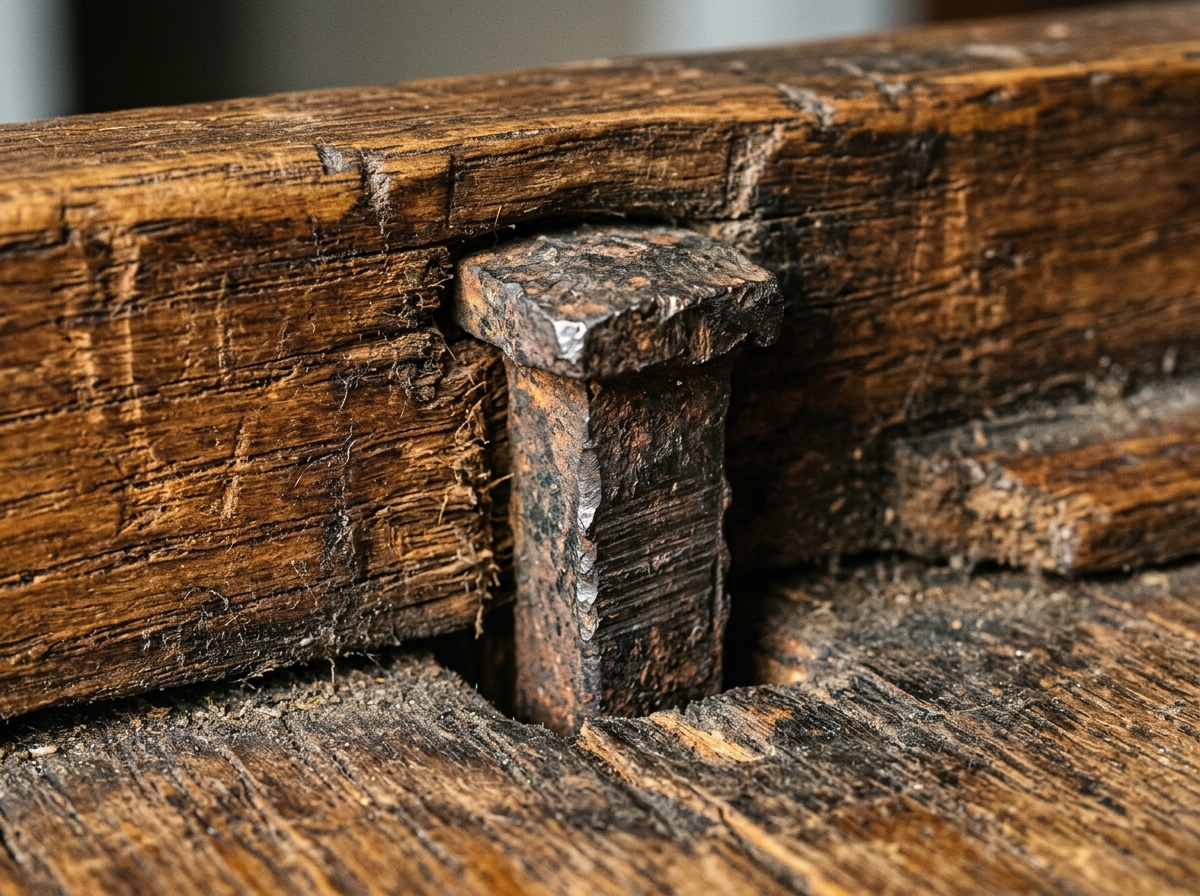
- Crisp Rectangular Head: The heads are mechanically centered, symmetrical, and rectangular or T-shaped.
- Blunt Chisel Tip: Cut nails terminate in a flat, blunt chisel edge rather than a sharp point. When driven correctly with the blunt edge perpendicular to the wood grain, cut nails shear the wood fibers rather than wedging them apart, dramatically reducing the risk of splitting.
- Shear Lines on the Same Side: Because 1830s rolling technology improved, the grain of the iron plate ran parallel to the shank, resulting in cutting striations on the two opposing sheared faces.
- Victorian Furniture Standardization: Found on virtually all Mid-Victorian Rococo Revival, Gothic Revival, Renaissance Revival, and Eastlake furniture. They frequently appear alongside machine-made screws and the distinctive pin-and-cove joint (detailed in our guide to identifying the Knapp joint).
5. 1880s to Present: The Drawn Wire Nail Revolution
The introduction of the modern wire nail marks the definitive dividing line between 19th-century hand-crafted or mechanized timber joinery and 20th-century mass-produced industrial furniture.
Wire nails were manufactured by extruding molten mild steel through circular dies into continuous coils of round wire. Automated machines pulled the wire, cut it with diagonal pinching cutters to form a sharp four-sided diamond point, and stamped the blunt end to create a flat, circular head with small raised gripping serrations.
The 1885–1890 Chronological Benchmark:
- Round Cylindrical Shank: Modern wire nails have a perfectly smooth, circular cross-section. If you view the head or shaft, there are zero flat planes, hammer facets, or sheared edges.
- Market Tipping Point: In 1880, wire nails accounted for less than 2% of American nail production. By 1892, wire nails surpassed cut nails in total production. By 1900, wire nails accounted for over 90% of the entire global fastener market.
- The Golden Rule of Authentication: If an antique dealer claims a dining table was made in 1780 or 1830, but the original structural cleats or backboards are attached with original round wire nails, the claim is impossible. The furniture was either constructed after ~1890, or the fasteners represent a modern repair.
6. Master Antique Nail Dating Matrix
Use this forensic comparison table during auction inspections, flea market visits, and appraisal evaluations:
| Nail Classification | Historical Era | Shank Geometry | Head Formation | Metallurgical Grain |
|---|---|---|---|---|
| Hand-Forged Wrought Nail | Pre-1790 (Colonial to 1790) | Square to rectangular; tapers on all 4 faces to a hand-hammered point | 4-facet “rosehead”, flat clout, or L-head; hand-hammered irregularities | Fibrous wrought iron with silicate slag; dark black tannin halos |
| Early Cut Nail (Type A) | c. 1790–1830s (Transitional) | 2 parallel sheared sides; 2 opposing tapered sides; blunt chisel tip | Hand-struck or early mechanical head; off-center or rough burrs | Cross-grained rolled iron sheet; dark tannin halos in aged timber |
| Mature Cut Nail (Type B) | c. 1830s–1880s (Peak Victorian) | Strictly uniform rectangular cross-section; blunt sheared tip | Crisp, machine-upset rectangular or square head; symmetrical | Longitudinal-grained rolled iron plate; moderate dark oxidation |
| Modern Drawn Wire Nail | c. 1885/1890 to Present | Perfect cylindrical round shank; sharp 4-facet diamond point | Circular stamped head with raised crosshatch grid or smooth circle | Mild drawn steel wire; surface red/orange rust with no deep black halo |
7. Where to Look: 5 Hidden Locations on Antique Tables
In fine antique tables, primary joints—such as leg-to-apron connections—were joined with mortise-and-tenon joints secured by wooden pegs (tunnels). However, cabinetmakers relied extensively on nails for secondary structural elements:
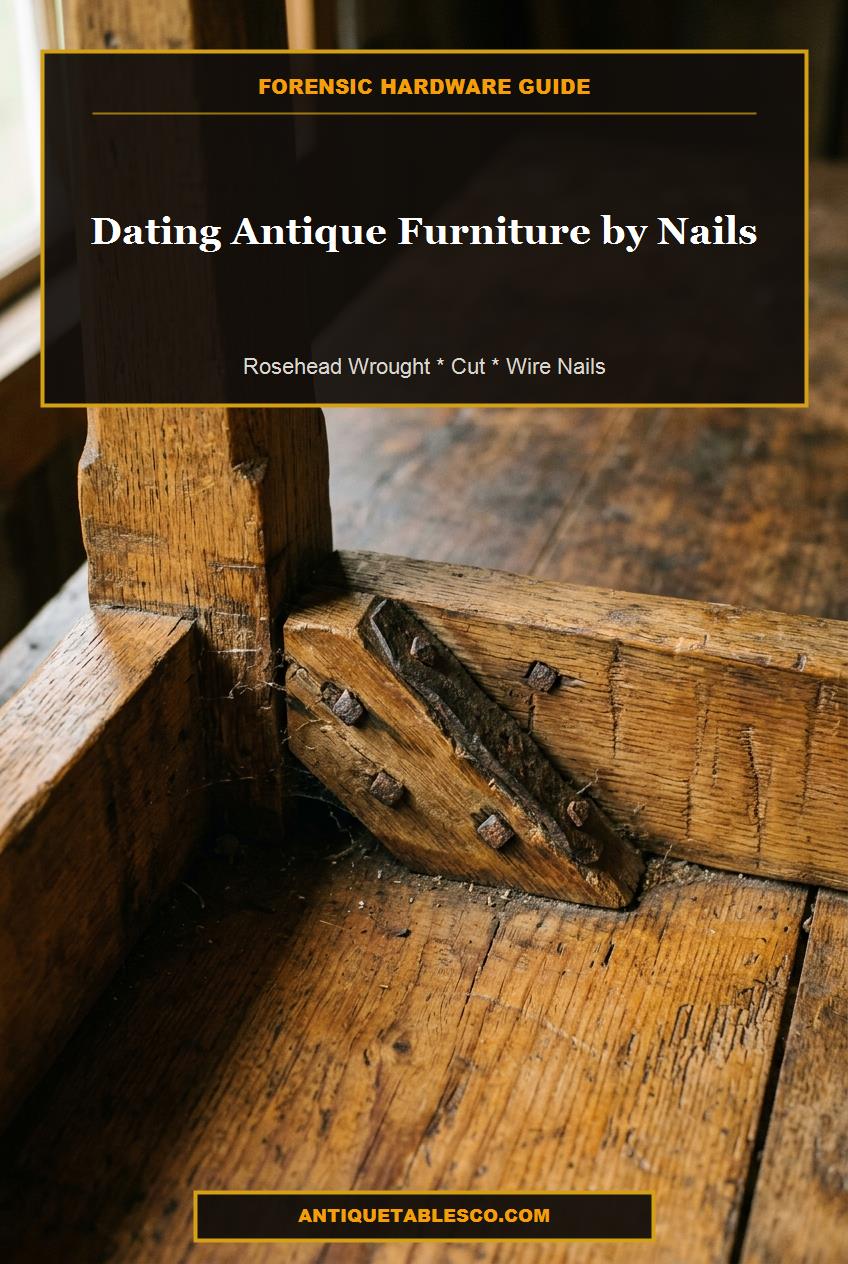
- Underside Corner Glue Blocks & Angle Braces: Look under the four corners of a table apron. The triangular or rectangular blocking blocks that reinforce the leg-to-skirt joint were routinely tacked in place with nails while animal hide glue dried.
- Drawer Bottom Runners & Kickers: In tables with drawers (such as pembroke, drop-leaf, and library tables), pull the drawer out and examine the interior carcase. The wooden guide strips and stops along the frame sides are typically nailed into place.
- Underside Tabletop Battens & Cleats: Wide solid wood tabletops (as explored in our solid wood vs veneer guide) expand and contract across their width. Craftsmen installed underside transverse battens or sliding pocket cleats secured with nails or screws to prevent warping.
- Drop-Leaf Rule Joint Hinge Areas: On drop-leaf and gateleg tables, examine the iron or brass butt hinges. While screws were standard, early craftsmen frequently supplemented hinge flaps with stabilizing wrought or cut nails.
- Carcase Backboards and Bottom Dust Boards: The large secondary softwood backboards of enclosed tables or console cabinets were nailed to the rabbeted frame edges.
8. Forensic Traps: How to Avoid Misdating
Trap #1: The Modern “Restoration Cut Nail”
Do not assume every square cut nail was made in the 19th century! Companies like the historic Tremont Nail Company (founded in 1819 in Wareham, Massachusetts) still manufacture authentic steel cut nails today for historic home restoration and reproduction cabinetmaking. To distinguish authentic 19th-century cut nails from modern reproductions, look at the head thickness, edge burrs, and the presence of genuine black iron-tannin halos deep inside the wood fibers.
Trap #2: Secondary Repair Fasteners
Finding a modern round wire nail in an antique table does not automatically mean the entire table is a fake! Tables suffer immense physical stress over two centuries. A loose corner block or detached drawer runner was often re-secured by an owner in 1930 with whatever hardware was in their toolbox. Look closely at the fastener site: is the wire nail driven into an older, oversized, black-stained nail hole? If yes, it represents a later maintenance repair on an authentic older piece.
Save This Antique Nail Dating Field Guide on Pinterest
Pin our forensic fastener comparison guide to your antique furniture identification board for instant access at auctions, estate sales, and antique malls.
Frequently Asked Questions About Antique Furniture Nails
What year did they stop using square cut nails in furniture?
Square machine-cut nails were largely phased out of mainstream furniture manufacturing between 1885 and 1895 as cheap, mass-produced round wire nails took over the industrial market. While cut nails continued to be produced for masonry, flooring, and specialized boat building, their appearance as original construction hardware in American furniture virtually ceased by 1890–1900.
What is a rosehead nail on antique furniture?
A rosehead nail is a hand-forged wrought iron nail dating prior to 1790. Its name derives from its multifaceted pyramidal head, formed by a blacksmith striking the red-hot iron four times in a swage block. The resulting faceted crown resembles the stylized petals of a rose. Rosehead nails taper on all four sides of the shank and are hallmarks of authentic 18th-century colonial craftsmanship.
Can you tell the age of furniture just by square nails?
Square nails provide a reliable date bracket between approximately 1790 and 1885. Early cut nails (1790–1830s) have machine-sheared shanks with irregular hand-hammered heads and opposing burrs. Mature cut nails (1830s–1880s) have completely machine-stamped rectangular heads. To confirm the piece’s age, always cross-reference square nails with other forensic clues such as saw marks, wood plane patterns, and screws.
Why does wood turn black around old antique nails?
The black discoloration around antique nails is caused by a chemical reaction between iron oxide and naturally occurring tannic acid in the wood, producing insoluble ferric tannate. This “iron-tannin halo” takes decades to centuries to migrate deeply through wood capillaries, serving as a reliable biological indicator of authentic age that cannot be faked with superficial chemical stains.
What does it mean if an antique table has round wire nails?
If round wire nails appear as the original primary fasteners throughout the table’s carcase, the piece was manufactured after 1885–1890. However, if an authentic 18th- or early 19th-century table contains an isolated round wire nail, inspect the area closely; it almost always indicates a later repair where a loose leg brace, batten, or drawer rail was reinforced in the 20th century.
Explore More Forensic Antique Identification Guides
Expand your authentication toolkit with our comprehensive woodworking forensics series:
- How to Date Antique Furniture by Screws & Hardware: Hand-filed blunt tips vs machine-pointed gimlet screws.
- Straight Saw Marks vs Circular Saw Marks on Antique Furniture: Pit saws, sash mills, and circular arcs.
- The Knapp Joint (1867–1900): Deciphering the pin-and-cove joint on late Victorian furniture.
- Solid Wood vs Veneer: How to Tell on Antique Furniture: The end-grain test and historic veneer thickness.
- Complete Guide to Antique Table Styles: From Jacobean and Queen Anne to Chippendale and Victorian.
Pingback: Dating Antique Furniture by Screws & Hardware: The Forensic Collector’s Guide - Antique Tables
Pingback: Antique Drop Leaf Table Identification & Value Guide (With Dating Marks) - Antique Tables