
Collector & Appraiser Quick Reference: Saw Mark Dating Chronology
- Pre-1800 (Hand Pit Saw / Whip Saw): Straight, non-uniform, slightly angled parallel kerfs. Varying depth, irregular tooth spacing, and human hesitation gouges. Found on colonial Queen Anne, Chippendale, and early Federal pieces.
- c. 1800–1840s (Water-Powered Up-and-Down Sash / Muley Saw): Straight, strictly parallel, evenly spaced vertical kerfs (~1/8″ to 1/4″ apart). Consistent mechanical cadence with straight lines perpendicular or slightly tilted across the plank.
- c. 1840s–1880s (Steam-Powered Circular Saw): Distinct sweeping curved arcs (radial semicircles). Kerfs cut in circular curves corresponding to 36″–60″ rotating mill blades. If a board has circular saw marks, the timber was converted after ~1845.
- 1880s+ (Continuous Band Saw & Rotary Planers): Very fine, closely spaced parallel straight striations (~1/32″ or less), or completely smooth boards with rotary planer scallop waves. Standard in Victorian Golden Oak, factory Colonial Revival, and Arts & Crafts furniture.
- Best Inspection Locations: Underside of tabletop leaves, interior surfaces of table aprons, drawer bottoms, and carcase backboards.
When an antique appraiser slides their hand beneath a 200-year-old dining table, they are not merely checking for dust or maker stencils. They are searching for the physical signature of the blade that converted the raw tree trunk into lumber. Among all woodworking authentication techniques, the battle between straight saw marks vs circular saw marks on antique furniture represents the single most reliable, non-destructive chronological dividing line in American and European furniture history.
Cabinetmakers spent hours planing, scraping, and French polishing the show surfaces of fine antique tables. But in the hidden recesses—beneath the leaves of an antique drop-leaf table, inside the perimeter apron of a dining table, or across the underside of an antique tilt-top tea table—they left the secondary timber in its raw, rough-sawn state. By learning to decode the direction, geometry, spacing, and depth of these “kerf marks,” you can immediately distinguish an authentic 18th-century masterpiece from a mid-19th-century Victorian factory build or a clever 20th-century reproduction.
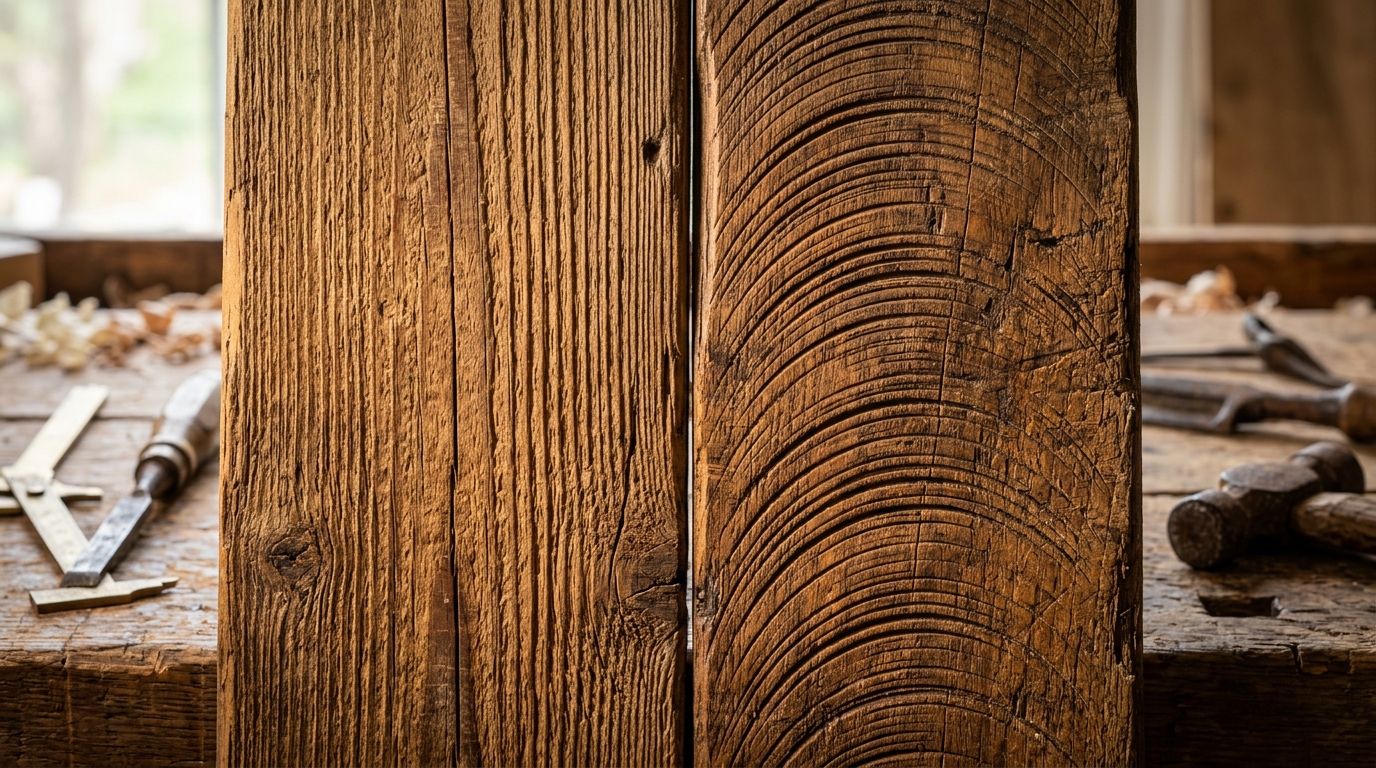
1. The Physics of the Kerf: Why Saw Marks Don’t Lie
In historical woodworking terminology, a kerf refers to the slot, channel, and tooth score marks left behind in the timber by a saw blade. Every saw design generates a distinct kinetic footprint based on how its blade interacts with the wood fibers:
- Reciprocating Motion (Pit & Sash Saws): The blade moves back and forth in a straight line along a single plane. As the log advances forward into the vertical stroke, the teeth bite into the timber at a fixed angle, leaving straight, parallel linear kerfs.
- Rotary Motion (Circular Saws): The blade spins on a central arbor at high speed. As the carriage feeds the log through the spinning disc, the teeth cut along a continuous arc, leaving curved, radial semicircular scores across the timber face.
- Continuous Loop Motion (Band Saws): A continuous flexible steel ribbon loops around two rotating wheels. The blade travels in a single direction down through the wood at immense speed, leaving ultra-fine, tightly spaced straight lines that are nearly imperceptible to the naked eye.
Unlike hardware which can be replaced, or finishes which can be stripped and reapplied (as discussed in our guide on how to remove white heat rings without stripping), the rough saw marks on original structural timber represent the foundational birth certificate of the lumber itself.
2. Pre-1800: The Hand Pit Saw & Whip Saw (Irregular Straight Kerfs)
Prior to the widespread availability of water-powered sawmills in colonial America and pre-industrial Europe, timber was converted into boards by raw human muscle using a two-man pit saw (also known as a whip saw or rip saw).
The log was hoisted over an excavated pit or supported on high timber sawhorses. The master sawyer (the “Topman”) stood atop the log steering the saw along a chalked line, while the apprentice or laborer (the “Pitman”) stood inside the pit below pulling the blade downward on the power stroke and enduring showers of sawdust.
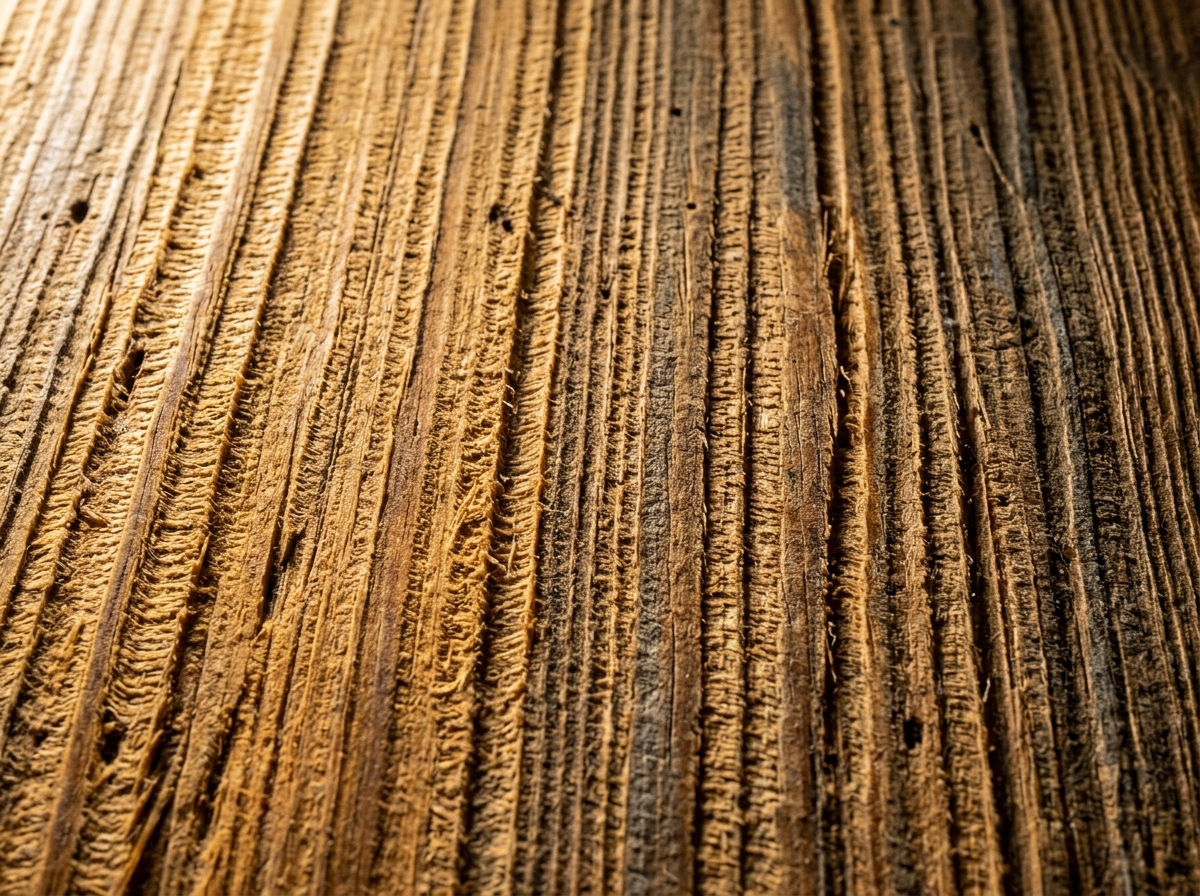
Diagnostic Fingerprints of Hand Pit Saw Marks:
- Straight, But Non-Parallel Angles: Because two human beings were constantly adjusting their stance, balance, and fatigue levels, the angle of the straight cut lines shifts subtly across the length of the board (varying by 5° to 15°).
- Irregular Kerf Spacing: The distance between tooth gouges is completely inconsistent—ranging from 1/16″ during difficult knot cuts to 3/8″ when the sawyers found a rhythm through soft wood.
- Hesitation Scars & Back-Cuts: You will frequently spot deep gouges or jagged stops where the sawyers paused, rested, or restarted their stroke.
- Co-Occurring Forensic Markers: Hand pit-sawn boards are almost universally fastened with hand-wrought rosehead nails (pre-1790) or hand-filed, blunt-tipped wood screws (see our definitive guide to dating antique furniture by screws and hardware).
3. c. 1800 to 1840s: Water-Powered Up-and-Down Sash & Muley Saws (Uniform Straight Kerfs)
As the 19th century dawned, water-powered vertical sawmills began dominating commercial timber production. In these mills, a long, straight saw blade was stretched taut inside a rectangular wooden frame called a sash (later improved as an un-framed muley saw). Driven by a water wheel and pitman arm, the sash saw moved up and down with rigid mechanical regularity while a ratcheted carriage mechanically advanced the log by a fixed increment on each stroke.
Diagnostic Fingerprints of Sash & Muley Mill Marks:
- Strictly Parallel Straight Lines: Unlike the human pit saw, every kerf line on a sash-sawn board is perfectly parallel to its neighbor.
- Rhythmic, Uniform Stroke Spacing: Because the carriage advanced log feed automatically with every stroke of the water wheel, the distance between kerf lines is remarkably consistent—typically spaced exactly 1/8″ to 1/4″ apart across the entire plank.
- Perpendicular or Slight Rake Angle: The straight kerfs run almost directly perpendicular (90°) to the edge of the board, occasionally raked slightly back depending on the pitman stroke geometry.
- Furniture Associations: Standard on American Federal, Classical Empire, and early Sheraton dining tables, drop-leaf consoles, and gateleg tables constructed between 1800 and 1845.
4. c. 1840s to 1880s: The Circular Saw Revolution (Radial Curved Arcs)
The introduction of the commercial circular saw completely transformed lumber manufacturing and provides antique furniture collectors with the most critical chronological benchmark in the entire trade.
While circular saw blades were experimented with in late 18th-century England and patented in the United States in the early 1810s (frequently credited to Shaker sister Tabitha Babbitt and Benjamin Cummins), they were initially limited to light cross-cutting tasks (shingle making and stave cutting). Early water wheels simply lacked the high rotational speed and torque required to push massive hardwood logs through a 48-inch circular blade without binding or warping.
It was not until the late 1830s and early 1840s, with the advent of high-pressure stationary steam engines and improved metallurgical disc tempering, that large circular sawmills proliferated across the American East Coast and Midwest. By 1845 to 1850, virtually all commercial lumber production had shifted from vertical reciprocating sash mills to steam-powered circular mills.
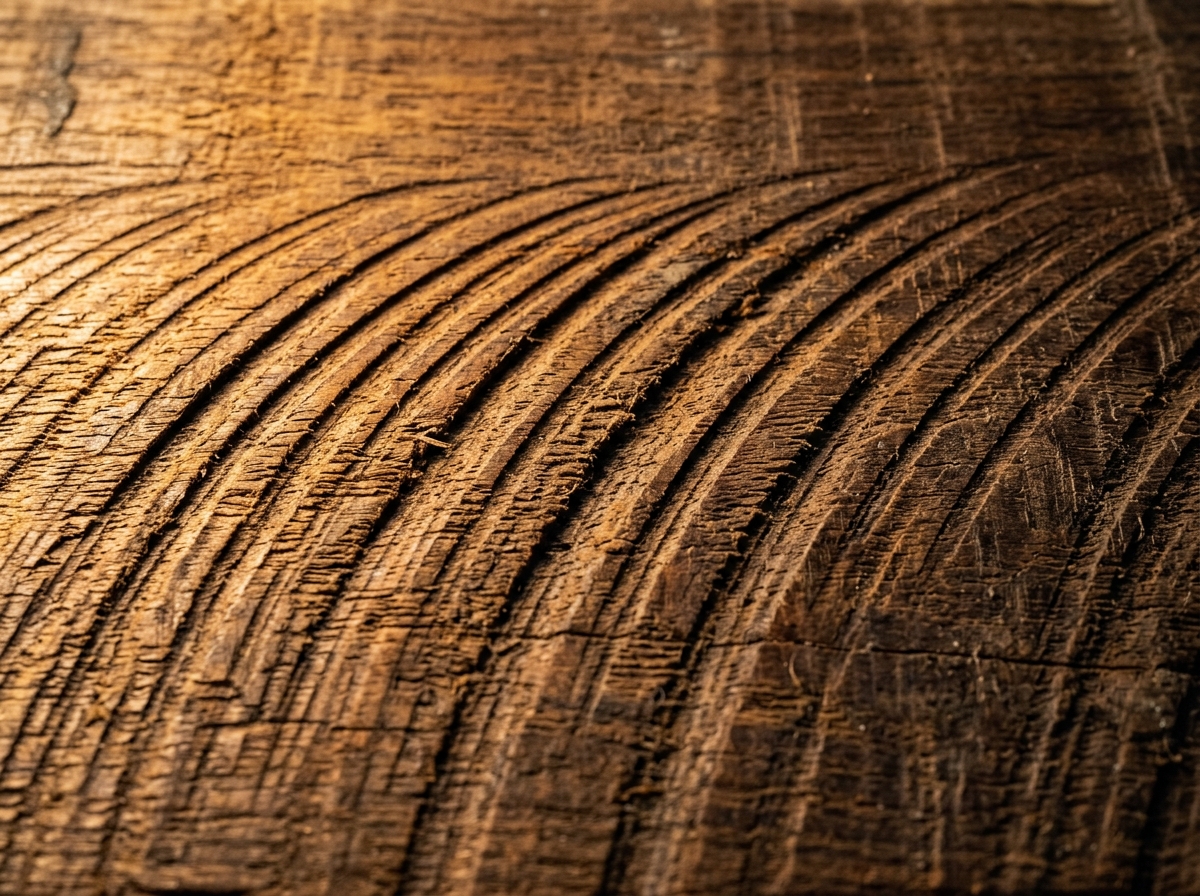
Diagnostic Fingerprints of Circular Saw Marks:
- Unmistakable Curved Radial Arcs: Circular saw kerfs appear as sweeping, curved semicircular ridges and valleys across the timber face. You can visualize the circular rim of the spinning blade cutting through the wood.
- Arc Radius Matches Blade Diameter: By measuring the curvature of the arc, appraisers can calculate the diameter of the historical saw blade (most commonly between 36 inches and 60 inches in 19th-century American mills).
- The 1845 Benchmark Rule: If an antique table features circular saw marks on original, unaltered structural timber, the table cannot have been made before the 1840s. Any claim that a table with circular saw marks is an 18th-century Chippendale or 1810 Federal table is an immediate red flag indicating a later reproduction, a rebuilt marriage, or heavily repaired secondary wood.
- Matching Machine Joinery: Circular saw lumber frequently pairs with mid-to-late Victorian joinery, such as machine-stamped screws with pointed gimlet tips (post-1846) or the pin-and-cove joint (see the Knapp joint furniture identification guide, patented in 1867).
5. 1880s to Present: Industrial Band Saws & Rotary Planers
By the late 19th century, circular sawmills were heavily supplemented by high-speed industrial band saws. While the band saw was originally invented in 1808 by William Newberry, reliable flexible steel band metallurgy was not perfected until French engineer Périn patented improved tempering methods in the 1850s, leading to widespread American commercial sawmill installation by the 1880s.
Unlike the rough, toothy kerfs of early pit and sash saws, an industrial band saw produces extremely fine, whisper-thin, closely spaced straight striations (often spaced 1/32″ or less). Furthermore, by the 1880s, mass-production furniture factories like the Mersman Table Company and the Tell City Chair Company routed virtually all secondary timber through high-speed rotary thickness planers.
Rotary planers leave shallow, rhythmic, scalloped “cutter ripples” or “planer waves” across the wood surface, completely obliterating saw kerfs. If the underside of a tabletop is smooth with faint periodic planer scallops, it is a hallmark of late 19th- or 20th-century industrialized milling.
6. Master Saw Mark Forensic Comparison Matrix
Use this comprehensive matrix to compare saw mark characteristics, operational mechanics, and corresponding furniture eras during your field appraisals:
| Saw Technology | Primary Era | Kerf Geometry | Spacing & Rhythm | Historical Furniture Styles |
|---|---|---|---|---|
| Hand Pit Saw (Whip Saw) | Pre-1800 (Colonial to 1790s) | Straight lines with shifting, non-parallel angles (5°–15° variance) | Irregular (1/16″ to 3/8″); hesitation gouges and resting stops | William & Mary, Queen Anne, Chippendale, Early Federal |
| Water-Powered Sash / Muley Saw | c. 1800–1840s (Peak 1810–1845) | Straight lines; strictly and uniformly parallel to each other | Mechanical cadence; evenly spaced (approx. 1/8″ to 1/4″ apart) | American Federal, Classical Empire, Sheraton, Late Neoclassical |
| Steam Circular Saw | c. 1840s–1880s (Firm post-1845 benchmark) | Sweeping curved arcs; radial semicircles across grain | Pronounced ridges and valleys matching rotating tooth orbit | Victorian Rococo, Gothic Revival, Renaissance Revival, Eastlake |
| Industrial Band Saw & Planers | c. 1880s to Present | Very fine, tightly packed straight lines or scalloped planer waves | Micro-spaced (1/32″ or less); near-smooth machined finish | Golden Oak, Arts & Crafts / Mission, Factory Colonial Revival |
7. Where to Look: 5 Hidden Forensic Hotspots on Antique Tables
Because cabinetmakers smoothed all visible exterior surfaces, finding pristine, unaltered saw marks requires knowing exactly where 18th- and 19th-century craftsmen cut corners:
- The Raw Underside of Table Tops: Crawl beneath the table with a high-intensity flashlight held at a low, raking angle (15° to the surface). Raking light casts deep micro-shadows inside saw kerfs, making faint straight or curved marks jump out dramatically. Pay special attention to unplaned wide pine boards beneath dining tables and Pembroke tables.
- The Interior Faces of Table Aprons and Skirts: While the outer face of an apron was polished or veneered (as explained in our guide on how to tell solid wood from veneer in antique furniture), the interior face facing into the table frame was almost never planed smooth.
- Drawer Bottoms and Drawer Backs: In small tea tables, sofa tables, and consoles equipped with drawers, remove the drawer entirely. Inspect the underside of the secondary bottom board and the exterior surface of the drawer back. These were routinely made from rough secondary softwoods (white pine, yellow poplar, or chestnut).
- The Underside of Drop-Leaf Hinged Leaves: On an antique drop-leaf table or gateleg table, examine both the stationary central top and the drop leaves. If the center top has straight sash saw marks but one hinged leaf displays circular saw arcs, that leaf is a later Victorian or 20th-century replacement.
- Pedestal Base Mounting Blocks: On pedestal dining tables and tilt-top tea tables, the heavy square or rectangular “birdcage” block fastened beneath the top was sawn from thick, heavy stock and frequently preserves deep, pristine mill kerfs.
8. Forensic Traps: How to Avoid Misdating
While saw marks are among the most trustworthy indicators in antique woodworking, novice collectors frequently fall into three deceptive traps:
Trap #1: Confusing Scrub Plane Marks with Saw Kerfs
Before boards were smoothed, cabinetmakers used a scrub plane with a heavily cambered (curved) iron to rapidly hog off rough timber. This tool leaves shallow, concave, scalloped parallel troughs across the grain (roughly 1″ to 1.5″ wide). Novices often confuse these hand-planed troughs with circular saw marks. However, scrub plane marks are smooth, wide, and hand-scalloped, whereas circular saw kerfs are narrow, sharp, tooth-scored radial ridges.
Trap #2: The Reclaimed Timber & “Marriage” Scam
Forgers and reproduction makers in the 1920s Centennial boom frequently harvested authentic 18th-century pit-sawn subfloor boards from demolished colonial barns and built “antique” tavern tables. Always cross-examine the timber: are there mysterious, unused nail holes or filled mortises that don’t align with the table’s frame? If a tabletop has authentic 1780 pit-saw marks but is held to the apron with 1920s modern wire nails and modern slotted screws, the piece is a marriage or reproduction.
Trap #3: Rural “Lag” in Sawmill Technology
While major metropolitan lumber mills in Philadelphia, New York, and Boston adopted circular saws by the mid-1840s, remote Appalachian and rural frontier communities occasionally operated water-powered sash mills well into the 1850s and 1860s. Therefore, straight saw marks mean the timber could be pre-1845 OR made in a rural area slightly later. However, circular saw marks are an absolute one-way cutoff: they NEVER appear prior to ~1840 on furniture lumber.
Save This Wood Dating Cheat Sheet on Pinterest
Pin our forensic visual guide to your antique furniture identification board for quick reference at flea markets, auctions, and estate sales.
Frequently Asked Questions About Antique Saw Marks
What do circular saw marks tell you about antique furniture?
Circular saw marks prove definitively that the timber was converted in a commercial sawmill after approximately 1840 to 1845. While small circular saw blades existed earlier for specialty barrel and shingle cutting, large circular blades capable of milling furniture-grade timber were not commercially deployed until steam power emerged in the 1840s. A piece with original circular saw marks cannot be an 18th-century antique.
Did they have circular saws before 1800?
No. In pre-1800 furniture making, circular saws did not exist in commercial lumber mills. All furniture lumber converted prior to 1800 was sawn using two-man manual pit saws (leaving irregular straight kerfs) or early vertical water-powered sash saws (leaving uniform parallel straight kerfs).
What do straight saw marks look like on antique wood?
Straight saw marks appear as linear, parallel or near-parallel ridges and score marks across the wood. Two-man hand pit saw marks (pre-1800) feature slight variations in angle (human fatigue) and uneven spacing. Water-powered sash mill marks (c. 1800–1840s) appear as strictly parallel, evenly spaced straight lines approximately 1/8″ to 1/4″ apart.
Can circular saw marks appear on a genuine 18th-century antique table?
Yes, but only on later repair parts or alterations. For instance, an authentic 1770 Chippendale table may have suffered a broken drop-leaf or cracked apron support that was replaced by a Victorian cabinetmaker in 1875 using circular-sawn lumber. If circular saw marks appear on the primary, unaltered structural timbers, the table is not an 18th-century antique.
Why are saw marks only visible on the unfinished parts of antique furniture?
Historical cabinetmakers smoothed all visible show surfaces (tabletops, legs, outer aprons) using hand planes, scrapers, and sandpaper to prepare them for finishing oils, waxes, and shellac. Rough secondary surfaces—such as the underside of tabletops, drawer bottoms, and interior carcase framing—did not affect appearance, so craftsmen left the original mill saw marks untouched to save labor.
How do band saw marks differ from pit saw or circular saw marks?
Commercial band saws (widespread post-1880s) utilize a continuous thin steel ribbon loop that runs at high speeds. They leave very fine, tightly packed, micro-spaced straight striations (often 1/32″ or less apart) that are far smoother and more uniform than the aggressive, rough kerfs of early hand pit saws or circular saws.
Explore More Forensic Antique Identification Guides
Continue mastering non-destructive antique authentication with our companion field references:
- How to Date Antique Furniture by Screws & Hardware: Hand-filed blunt tips vs pointed gimlet screws.
- The Knapp Joint (1867–1900): Deciphering the pin-and-cove joint on late 19th-century furniture.
- Solid Wood vs Veneer: How to Tell on Antique Furniture: End-grain continuity and historic veneer thickness.
- How to Tell if a Table is Antique Oak: Quartersawn medullary rays and tiger oak identification.
- Complete Guide to Antique Table Styles: Queen Anne, Chippendale, Federal, and Victorian eras.
Pingback: Dating Antique Furniture by Screws & Hardware: The Forensic Collector’s Guide - Antique Tables
Pingback: The Knapp Joint: How Pin-and-Cove Joinery Dates Antique Furniture (1870–1900) - Antique Tables