
In the forensic authentication of antique tables, desks, and case furniture, drawer pulls and mounting hardware represent the most revealing—and frequently tampered with—chronological evidence on the piece. While cabinet woods can be skillfully aged and tabletop finishes artfully distressed, brass drawer pulls, escutcheons, and fastener posts carry the indelible metallurgical fingerprints of the industrial era in which they were cast, stamped, or turned. An educated glance at a drawer pull’s backplate, post threading, and interior nut can instantly differentiate an authentic 1760 Chippendale original worth thousands of dollars from a clever 1920s Colonial Revival reproduction worth a few hundred.
However, because drawer hardware was routinely replaced over the centuries to match shifting decorative tastes, accommodate broken bail handles, or modernize an inherited family heirloom, collectors and appraisers must know how to spot original period hardware, detect filled bore holes, and verify authentic “ghost marks.” In this definitive collector’s guide, we decode the historical chronology of antique drawer pulls from 1680 to 1920, examine the forensic fasteners hidden on the drawer interior, evaluate the catastrophic valuation impact of replaced brasses, and provide non-destructive conservation guidelines.
⚡ Collector Fast Reference: Dating Antique Drawer Pulls in 60 Seconds
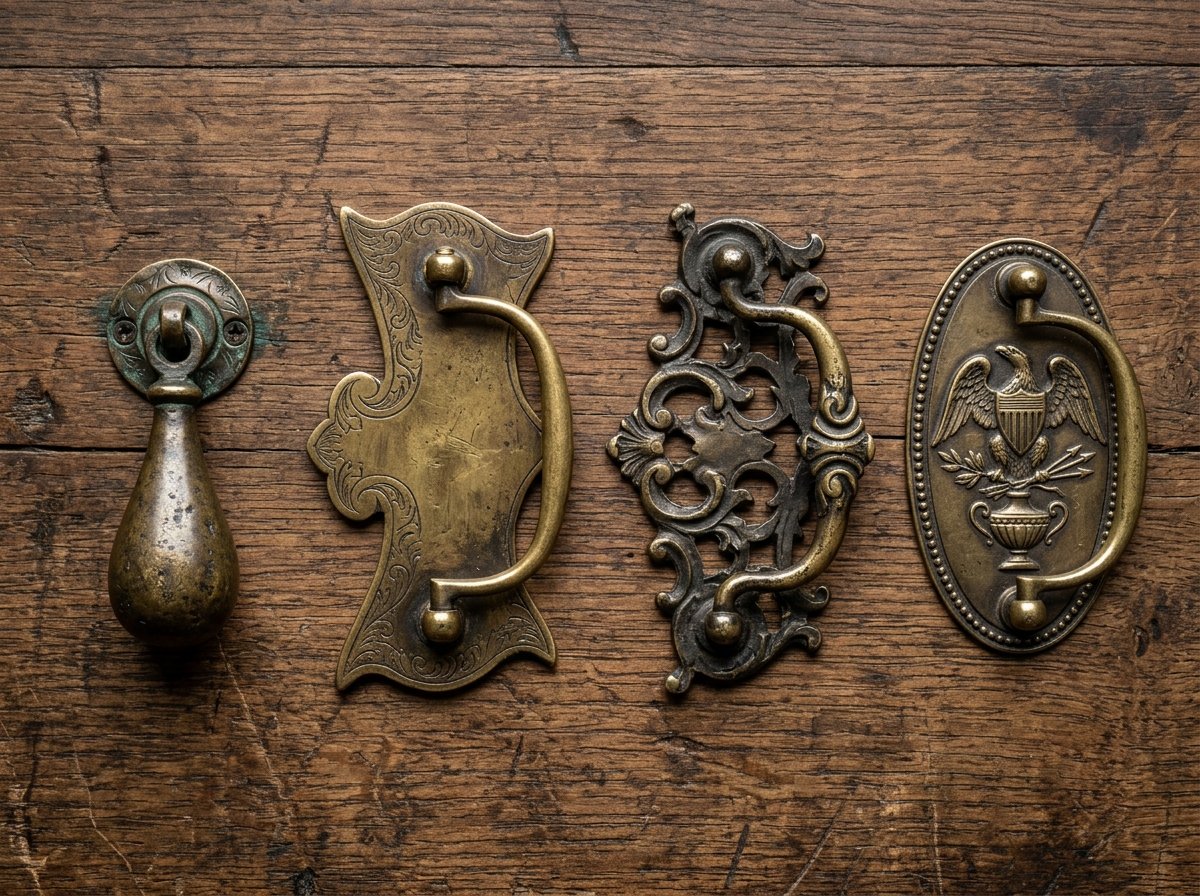
- 1680–1710 (William & Mary): Teardrop or pear-shaped cast brass pendants hanging from a single circular rosette boss. Fastened through the drawer with a soft, split-wire brass cotter pin bent flat against the drawer interior.
- 1710–1750 (Queen Anne): The first horizontal bail handles swinging between two posts on a solid, unpierced brass backplate with scalloped curves (the famous batwing or willow pull). Fastened with cast brass posts and hand-cut square or faceted brass nuts.
- 1750–1780 (Chippendale): Elaborate openwork pierced backplates featuring rococo fretwork, hand-beveled edges, and swan-neck bail handles. Hand-cast brass with pebbled undersides, secured with cast posts and hand-filed square nuts.
- 1780–1820 (Federal / Hepplewhite / Sheraton): Thin, die-stamped sheet brass with hollow embossed backs featuring patriotic American eagles, classical urns, or floral motifs. Oval, octagonal, or circular rosettes with machine-stamped iron posts and round or hexagonal nuts.
- 1820–1850 (Empire & Early Victorian): Turned wooden mushroom knobs (mahogany, walnut, cherry) or Sandwich pressed glass knobs secured with central iron bolts.
- The “Ghost Mark” Smoking Gun: Original hardware always leaves a distinct “shadow”—an unoxidized, lighter wood silhouette and circular bail swing drag marks directly beneath the backplate. If you see extra plugged holes or mismatching shadows, the hardware has been replaced.
- Valuation Impact: Replacing original period brasses with modern reproductions reduces the market value of a fine 18th-century antique by 30% to 50%+.
The Chronological Evolution of Antique Drawer Pulls (1680–1920)
To date an antique table or chest accurately, examine the silhouette, metal thickness, and decorative motif of the pull. Antique hardware followed a strict decorative evolution that mirrored the broader furniture design movements of the Western world:

1. William & Mary Teardrop & Pendant Pulls (1680–1715)
Before 1710, horizontal bail handles did not exist on American and British case furniture. Instead, late 17th-century William & Mary dressing tables, lowboys, and chest drawers relied on teardrop pendant pulls. These consist of a solid cast brass or bronze pear-shaped drop hanging vertically from an eye-bolt secured to a small, circular or flower-shaped stamped brass backplate (known as a boss).
Because these pulls operated with a single mounting hole through the drawer front, they put immense leverage on the fastener. The definitive hallmark of an authentic William & Mary pull is its mounting method: it is fastened not with a threaded screw, but with a split-wire cotter pin. Craftsmen passed the two prongs of the brass wire pin through the drawer front, spread them apart inside the drawer, and hammered them flat against the raw secondary wood.
2. Queen Anne Batwing & Willow Brasses (1710–1750)
With the dawn of the Queen Anne period, furniture makers recognized that wide, heavy drawers required two-handed leverage. This spurred the invention of the bail handle—a curved U-shaped brass bar that swung freely between two mounting posts. To protect the tabletop and drawer face from fingernail gouges and swinging bail wear, cabinetmakers installed a solid sheet of brass behind the handle.
The earliest versions featured a solid backplate with a curvilinear perimeter resembling the outstretched wings of a bat (hence the collector term batwing pull) or drooping willow branches (willow brasses). These plates are 100% solid sand-cast brass, completely unpierced except for the two post holes and engraved line borders around the perimeter. Matching batwing keyhole escutcheons were mounted in the center of the drawer.
3. Chippendale Pierced & Rococo Backplates (1750–1780)
As Thomas Chippendale’s influential design books transformed European and colonial taste in the 1750s, furniture hardware became lighter, more sculptural, and dramatically more ornate. Instead of heavy solid batwing plates, Chippendale introduced pierced openwork backplates. Craftsmen cast a thick brass plate and used delicate jeweler’s fret saws and hand chisels to cut intricate openings, scrollwork, and stylized acanthus leaves directly through the center of the plate.

The bail handle itself evolved into the elegant swan-neck handle, characterized by gracefully arched, s-curved terminals that curved downward before engaging the posts. The outer edges of genuine Chippendale backplates are distinctly beveled with hand files, creating micro-facets that catch ambient candlelight. If you examine the pierced openings under magnification, authentic 18th-century examples show tiny irregular file marks, whereas modern machine-stamped reproductions exhibit laser-smooth, perpendicular edges.
4. Federal, Hepplewhite & Sheraton Stamped Brasses (1780–1820)
Around 1780 in Birmingham, England—the hardware manufacturing capital of the Western world—metalworkers perfected industrial water-powered and steam-driven stamping presses. This revolutionized furniture hardware. Heavy cast brass was replaced by stamped sheet brass. By striking a thin sheet of rolled brass with a hardened steel die, manufacturers could press breathtakingly sharp, classical neoclassical designs into backplates in seconds.
Federal period pulls on American tables (such as delicate drop-leaf and antique Pembroke tables) are characterized by geometric shapes: horizontal ovals, octagons, and circles with beaded or rope-twist borders. Popular embossed motifs celebrate the newly independent United States: the American bald eagle holding arrows and olive branches (the Great Seal), classical Greek urns, cornucopias of harvest abundance, weeping willows, and wheat sheaves. If you inspect the reverse of a Federal backplate, it is hollow, perfectly mirroring the raised design on the front.
5. Empire & Early Victorian Wooden & Glass Knobs (1820–1850)
By the 1820s, the flamboyant neoclassical tastes of the American Empire and Biedermeier movements turned away from ornate brass plates in favor of clean, architectural lines. Two distinct non-metallic handle types dominated this era:
- Turned Wooden “Mushroom” Knobs: Crafted from matching hardwoods (dense Honduran mahogany, black walnut, or wild black cherry), these round, mushroom-profile knobs were turned on a lathe. Early originals feature an integral wooden screw carved directly onto the back of the knob shank, which threaded directly into the drawer face, or were secured from behind with an iron screw.
- Pressed Sandwich Glass Knobs: Pioneered by the Boston & Sandwich Glass Company of Massachusetts in the late 1820s, sparkling molded glass knobs became the ultimate fashion statement. Featuring faceted daisy patterns, starbursts, or octagonal faces in clear, milky opalescent, cobalt blue, or rich vaseline glass, these knobs were fastened by a central iron bolt passing through the middle of the glass body.
6. Late Victorian, Eastlake & Aesthetic Movement (1850–1900)
The late Victorian era brought an explosion of heavy, machine-manufactured hardware styles. The Renaissance Revival (1860–1880) favored massive cast bronze or iron drawer handles with lion heads, gargoyles, and medieval cartouches. This was followed by the influential Eastlake movement (1870–1890), which rejected curved rococo flourishes in favor of geometric, angular, and incised Japanese-inspired floral patterns. Eastlake drawer pulls typically feature rectangular or strap-like backplates with dark antique “statuary bronze” patinas, drop-ring handles, and incised linear diapering. During this period, drawers were commonly built with the iconic Knapp pin-and-cove joint.
| Furniture Era | Manufacturing Dates | Primary Hardware Style | Metal / Material | Fastener Method | Key Defining Detail |
|---|---|---|---|---|---|
| William & Mary | 1680–1715 | Teardrop / Pendant Drops | Sand-cast brass | Split-wire cotter pin | Single hole; pendant dangles from loop |
| Queen Anne | 1710–1750 | Batwing / Willow Bail | Sand-cast brass | Cast post & square nut | Solid, unpierced plate; horizontal bail |
| Chippendale | 1750–1780 | Pierced Rococo Backplate | Sand-cast brass | Cast post & square nut | Openwork fretwork; hand-beveled edges |
| Federal / Hepplewhite | 1780–1820 | Stamped Oval / Octagon | Die-stamped sheet brass | Machine screw & nut | Hollow back; eagles, urns, beaded rims |
| American Empire | 1820–1845 | Wooden / Glass Knobs | Mahogany or pressed glass | Integral wood screw or iron bolt | Turned mushroom shape; Sandwich glass |
| Victorian Eastlake | 1870–1890 | Geometric Incised Plates | Cast bronze / brass / iron | Machine screws from rear | Angular shapes; incised geometric flora |
The Interior Drawer Test: Nuts, Posts & Fasteners
While any antique reproducer can buy an authentic-looking Chippendale backplate, very few reproduce the microscopic mechanical fasteners on the inside of the drawer. When evaluating an antique table, open the drawer immediately and inspect the back of the hardware posts—and take note of the overall drawer box construction, including hand-planed chamfered bottoms and layout score marks (see our collector guide to dating antique furniture by drawer construction & scribe marks):
1. Split Cotter Pins (Pre-1720)
If the pull is held in place by two flat strips of soft brass wire passed through a single hole and splayed out like a modern paper fastener, you are examining pre-1720 William & Mary hardware. Because wire cotter pins loosened quickly under heavy use, original pins are frequently found packed with small wood wedges or leather washers driven beneath the prongs to tighten the grip.
2. Hand-Cut Posts & Faceted Square Nuts (1720–1780)
Between 1720 and 1780, high-end British and American bail handles utilized cast brass posts. The post shaft passed through the drawer front, terminating in hand-cut screw threads. Notice the word hand-cut: before the invention of automated screw-cutting lathes, threads were filed by hand with screw plates, resulting in coarse, uneven thread pitch and blunt tips (cross-reference our guide on dating antique furniture by screws).
The nuts that secure these posts are unmistakably irregular. They are square or slightly octagonal, hand-hacked from sheet brass or iron with cold chisels. If you unscrew two nuts from the same 18th-century drawer pull, you will find they are rarely interchangeable: each nut was custom-threaded to fit its specific post. Furthermore, cabinetmakers often counter-bored (chiseled a shallow square recess into) the drawer interior so the protruding nut would not snag folded linens or documents.
3. Modern Machine Threads & Hexagonal Nuts (Post-1830 / 1900)
If the threaded post on a Chippendale-style pull exhibits razor-sharp, pitch-perfect machine threads with a standard modern 8-32 or 10-24 gauge, and is secured by a clean hexagonal stamped steel nut or modern flat washer, the hardware is a 20th-century reproduction. Similarly, if the handle is held by a modern Phillips-head screw (invented in the 1930s) driven from behind the drawer face into a threaded hole in the pull, the hardware is modern.
The “Ghost Mark” & Bore Hole Inspection
Even if the pulls on an antique table appear authentic, they may not be original to that specific piece. To determine whether an antique table retains its original factory hardware, perform these two forensic tests:
1. The Shadow Silhouette Test
Over a century of exposure to sunlight, airborne soot, dust, and annual paste wax treatments, the wood finish on a drawer front darkens and patinates. However, the wood sheltered tightly underneath the brass backplate is sealed off from ambient light and wax. If you gently remove one pull, original hardware leaves behind an unmistakable ghost mark—a crisp, lighter-colored silhouette that matches the exact contour of the plate down to the millimeter.
If you remove a Chippendale batwing plate and discover an oval shadow beneath it, an amateur restorer replaced original 1790 Federal oval brasses with 1760 Chippendale pulls to make the table look older. Conversely, if there is no shadow whatsoever and the wood under the plate is identically darkened and varnished, the table was completely chemically stripped and refinished (read our forensic checklist on how to tell if antique furniture has been refinished).
2. The Plugged Bore Hole Inspection
Open the drawer and inspect the backside of the drawer front with a high-intensity flashlight. When owners replaced original 3-inch center-to-center bail pulls with 2.5-inch Victorian pulls or single wooden knobs, they were forced to drill new holes and plug the original bore holes. Look for round wooden dowel plugs, colored wood putty, or mismatching grain patches. Even the most skilled furniture restorer cannot conceal a plugged hole on the unfinished interior face of the drawer front.
Valuation Impact: Original vs. Replaced Hardware (2026 Guide)
In the fine antiques trade, few flaws penalize a piece more severely than missing original hardware. While minor wood scratches and normal tabletop finish wear are embraced as authentic historical character, replaced hardware directly degrades both historical integrity and auction liquidity.
| Hardware Condition Status | Market Value Impact | Collector Market Desirability | Appraisal & Auction Action |
|---|---|---|---|
| 100% Original Period Hardware (Untouched patina, matching ghost marks, square nuts) | Full Market Benchmark (100% Baseline Value) | Highest Tier (Museum & Serious Collector) | Guarantees top catalog placement; zero deduction |
| Period-Correct Antique Replacements (Genuine 18th-c. brasses fitted into existing original holes) | -15% to -25% Deduction | Strong Commercial Grade (Decorators & General Buyers) | Appraisers must disclose; minor value penalty |
| Period-Correct Replacements with Plugged Holes (Antique brasses fitted, but required drilling/plugging) | -30% to -40% Deduction | Moderate Interest (Secondary Antique Malls) | Noticeable deduction for structural alteration |
| Modern Reproduction Brass Hardware (Cast or stamped 20th-century pulls with modern machine screws) | -35% to -50% Deduction | Budget Collectors & Everyday Furnishings | Significant discount; priced primarily as decorative furniture |
| Anachronistic / Mismatched Hardware (e.g. Victorian glass knobs on 1760 Chippendale desk) | -50% to -65% Deduction | Low (Requires restoration capital to correct) | Severe deduction; buyer will discount cost of sourcing period brasses |
Conservation Guidelines: Should You Polish Antique Drawer Pulls?
The most frequent and tragic mistake made by novice antique owners is aggressively polishing historical brasses with modern abrasive chemical cleaners (such as Brasso). Never polish 200-year-old brass to a shiny mirror finish!
- Why Patina Matters: Authentic antique brass possesses a mellow, deep bronze-gold glow with dark chocolate oxidation in recessed relief areas and delicate traces of greenish copper carbonate in the crevices. This patina is living proof of the metal’s age; polishing it down to bare raw metal destroys its visual authenticity and can wipe 20% off the piece’s resale value overnight.
- Safe Surface Cleaning: If drawer pulls are caked with sticky household grease, food residue, or layers of old paste wax, remove the hardware carefully from the drawer. Soak the brasses in warm water mixed with mild liquid dish soap for 20 minutes. Gently scrub the surface with a soft natural-bristle toothbrush (never brass-wire or steel wool brushes!). Rinse in clean water and dry thoroughly with a soft flannel cloth.
- Wax Protection: Once clean and completely dry, rub a microscopic coat of high-grade microcrystalline wax (such as Renaissance Wax) or pure beeswax over the brass using a soft rag (review our finishing tutorial on applying paste wax to antique furniture). This seals the surface against atmospheric oxidation without stripping its irreplaceable historic patina.
Frequently Asked Questions (FAQ)
How can you tell if antique drawer pulls are original to the furniture?
To verify if drawer pulls are original, check three physical areas: (1) look behind the backplate for a matching “ghost mark”—a lighter, unoxidized wood shadow matching the exact silhouette of the brass; (2) inspect the inside of the drawer for hand-threaded posts with irregular square or faceted brass/iron nuts, ensuring there are no plugged secondary holes or dowels; and (3) verify that natural circular swing wear scratches exist in the wood beneath the swinging bail handle.
What does a ‘batwing’ drawer pull look like and what era is it from?
A batwing drawer pull features a solid, unpierced cast-brass backplate whose scalloped, curved outer perimeter resembles the outstretched wings of a bat. The handle consists of a horizontal curved bail bar swinging between two brass posts. Batwing pulls were the defining hardware style of the Queen Anne period, manufactured primarily between 1710 and 1750.
How do the nuts and bolts on the back of a drawer pull date the furniture?
Before 1720, pulls were fastened with split-wire brass cotter pins bent flat inside the drawer. From 1720 to 1780, hardware used cast brass posts with hand-cut threads and hand-filed, irregular square brass or iron nuts. From 1780 to 1830, machine-cut iron posts with round or hexagonal nuts emerged. Modern factory screws threaded into the back of the pull from behind indicate 20th-century reproduction hardware.
Does replacing drawer pulls reduce the value of antique furniture?
Yes, significantly. Replacing original period hardware with modern reproductions generally reduces the market value of an 18th- or 19th-century antique by 30% to 50%. If original holes were plugged and new holes drilled to accommodate different post spacing, the deduction can reach 40% to 60%. Collectors place an immense premium on 100% original, untouched period brasses.
Should you polish antique brass drawer pulls?
No. You should never polish antique drawer pulls with aggressive chemical polishes (like Brasso) to achieve a bright, shiny mirror finish. Centuries of natural oxidation create a rich, mellow bronze patina that authenticates the age of the piece. Polishing off this patina diminishes the antique’s historical authenticity and market value. Instead, clean gently with warm water, mild dish soap, and a soft toothbrush, followed by a coat of microcrystalline wax.
Pingback: Antique Tavern Table Identification & Value: The Collector’s Guide