
Stickley furniture markings identify which of the four distinct Stickley family workshops produced a piece and establish whether it dates to the golden 1900–1916 Arts & Crafts era or is a modern 1989+ reproduction. The most valuable mark is Gustav Stickley’s burned joiner’s compass enclosing the Flemish motto “Als ik kan” (c. 1901–1912), followed by L. & J.G. Stickley’s red handscrew clamp “Handcraft” emblem (1906–1912), Stickley Brothers’ Art Nouveau “Quaint Furniture” brass tags from Grand Rapids, and Charles Stickley’s Binghamton paper decals.
Key Takeaways: Decoding Stickley Maker’s Marks
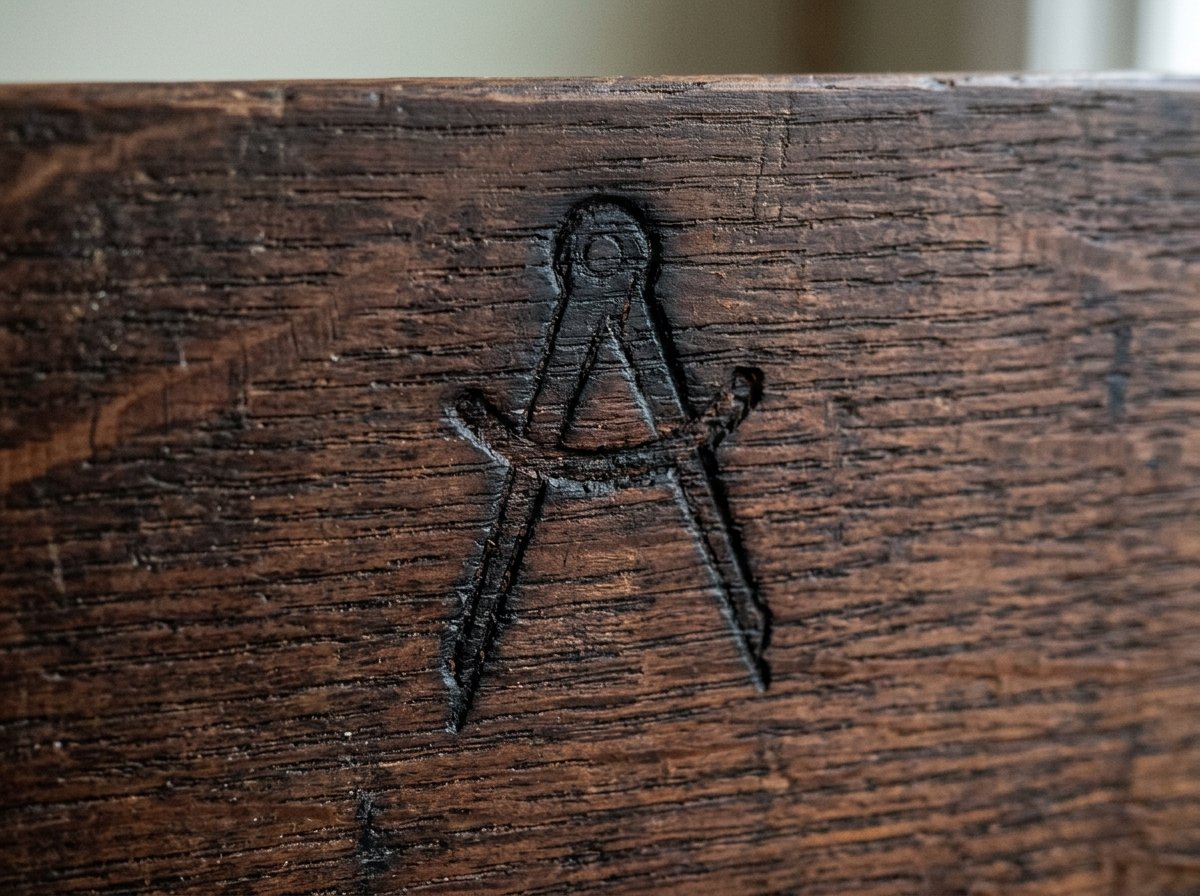
- The Joiner’s Compass = Gustav Stickley (1901–1916): Look inside top drawers or beneath stretchers for a red decal or wood-burned compass enclosing “Als ik kan” (“If I can”). Early Eastwood pieces (1901–1903) also include a box stating “United Crafts.”
- The Red Wood Clamp / “Handcraft” = L. & J.G. Stickley (1906–1912): Brothers Leopold and John George used a red wooden handscrew clamp logo before transitioning to the rectangular block brand “The Work of L. & J.G. Stickley” in 1912.
- “Quaint” Script = Stickley Brothers Co. (Grand Rapids, MI): Operated completely independently by brother Albert Stickley. Marked with artistic Art Nouveau “Quaint” brass tags, stencils, or early Colonial paper labels (generally lower auction values than New York Stickleys).
- Post-1989 Reissues Feature Metal Date Plaques: Authorized modern Mission Collection reproductions from Manlius, NY carry laser-etched compass marks, contemporary brass plates, and date serials—do not confuse them with rare 1905 antiques.
- Never Strip Original Fumed Oak Finish: Original Gustav Stickley tables were ammonia-fumed rather than stained. Chemical stripping erases the dark tannic patina and reduces auction value by 50% to 75%.
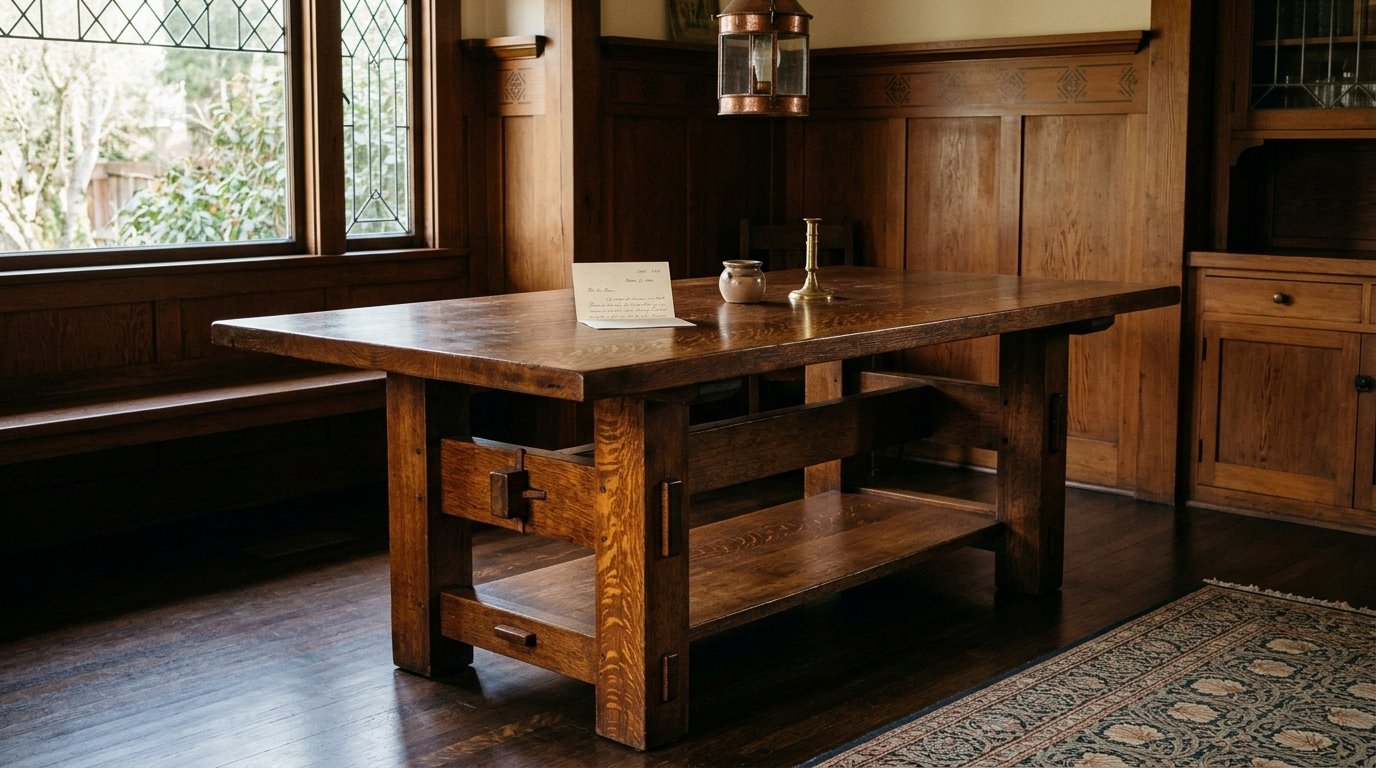
Understanding the Stickley Family Empire: Why Four Firms Share One Name
The single greatest source of confusion for collectors at estate sales and regional auctions is that there was not one “Stickley Furniture Company.” Five German-American brothers from Wisconsin—Gustav, Leopold, John George, Albert, and Charles—splintered into fierce business rivals operating competing factories in New York and Michigan between 1891 and 1940.
Because an unmarked oak library table or Mission trestle dining table can bring $850 if attributed to Stickley Brothers or $18,500 if verified as an early Gustav Stickley shop piece, pinpointing the exact stamp is the cornerstone of Arts & Crafts valuation.
1. Gustav Stickley / The Craftsman Workshops (Eastwood & Syracuse, NY | 1898–1916)
Gustav Stickley (1858–1942) is universally recognized as the father of the American Craftsman movement. His Eastwood, NY workshops produced the purest, structurally cleanest, and most coveted collectible oak furniture in America before declaring bankruptcy in 1915–1916. Watch for these four strict chronological marks:
- 1898–1900 (Unmarked / Early Eastwood Era): Very rare transitional pieces were often unsigned or featured small fragile paper shop tags that rarely survive today.
- 1901–1903 (“United Crafts” Era): Marked with a red decal or wood brand featuring a Flemish joiner’s compass enclosing the Flemish phrase “Als ik kan” (“If I can” / “As best I can”) inside a rectangular box reading “United Crafts / Eastwood, N.Y.”
- 1904–1912 (Peak Craftsman Period): Eliminated “United Crafts” in favor of the iconic standalone Compass + “Als ik kan” + “Gustav Stickley” brand—frequently applied as a bright crimson-red ink decal inside top drawers or deeply scorched into bare wood undersides with a hot iron die.
- 1912–1916 (Late Period Before Collapse): As finances dwindled, the elaborate compass mark was frequently simplified to a straight block wood brand reading simply “Gustav Stickley” or “Craftsman” prior to his 1916 bankruptcy.
2. L. & J.G. Stickley (Fayetteville, NY | 1900–Present)
In 1900–1902, younger brothers Leopold and John George Stickley founded their own powerhouse plant just miles away from Gustav in Fayetteville, New York. After Gustav’s 1916 bankruptcy, L. & J.G. absorbed Gustav’s remaining factory assets (briefly operating as Stickley Associated Cabinetmakers in 1918). Their historical marks evolve across four eras:
- 1902–1904 (Tobey Contract / Unmarked): Early output was built to contract for major retailers like the Tobey Furniture Co. in Chicago and often carried only retail tags.
- 1904–1906 (“The Onondaga Shops”): Marked with a large oval brown or red ink stamp containing a bold capital letter “S” or a decal reading “The Onondaga Shops” (named after Onondaga County, NY).
- 1906–1912 (The “Handcraft” Red Clamp Mark): Introduced a signature red carpenter’s handscrew wood clamp emblem paired with “L. & J.G. STICKLEY — HANDCRAFT.” Visually echoing Gustav’s red compass mark, it fueled a bitter lifelong feud between the brothers.
- 1912–1920+ (“The Work of L. & J.G. Stickley”): Shifted to a clean rectangular red-and-yellow transfer label or deeply stamped block mark reading “THE WORK OF L. & J.G. STICKLEY” above Fayetteville, N.Y.
3. Stickley Brothers Co. / “Quaint Furniture” (Grand Rapids, MI | 1891–1940)
Albert Stickley (briefly joined by John George before 1900) operated an entirely separate furniture conglomerate in Michigan’s furniture capital of Grand Rapids. Known commercially for their “Quaint” trademarked Arts & Crafts, Tudor, and later Colonial lines, Stickley Brothers tables were typically lighter in scale and more factory-efficient than Gustav’s hand-wrought New York pieces:
- 1903–1915 (Quaint Mission Brass Tags & Stencils): Look underneath table aprons or inside drawers for stamped rectangular brass plates or black stencil ink reading “Quaint Furniture / Stickley Bros. Co. / Grand Rapids” stylized in flowing Art Nouveau calligraphy.
- 1920s–1940 (Quaint American): As Mission oak popularity cooled, labels switched to colorful shield decals reading “Quaint American Furniture of Character” for their cherry and maple Colonial Revival lines.
4. Charles Stickley / Stickley & Brandt Chair Co. (Binghamton, NY | 1891–1917)
Operating in Binghamton, New York alongside uncle Schuyler Brandt, youngest brother Charles Stickley initially produced eclectic Victorian rockers before introducing sturdy, budget-friendly Mission oak armchairs, Morris chairs, and occasional tables around 1909–1917. Authentic pieces bear fragile oval paper decals reading “Stickley and Brandt Chair Co. / Binghamton, N.Y.” or Charles Stickley’s personal script mark.
5. Modern Mission Collection Reissues (Manlius, NY | 1989–Present)
Revitalized under Alfred and Aminy Audi starting in 1974, modern L. & J.G. Stickley (now headquartered in Manlius, NY) launched their celebrated Mission Collection Reissue line in 1989. Built faithfully with solid quartersawn white oak, mortise-and-tenon joints, and traditional finish tones, these fine modern furnishings must never be mistaken for 1905 antiques. Modern reissues bear machined brass nameplate tags, crisp CNC-engraved compass marks accompanied by modern manufacture date stamps / serial numbers, and factory barcodes underneath tabletops.
Master Stickley Maker’s Marks & 2026 Value Matrix
Use this side-by-side matrix to match your exact stamp, verify manufacturing city and production dates, and benchmark fair 2026 secondary auction pricing:
| Stickley Workshop | Active Dates | Signature Mark / Tag | Typical Hallmarks | 2026 Auction Range (Tables) |
|---|---|---|---|---|
| Gustav Stickley (Eastwood / Syracuse, NY) | 1901 – 1916 | Flemish Joiner’s Compass + “Als ik kan” + “United Crafts” or “Craftsman” | Deep wood burns, crimson red decal, copper hardware, ammonia fuming | $2,500 – $35,000+ (Trestle #634 / Harvey Ellis: $15k+) |
| L. & J.G. Stickley (Fayetteville, NY) | 1904 – 1925 | “Onondaga Shops”, Red Handscrew Clamp (“Handcraft”), or “The Work of L. & J.G. Stickley” | Heavy pinned oak frames, chamfered slats, red/yellow decals | $1,400 – $12,000 |
| Stickley Brothers (Grand Rapids, MI) | 1891 – 1940 | Art Nouveau “Quaint Furniture” brass plate, ink stencil, or “Quaint American” shield | Lighter plank scales, factory efficiency, oak & maple Colonial lines | $500 – $3,200 |
| Charles Stickley / Brandt (Binghamton, NY) | 1891 – 1917 | “Stickley & Brandt Chair Co.” paper decal or Charles Stickley script | Sturdy regional oak seating, rockers, occasional parlor tables | $350 – $2,400 |
| Modern Reissue Stickley (Manlius, NY) | 1989 – Present | Metal brass Manlius plaque, laser-engraved compass with modern date stamp | Precision modern machining, catalyzed lacquer finish, barcode labels | $650 – $4,800 (Pre-owned luxury retail comps) |
The 5 Forensic Tests to Authenticate Period Stickley Tables
Because authentic early Gustav Stickley pieces fetch extraordinary sums, fraudulent sellers occasionally stamp fake brass compass brands onto generic unsigned Sears or Larkin oak tables—or attempt to pass 1990s Manlius reissues as 1905 antiques. Verify originality across these five physical checks:
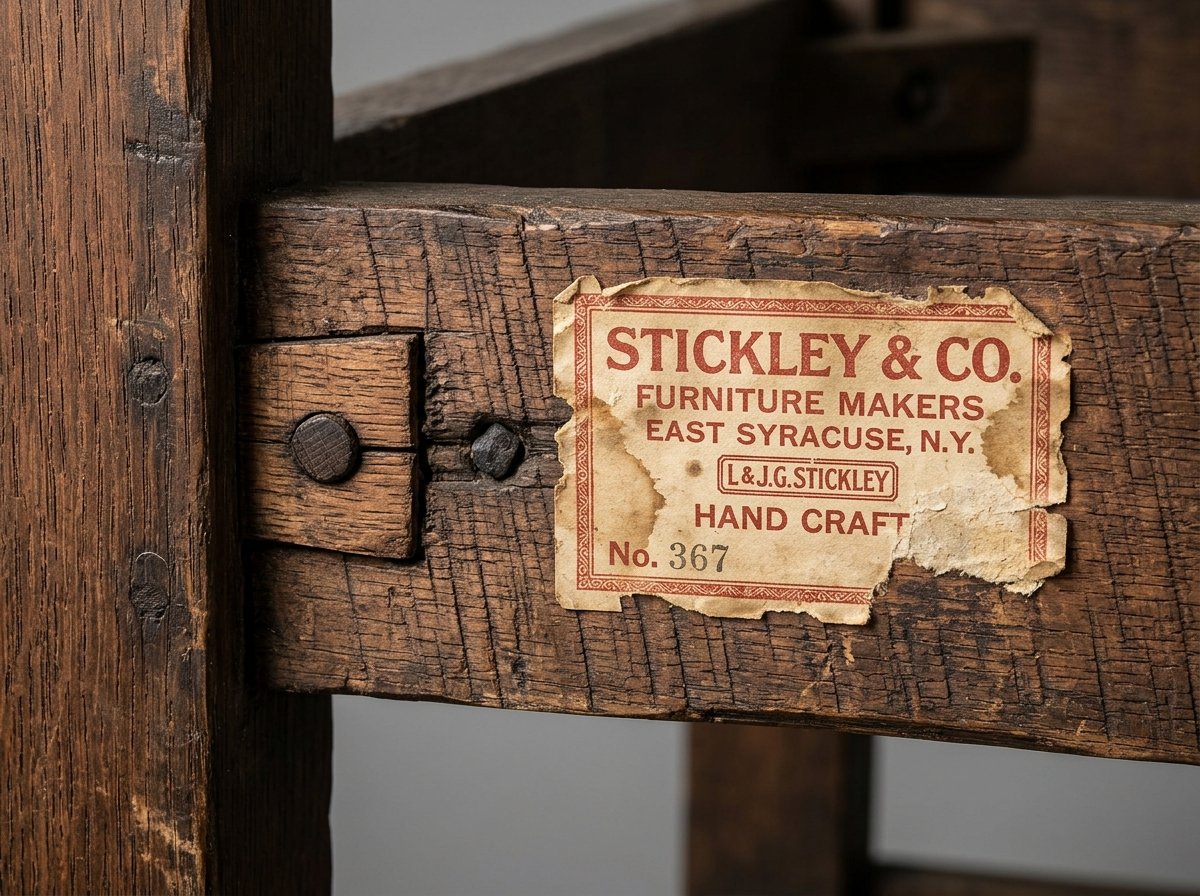
1. Inspecting Red Decals & Wood Burn Carbon Scorching
Under a 10x loupe and 365nm blacklight, genuine 1901–1912 markings betray clear physical hallmarks:
- Hand-Heated Brand Compression: Authentic early cast brass branding irons were heated over shop gas flames and pressed manually by craftsmen. Because oak features hard dense medullary rays alongside softer open earlywood pores, the heated brand scorches deeper inside open pores while slightly crushing edge fibers—often showing tiny unevenness in strike depth on the left vs. right sides. Counterfeit laser burns look uniform, flat, and lack mechanical wood compression.
- Aged Red Transfer Decals: Original crimson ink decals applied inside Gustav Stickley drawers or L. & J.G. Handcraft stretchers were protected by thin coats of aged shellac. Under a 365nm UV blacklight finish test, the untouched shellac overcoat over the decal glows soft warm amber-orange rather than bright dead purple or neon modern lacquer.
- Paper Shop Tags & Hide Glue: Check drawer bottoms or inside leg rails for faded cream, blue, or tan paper shop labels specifying shop order numbers and model codes (such as “Model 634” or “No. 404”). Authentic paper tags are glued with brittle dark amber animal hide glue rather than modern white acrylic glue.
2. Quartersawn Tiger Oak & Deep Ammonia Fuming
Gustav Stickley did not merely brush brown walnut stain across his premium tables. He utilized authentic quartersawn Northern white oak prized for its shimmering horizontal silver-dollar ribbons—known among collectors as antique quartersawn tiger oak—and rolled assembled pieces into sealed airtight fuming chambers filled with liquid ammonium hydroxide vapors for 24 to 72 hours.
The ammonia gas reacted naturally with organic tannins inside white oak sapwood and heartwood, darkening the timber internally to a rich velvet chestnut brown up to 1/8 inch beneath the surface without obscuring the crisp ray fleck clarity. If you inspect a minor edge nick on a true Gustav piece, the wood beneath remains deeply toned cocoa—whereas stained reproductions expose bright raw blond oak immediately beneath the chipped varnish film.
3. Keyed Through-Tenons, Chamfered Pins & Splines
Both Gustav and L. & J.G. Stickley celebrated “honest” structural engineering—meaning structural joints were deliberately highlighted as ornament:
- Pinned Mortise-and-Tenon Rails: Table aprons lock into thick quarter-sawn square corner posts with deep mortise-and-tenon joints secured by raised, slightly pyramidal or flat wooden drawbore pegs (treenails) rather than modern pocket screws or L-brackets.
- Protruding Keyed Tenons: Stretcher shelves and trestle cross-beams pass cleanly through outer upright slabs, wedged tight with tapered oak keys. Check our guide on dating furniture by hand vs. machine dovetails to verify period Stickley drawer boxes (typically cleanly cut semi-uniform early dovetails combined with oak/chestnut secondary wood).
- Butterfly Splines: Broad multi-board library tabletops frequently show delicate wooden bow-tie butterfly keys inlaid cleanly into underside plank seams to arrest splitting.
4. Hand-Hammered Copper Hardware & Square Nuts
On Stickley library tables, desks, and sideboards equipped with drawers, authentic period hardware serves as an infallible verification tool. Look closely at drawer pulls and escutcheons:
- Authentic Gustav Copper Pulls: Period pulls are forged from heavy-gauge copper (never magnetic stamped steel plated in brown paint!), showing irregular blacksmith planishing hammer dimples across hand-beveled square V-pulls or copper rings suspended from faceted plates.
- Fastening Posts: Reach inside the drawer to confirm threaded iron or brass posts bolted with heavy square nuts and square washers—cross-reference our antique drawer pull hardware chronology and check for period drawer bottom grain orientation and scribe lines.
5. Spot Checking Authentic 1905 vs. 1989+ Manlius Reissues
Modern post-1989 Stickley Mission reissues are stunning heirloom-grade furniture crafted using solid white oak and genuine tenons—but their wholesale collector value is 50% to 80% lower than century-old originals. Spot modern reissues instantly by looking for:
- Barcodes & Branded Dates: Modern Stickley tags always state explicit production dates (e.g., “1994” or “Manlius, NY”) or stamped brass badges pinned cleanly to the bottom stretcher.
- Machined Surface Perfection: Inspect the underside of the tabletop planks. Period 1905 tables exhibit subtle rotary planer chatter marks or slightly curved circular saw arcs alongside natural 100-year oxidation darkening. Modern 1989+ reissues possess velvety-smooth high-RPM CNC surfaces, bright sealed undersides, and flawless catalyzed factory lacquer impervious to denatured alcohol tests.
2026 Market & Auction Valuation Guide for Stickley Tables
Because Arts & Crafts collectors prize untouched condition and provenance, small marks and preservation details cause dramatic swings at leading specialty auction houses like Rago Arts, Toomey & Co., Treadway, and Christie’s:
- Early Gustav Stickley Masterpieces ($10,000 – $45,000+): Signed 1901–1908 dining tables with intact keyed trestles (e.g., Model #634 eight-foot dining trestle or #656 spindle tables), rare drop-leaf library desks, or inlaid Harvey Ellis period forms retaining untouched ammonia-fumed finish routinely clear $15,000 to $35,000+.
- Standard Period Gustav Stickley Library & Round Tables ($2,500 – $8,500): Marked 1904–1912 single-drawer oak library tables, round 48-inch pedestal or four-leg dining tables with matching leaves, and occasional tabourets trade reliably between $2,500 and $8,000 depending on grain quality and intact copper pulls.
- Period L. & J.G. Stickley Handcraft Tables ($1,400 – $10,500): Authentic Fayetteville Handcraft trestle and library tables command roughly 65% to 80% of equivalent Gustav pieces, with exceptional tall bookcases and massive extension dining tables hitting $8,000–$12,000+.
- Stickley Brothers “Quaint” & Charles Stickley ($350 – $3,000): Smaller Grand Rapids Quaint side tables and tea stands generally sell for $500–$1,500, while rare large Quaint oak dining suites reach $2,500–$3,200.
- Over-Restored or Refinished Penalty (-50% to -75%): Sanding off Gustav Stickley’s original dark fumed finish and applying modern shiny polyurethane instantly drops a $10,000 Craftsman dining table down to roughly $2,500–$3,500. Always clean gently and protect genuine vintage wood with pure wax per our guide on the best wax for antique wood tables and check our guide on safe white heat ring removal rather than sanding!
Frequently Asked Questions: Stickley Maker’s Marks
Which Stickley maker’s mark is the most valuable?
Gustav Stickley’s earliest marks from his Eastwood/Syracuse workshop (1901–1912) command the highest collector and auction values. Specifically, pieces featuring the boxed “United Crafts” joiner’s compass decal (1901–1903) or a crisp red ink decal/wood brand of the Flemish joiner’s compass enclosing “Als ik kan” above “Gustav Stickley” consistently achieve 30% to 300% higher auction realizations than comparable L. & J.G. or Grand Rapids Stickley Brothers furniture.
How can you tell an antique 1905 Stickley piece from a modern 1989 reissue?
Modern Mission Collection reissues (manufactured in Manlius, NY beginning in 1989) explicitly identify themselves to prevent confusion: look for a stamped brass metal nameplate tag, a laser-etched compass logo paired with an explicit production year stamp (e.g., 1994, 2003), modern printed barcode inventory stickers, and ultra-smooth CNC-milled underside surfaces sealed in modern catalyzed lacquer rather than antique shellac or wax.
What does “Als ik kan” mean on Gustav Stickley furniture?
“Als ik kan” is a medieval Flemish motto translating in English to “If I can” or “As best I can.” Originally popularized by 15th-century Flemish painter Jan van Eyck (and later embraced by British Arts & Crafts visionary William Morris), Gustav Stickley adopted the motto in 1901 inside his woodworker’s joiner’s compass emblem to signify pride in honest, unhurried hand-craftsmanship.
Are Stickley Brothers (“Quaint”) and Gustav Stickley the same company?
No. Although founded by Gustav’s brothers Albert and (briefly) John George Stickley, Stickley Brothers Co. operated entirely independently out of Grand Rapids, Michigan from 1891 to 1940. Using the trademarked “Quaint Furniture” Art Nouveau script and brass tags, Stickley Brothers produced lighter-weight factory Mission oak and later Colonial Revival furniture that generally trades at substantially lower prices than New York Craftsman furniture.
Explore our complete historical furniture reference library—from antique trestle dining tables and Tell City Chair Company markings to Mersman table model numbers and The Complete Guide to Antique Table Styles.
Pingback: Antique Trestle Table Identification & Value (2026 Guide)
Pingback: Hide Glue in Antique Furniture: Identification & UV Tests
Pingback: The Complete Guide to Antique Table Styles: Eras, Identification & Values - Antique Tables