
You can identify authentic antique hide glue by its translucent dark-amber crystalline squeeze-out beads, pale bluish-ivory glow under a 365nm UV blacklight, brittle glass-like cleavage, and its ability to soften and smell faintly of warm gelatin when touched with a warm damp cotton swab. Used universally by Western cabinetmakers from antiquity until roughly 1945–1947, animal protein hide glue serves as a definitive chemical boundary separating true pre-WWII antiques from mid-century factory reproductions and modern synthetic PVA (white and yellow wood glue) repairs.
Key Takeaways: Hide Glue Forensic Identification
- The 1947 Chemical Cutoff: Borden introduced commercial white PVA glue (Elmer’s Glue-All) in 1947, followed by aliphatic yellow PVA resins in the 1950s. Unrestored joints assembled strictly with hot hide glue typically predate 1945.
- Visual Appearance (“Amber Rock Candy”): Unwiped hide glue squeeze-out on underside corner blocks dries hard, glassy, and translucent amber to dark reddish-brown with hairline stress crazing. Modern PVA dries dull white or opaque cream-yellow with rubbery flexibility.
- 365nm UV Fluorescence Test: Under filtered 365nm longwave ultraviolet light in a dark room, historic animal hide glue fluoresces pale milky bluish-white or frosty ivory. Modern yellow PVA appears dead purple-black or glows electric yellow-green depending on optical brighteners.
- The Warm Water Reversibility Test: Pressing a warm, damp Q-tip on an inconspicuous underside glue drop for 45 seconds turns hide glue slimy and sticky, releasing a faint warm animal-gelatin aroma. Synthetic PVA remains rubbery plastic and cannot be re-activated.
- Conservation Rule #1: Never pour modern yellow PVA wood glue or epoxy into a loose antique mortise-and-tenon joint. Fresh hide glue chemically bonds directly to 200-year-old hide glue; PVA seals wood pores permanently and slashes auction value by 40% to 70%.
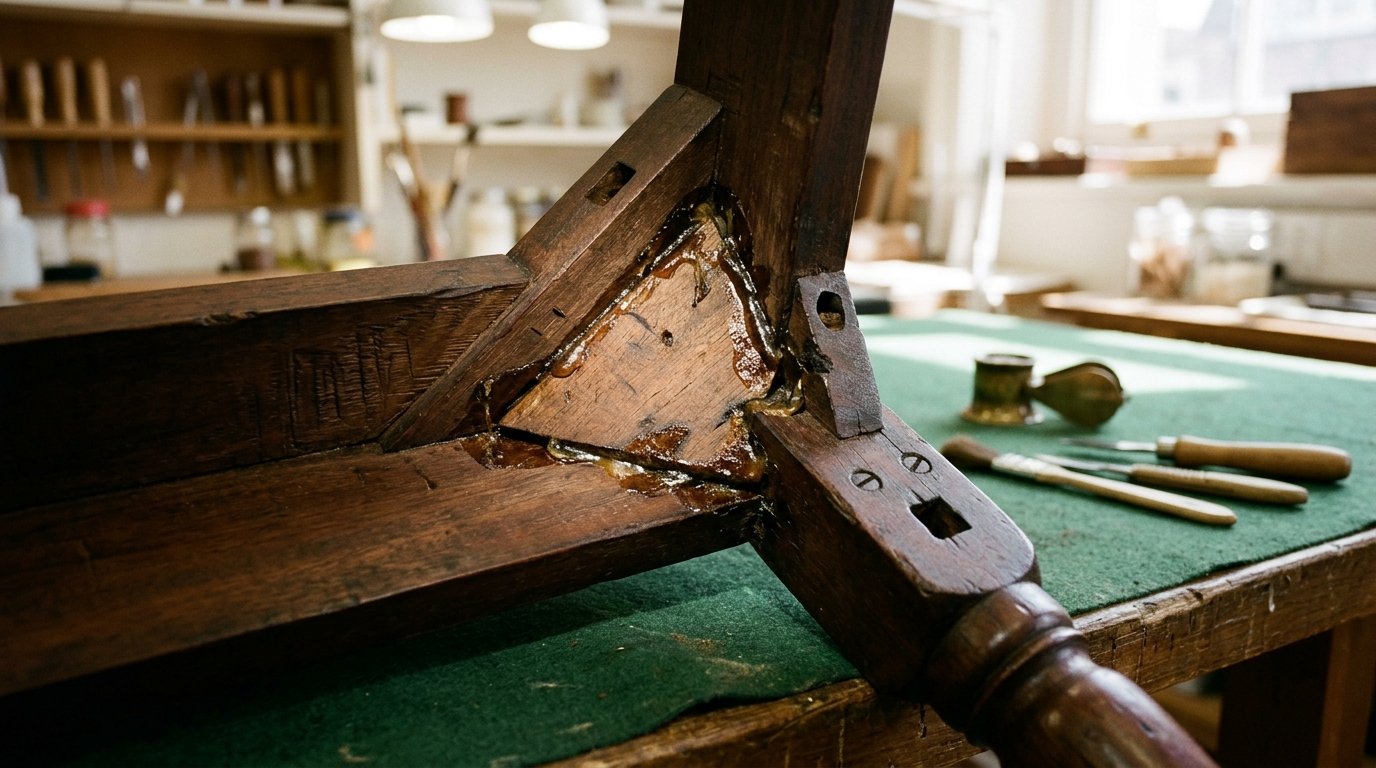
The Chronological Timeline of Antique Furniture Adhesives (1600–1960)
To date an antique table accurately or expose a concealed restoration, appraisers examine not only wood grain, saw marks, and screw hardware, but also the organic polymer chemistry holding the carcass together. Furniture adhesives underwent three monumental technological shifts over the past three centuries:
1. Hot Animal Hide Glue (1600–1945)
For over 3,000 years—spanning ancient Egyptian tomb furniture, 18th-century Georgian mahogany dining suites, and early 20th-century Gustav Stickley oak—nearly all quality cabinetwork relied on collagen-based animal hide glue. Manufactured by boiling trimmed cattle hides, sinews, rabbit skins, and bones into a concentrated gelatin broth, dried hide glue flakes were soaked in water and melted inside double-boiler cast-iron glue pots heated over coals, gas jets, or early electric elements to roughly 140°F–145°F.
Joiners had barely 60 to 90 seconds of open working time before the cooling gelatin jelled and gripped the wood fibers tightly. As remaining moisture evaporated over days, the collagen fibers contracted violently—actually pulling loose tenons and rubbed veneer joints tightly together under tension.
2. Casein & Urea-Formaldehyde Factory Resins (1925–1955)
During the 1920s and Great Depression, high-volume industrial furniture factories (such as Grand Rapids mahogany plants and Depression-era “Waterfall” bedroom factories) adopted early synthetic and dairy-protein adhesives. Casein glue (derived from milk curd protein mixed with lime) offered strong moisture resistance for heavy structural laminations, while urea-formaldehyde (UF) thermosetting powder resins debuted in the mid-1930s for hot-press veneering. UF adhesives dry extremely hard, dark brown or reddish-amber, and completely waterproof—failing by splintering when fractured.
3. Polyvinyl Acetate / PVA White & Yellow Glues (1947–Present)
In 1947, Borden Chemicals commercially introduced white polyvinyl acetate emulsion—marketed nationally as Elmer’s Glue-All—providing homeowners and factories with a cold, squeeze-bottle synthetic plastic resin requiring zero heating pots. Shortly thereafter in the 1950s, yellow aliphatic resin PVA glues (popularized by Titebond and Franklin Adhesives) revolutionized commercial woodworking with faster tack and higher creep resistance. If you discover flexible milky-white or opaque yellow squeeze-out fillets anywhere on an antique table, those joints were assembled or re-glued strictly after 1947.
Master Adhesive Identification Matrix
Compare visual texture, ultraviolet fluorescence, moisture reversibility, and historical production windows across the five major adhesives found in historic and repaired furniture:
| Adhesive Type | Historical Era | Visual Squeeze-Out & Texture | 365nm UV Blacklight Glow | Warm Damp Swab Reaction |
|---|---|---|---|---|
| Hot Animal Hide Glue | Prehistory – 1945 (Still used in high-end conservation) | Translucent amber, chestnut brown, glassy rosin-like beads with stress crazing hairlines | Pale milky bluish-white, frosty pearl, or soft cool ivory | Re-liquefies into sticky amber gel; faint smell of warm unflavored gelatin |
| Urea-Formaldehyde (UF) | 1935 – 1970s (Commercial plywood / veneers) | Hard opaque tan or dark reddish-brown brittle plastic crust; sharp fractures | Dull flat muddy green, dark olive, or dead matte gray | Zero change; completely waterproof and insoluble in warm water |
| White PVA Wood Glue | 1947 – Present | Semi-translucent milky white or pale gray smooth rubbery plastic film | Dead dark purple/black or faint chalky blue-violet (if brightened) | Swelled white elastic rubber skin; never melts back to runny liquid |
| Yellow Aliphatic PVA | 1955 – Present (Titebond / Modern DIY repairs) | Opaque creamy mustard-yellow or pale amber smooth polymer bead; yields to fingernail pressure | Electric neon chartreuse, bright yellow-green, or flat orange-tan | Turns soft, whitish, and chewy rubber; faint vinegar (acetic) scent |
| Epoxy & Polyurethane | 1970s – Present | Two-part thick amber/gray glassy blob (epoxy) or porous foaming tan crust (Gorilla Glue) | Vibrant electric turquoise/violet glow (epoxy) or flat dull brown (PU foam) | Zero reaction; impervious to water, steam, and mild organic solvents |
The 5 Non-Destructive Forensic Tests for Antique Hide Glue
Even without scraping timber or opening a mortise joint, decorative arts conservators can authenticate period glue composition in under five minutes by inspecting unexposed undersides and interior drawer runners with these five tests:
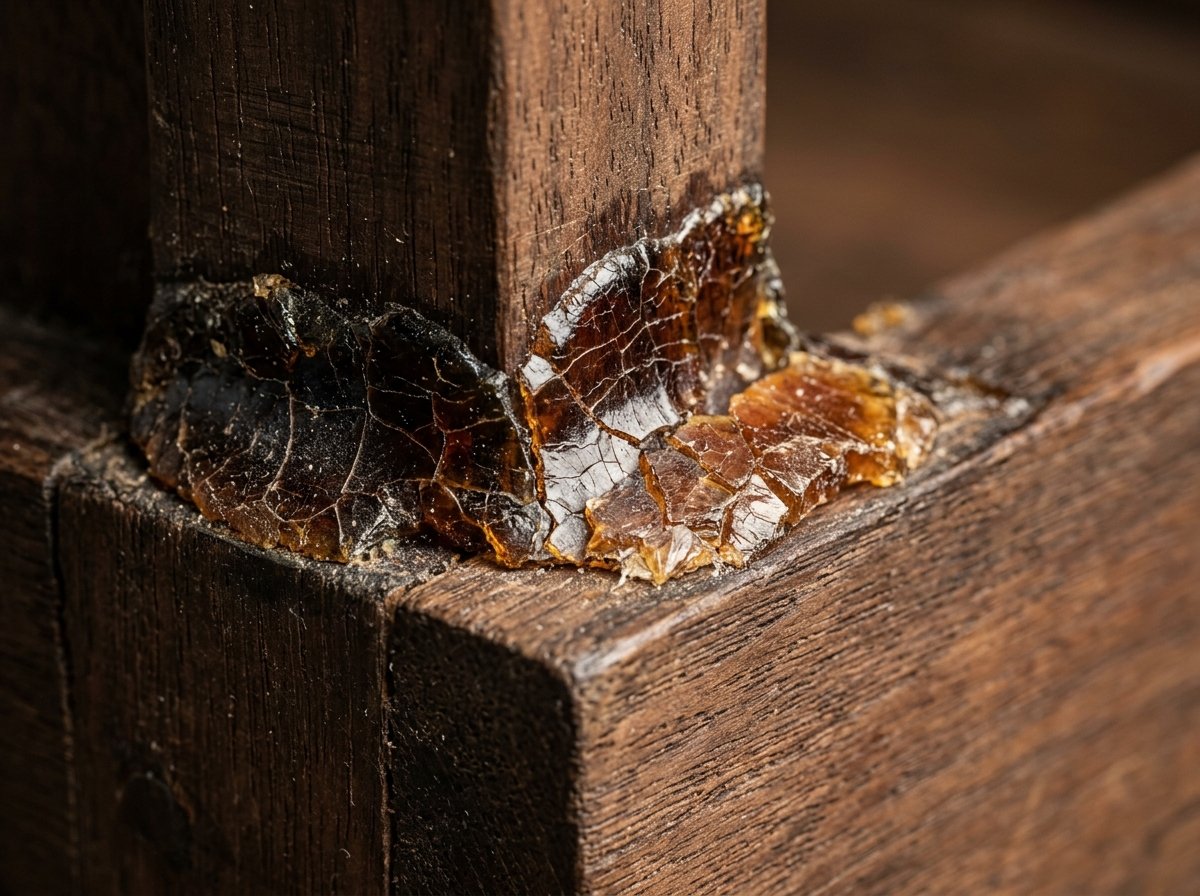
1. The Crystalline Amber Bead & Fingernail Cleavage Inspection
Flip the table upside down or pull out an antique drawer box to inspect the triangular wooden glue blocks tucked into the corners. Using a 10x jeweler’s loupe and raking LED light, examine any hardened glue drops squeezed out during assembly:
- Brittle Glass Crazing: Aged hot hide glue shrinks substantially as it dries over decades, generating microscopic stress cracks (“crazing”) through deep droplets. Light refracts internally like cracked amber glass or rosin.
- The Fingernail Test: Gently press your thumbnail edge into a hidden squeeze-out bead. Genuine 150-year-old hide glue is rock-hard—if pressed firmly with a brass probe, a small edge flakes cleanly off like dry shellac. Synthetic PVA glue exhibits elastomeric “give” and leaves a subtle fingernail dent because plasticizers retain permanent flexibility.
- Rubbed Corner Glue Blocks: 18th-century cabinetmakers rubbed triangular blocks tightly against table aprons with sizzling hide glue until air vacuum locked them fast, frequently driving zero nails (or only a single hand-forged wrought rosehead nail). Note thick, messy dark-brown runs radiating along raw vertical sash-saw marks.
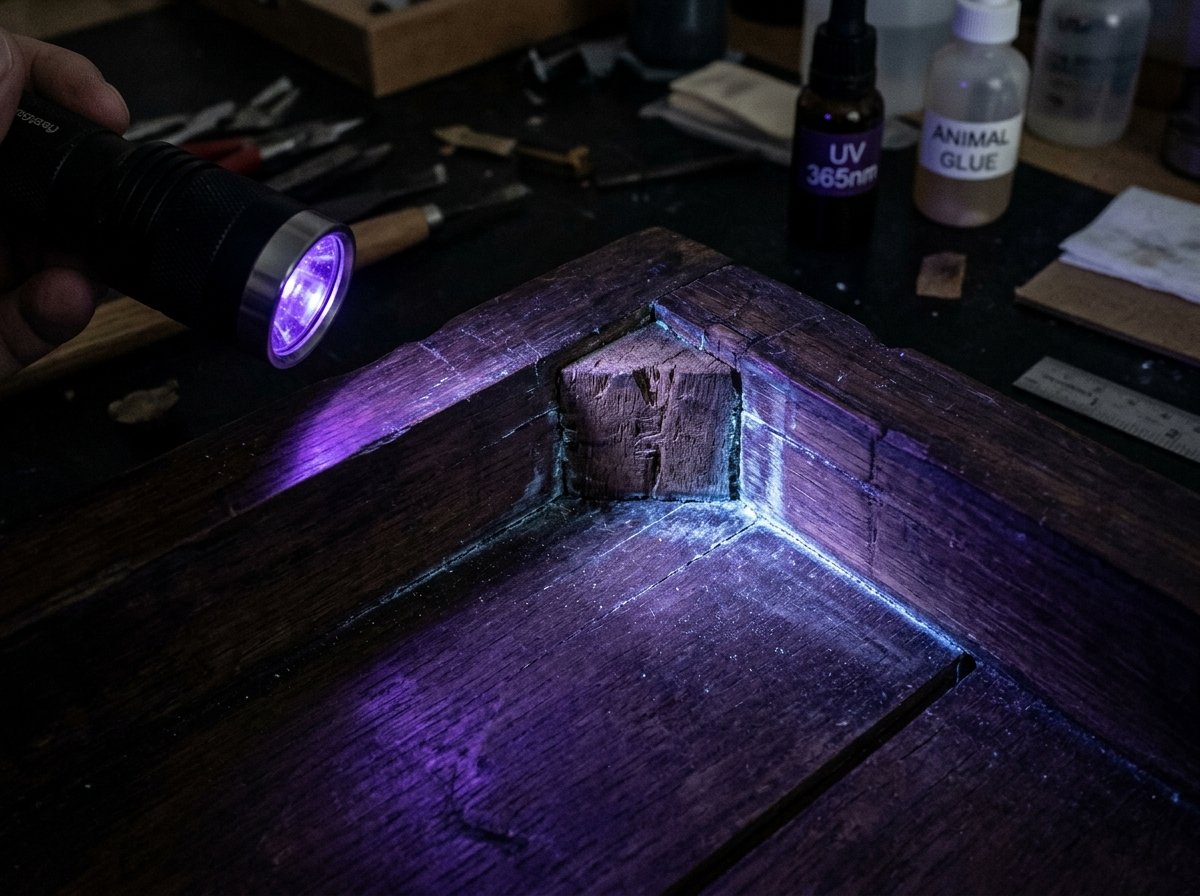
2. The 365nm Longwave UV Blacklight Fluorescence Test
Longwave ultraviolet (UV-A) examination is the museum standard both for verifying original shellac patinas vs. modern polyurethane and for exposing clandestine modern glue repairs hidden underneath an antique table:
- Use True Filtered 365nm UV (Not 395nm): Cheap hardware-store blacklights emit 395nm–405nm visible violet glare that blinds the human eye to subtle chemical signatures. Invest in a dedicated 365nm UV flashlight fitted with a dark Wood’s glass (ZWB2) filter so only pure invisible UV rays strike the glue.
- Virgin Hide Glue Glow: Natural collagen protein contains aromatic amino acids (tryptophan and tyrosine derivatives) that oxidize gradually. Under 365nm UV in complete darkness, authentic hide glue streaks emit a crisp pale bluish-white, frosty pearl, or cool silvery-ivory fluorescence.
- Catching Hidden Modern Repairs: If a seller glued a split table leg or re-attached a tabletop cleat using yellow PVA glue after 1955, the modern glue seam immediately betrays itself under 365nm light as an ugly dark purple-black void or an electric neon yellowish-green glow, clearly contrasting against the surrounding ancient hide glue blocks.
3. The Warm Damp Cotton Swab & Olfactory Test
Because hide glue is fundamentally pure animal gelatin, it remains 100% chemically reversible with warm water even 300 years after application. Perform this non-destructive diagnostic check on an invisible underside corner block or loose drawer rail:
- Dip a clean cotton swab into warm tap water (roughly 110°F–120°F) and blot off excess dripping moisture on a paper towel.
- Hold the warm, damp swab tip firmly against a tiny bead of suspected glue squeeze-out for 45 to 60 seconds.
- If it is Authentic Hide Glue: The brittle glass surface absorbs moisture, turns visibly lighter amber, and develops a slimy, gummy tack beneath your fingertip. Sniff the warmed bead closely—collagen releases a subtle, unmistakable earthy odor reminiscent of warm unflavored Knox gelatin or damp wool/bone meal. Once dry 20 minutes later, it re-hardens completely intact with zero damage.
- If it is Modern PVA Wood Glue: The bead gradually swells slightly on the outer surface into an opaque white, rubbery plastic skin that does not liquefy or smear smoothly, accompanied occasionally by a faint sour chemical scent of vinegar (acetic acid).
4. Veneer Cleavage & Lifting Failure Morphology
Examining chipped or blistered veneer along the apron edge of a Federal or Empire table yields another diagnostic signature. When studying solid wood vs. thick hand-sawn veneer on antique tables:
- Hide Glue Clean Cleavage: Over 150 years of seasonal swelling, moisture eventually crystallizes old hide glue beneath 1/16-inch thick mahogany or walnut veneer. When an edge chips away, the underlying chestnut or pine carcass exposes a smooth, flat plane coated in golden-brown shiny hide glue crystals—leaving wood fibers cleanly intact.
- PVA / Resin Structural Tearing: Because synthetic PVA forms tenacious cross-linked polymer grips stronger than softwood lignin, lifting modern veneer almost always rips ragged fibrous chunks directly out of the core substrate underneath.
5. Loose-Joint Survival vs. Cross-Grain Splits
Counterintuitively, a slightly wobbly mortise-and-tenon leg or loose wooden drawbore joint on an untouched 1800 table is often strong evidence of unmolested originality! Because aged animal hide glue gradually loses elasticity after a century, it harmlessly “micro-fractures” along joint faces when central heating dries out a winter room. The tenon loosens slightly—allowing a collector or conservator to simply tap the joint gently apart, reactivate the existing hide glue with steam, and restore rigid integrity without splitting solid heirloom boards.
Why Repairing Antiques with Modern Yellow Wood Glue Destroys Value
In historic conservation and fine auction appraisal, the single most destructive amateur DIY mistake is squeezing modern yellow or white PVA wood glue into a wobbly antique chair rung or table leg. Here is why auction houses penalize synthetic glue repairs heavily:
- The Chemical Lock-Out Trap: Hot hide glue possesses a miraculous metallurgical-like property: fresh hot hide glue chemically melts and re-amalgamates directly into 200-year-old hide glue. A trained restorer does not even need to scrape old hide glue completely bare. However, nothing sticks permanently to cured PVA—except rough sanding down into bare virgin wood. Once someone fills an antique hand-cut dovetail or leg mortise with Elmer’s or Titebond, future conservators must mechanically gouge away precious historical wood thickness just to clean the joint faces.
- Cold Creep Deformation: Under constant mechanical shear loads (such as dining table leg aprons or pedestal slides), standard PVA glues slowly stretch and “creep” permanently out of alignment over time, whereas rigid crystalline hide glue experiences zero creep.
- Irreversible Cross-Grain Splitting: When solid wide tabletops shrink across winter months against overly rigid PVA or epoxy repairs, the glue holds so violently that the wood relieves stress by cracking straight down the middle of an 18th-century Cuban mahogany plank. Documented amateur PVA and epoxy repairs routinely deduct 40% to 70% from the fair market auction value of period American and European antiques.
Frequently Asked Questions: Hide Glue Diagnostics
When did furniture makers stop using hide glue?
Most commercial furniture manufacturers transitioned away from traditional hot animal hide glue immediately after World War II. Borden introduced commercial white PVA emulsion glue (Elmer’s Glue-All) in 1947, and yellow aliphatic PVA adhesives rapidly replaced heated glue pots on commercial assembly lines between 1948 and 1960. Consequently, furniture constructed predominantly with crystalline hide glue generally dates prior to 1945 (though elite hand-custom reproduction makers and museum conservators still use hot hide glue today).
Does antique hide glue glow under a UV blacklight?
Yes. Under a filtered 365nm longwave ultraviolet blacklight in complete darkness, authentic aged animal protein hide glue typically emits a distinct pale milky bluish-white, frosty pearl, or silvery-ivory fluorescence. This provides an immediate contrast against modern yellow PVA resins (which often look dead dark purple-black or fluoresce bright neon chartreuse) and urea-formaldehyde resins (which look dull flat olive-gray).
How can you tell hide glue from modern PVA wood glue?
Inspect the squeeze-out beads along underside corner glue blocks and touch a tiny drop with a warm, damp cotton swab: (1) Visually, dried hide glue looks like shiny, translucent dark amber rosin or glass with stress cracks; PVA looks dull milky white or opaque mustard-yellow and yields slightly under a sharp fingernail. (2) Under moisture and heat, pressing a warm damp Q-tip on hide glue for 45 seconds melts it into a sticky gel smelling faintly of warm unflavored gelatin; PVA swells slightly into an insoluble rubbery plastic skin.
Can you put new hide glue directly over old antique hide glue?
Yes! That reversibility and self-bonding chemistry is precisely why museum conservators insist on hot or liquid hide glue for antique preservation. Unlike synthetic modern wood glues (which fail to stick properly over dried films), fresh warm hide glue gently swells and cross-links with existing antique collagen chains—creating a full-strength restoration bond without requiring destructive scraping of 18th-century wood surfaces.
For more non-destructive collector authentication tools and material science guides, explore our encyclopedic resources on dating antique furniture by dovetails, drawer construction & scribe marks, UV testing for original vs. refinished surfaces, and our master pillar directory: The Complete Guide to Antique Table Styles.
Pingback: Antique Card Table Identification & Value (2026 Guide)
Pingback: Antique Sewing Table Identification & Value (2026 Guide)