
In the pantheon of 20th-century American furniture makers, few names inspire the reverence, auction competition, and enduring prestige of Baker Furniture. Established by Dutch immigrant craftsman Siebe Baker in 1890 and elevated into an international luxury powerhouse by his visionary son Hollis S. Baker, the company transformed Grand Rapids and Western Michigan into the epicenter of museum-grade historical reproductions. From their celebrated 1930s Georgian mahogany dining suites and 1949 Asian-inspired Far East Collection to Sir Humphry Wakefield’s aristocratic Stately Homes Collection, authentic vintage Baker tables represent the absolute gold standard of heirloom cabinetmaking.
However, because Baker produced furniture across multiple distinct divisions over twelve decades—including high-end designer collaborations, mass-market colonial revival lines, and secondary labels like Milling Road—deciphering metal tags, paper labels, and factory stencils is essential for accurate dating and appraisal. In this definitive collector’s guide, we decode the chronological evolution of Baker Furniture table markings, examine factory model stencils, outline structural authentication forensics, and present a verified 2026 valuation guide.
⚡ Collector & Appraiser Fast Reference: Baker Furniture Markings
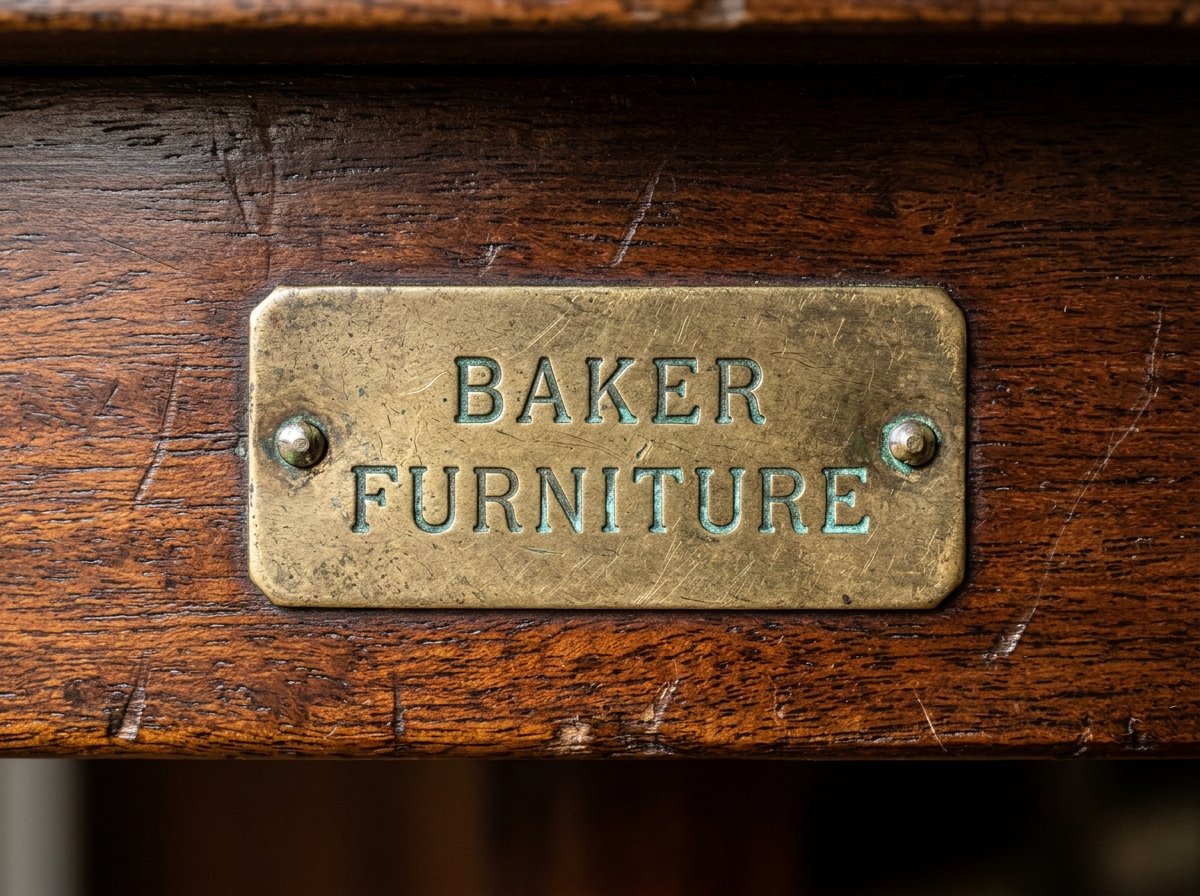
- The Primary Mark: Baker tables are predominantly marked with a stamped brass or metal plaque (oval from the 1930s–1950s; rectangular with rounded corners from the 1950s onward) tacked inside the center drawer or onto the underside apron with two small brads.
- Slogan Evolution: Early brass plaques (1930s–1940s) bear the signature motto “Cabinets of Character” alongside “Baker Furniture, Inc.” Post-war tags typically read “Baker Furniture / Grand Rapids, Mich.” or simply “Baker”.
- The Stately Homes Crest: Pieces from the coveted Stately Homes Collection (1980s–present) feature an exclusive brass plaque engraved with a royal coronet, Sir Humphry Wakefield’s endorsement, and the historic English estate name where the original antique resides (e.g., Woburn Abbey, Broadlands).
- Factory Model Stencils: The underside unfinished secondary wood always bears crisp black or dark blue ink-stenciled model and finish numbers (e.g., “MODEL 4822” and “FINISH 814”). Absence of factory stencils strongly suggests refinishing or an unbranded reproduction.
- Subsidiary Brand (Milling Road): Baker’s slightly more casual, accessible division is marked “Milling Road Furniture / A Division of Baker Furniture”, featuring its own distinctive script branding or burned brand.
- 2026 Market Valuation: Standard vintage Baker mahogany drop-leaf or occasional tables trade between $350 and $900; full double-pedestal dining tables fetch $1,500 to $4,500; and rare Stately Homes or Finn Juhl mid-century modern tables command $5,000 to $20,000+ at high-end auctions.
The Story of Baker Furniture: Craftsmanship Over Mass Production
To understand Baker markings, one must understand the company’s unique manufacturing philosophy. While neighboring Midwestern manufacturers like Mersman Tables prioritized high-volume mass production for middle-class department stores, Baker deliberately chose the opposite path: uncompromising hand craftsmanship, architectural accuracy, and elite interior design markets.
Founded in 1890 in Allegan, Michigan, as Cook, Baker & Co., the firm initially produced desks and bookcases. When Henry Cook retired in 1903, Siebe Baker renamed the operation the Baker Furniture Company. The turning point arrived in the 1920s when Hollis S. Baker took the helm. A connoisseur of fine decorative arts, Hollis traveled extensively across Europe and Asia, purchasing authentic 17th- and 18th-century antique originals to serve as direct study models in the Baker workshops.
In 1933, Baker established an influential presence in Grand Rapids, Michigan—the nation’s furniture capital—opening high-end showrooms in the Exhibitors Building. By 1954, Baker was influential enough to acquire fellow Grand Rapids table innovator Imperial Furniture Company, absorbing their manufacturing capacity while preserving their own ultra-luxury branding.
Chronological Guide to Baker Furniture Marks, Tags & Labels
Because Baker operated continuously through the 20th century, physical maker marks evolved across distinct stylistic eras. Inspect your table’s drawer interior, underside apron, or pedestal support to match the maker’s mark:
1. Early Paper Labels (1900s – 1920s)
Prior to the widespread adoption of metal tags in the 1930s, Baker relied on rectangular gummed paper shipping and factory labels affixed to the underside of table tops or the back of drawer boxes. These early labels featured ornate serif lettering reading “Baker Furniture Company, Allegan, Michigan”. Because organic vegetable-based glue degrades over decades, paper labels from this foundational era are frequently torn, darkened by wood tannins, or lost entirely. Attribution for pre-1930 pieces relies heavily on matching factory catalogs, hand-sawn secondary drawer bottoms, and distinctive early joinery.
2. The Oval Brass Plaque: “Cabinets of Character” (c. 1930s – 1950s)
During the golden age of Baker’s 18th-century English and French reproductions, the company introduced its most famous pre-war signature: a small, stamped oval brass medallion. Fastened with two tiny brass brads inside the top right drawer or directly onto the underside table apron, this mark features raised lettering:
- Top Arc: “CABINETS OF CHARACTER” in clean uppercase serif type.
- Center: “BAKER FURNITURE INC.” displayed boldly across the widest part of the oval.
- Bottom Arc: “ALLEGAN, MICH.” or “GRAND RAPIDS, MICH.”
If your table bears this oval brass medallion, it dates to Baker’s peak pre-war and early post-war period (c. 1932–1952), a period renowned for exceptional solid mahogany construction, hand-rubbed shellac and nitrocellulose lacquer finishes, and authentic bench-crafted dovetailing.
3. Rectangular Metal Plaques & Designer Collections (1950s – 1970s)
In the 1950s, Baker streamlined its branding to a sleek rectangular metal plaque with softly rounded corners. Finished in brushed brass or antiqued bronze, this tag read simply “Baker Furniture” in a distinctive customized serif typeface, occasionally accompanied by “Grand Rapids” below.
During this transformative post-war era, Baker pioneered legendary high-design lines that carried specialized secondary identification:
- The Far East Collection (1949–1960s): Designed under Hollis Baker’s direction, tables from this collection featured Asian geometric frets, Ming-style horsehoof feet, and exotic inlays. Marked with standard Baker tags plus a specialized stamped “Far East” collection stencil.
- Finn Juhl for Baker (1951–1955): Legendary Danish architect Finn Juhl partnered with Baker to manufacture modern Scandinavian sculptural masterworks in American walnut. Pieces carry a dedicated stamped cartouche reading “Finn Juhl / Baker Furniture Inc.”. These tables are museum-tier rarities commanding top collector prices today.
- Milling Road Division: Introduced as Baker’s semi-independent country and provincial line, marked with a distinctive script brass plaque or heat-brand reading “Milling Road / A Division of Baker Furniture”.
4. The Stately Homes & Historic Charleston Collections (1970s – 1990s)
In the late 20th century, Baker solidified its status as America’s preeminent reproduction atelier through two landmark museum-licensed collections, each bearing magnificent dedicated hardware badges:
- The Stately Homes Collection (Initiated 1980): Curated by Sir Humphry Wakefield, this prestigious line reproduced authenticated heirlooms from British and Irish palaces and stately estates. Tables carry an elaborate cast-brass plaque featuring a ducal coronet crest, Sir Humphry Wakefield’s engraved signature, and the inscription: “Selected by Sir Humphry Wakefield Bt. from the Stately Homes of England and Scotland / Baker Furniture”. Each model also bears a specific numbered brass tag identifying the historic ancestral seat of the original design.
- The Historic Charleston Reproductions: Officially licensed by the Historic Charleston Foundation, tables in this collection bear an oval or rectangular brass plate reading “Historic Charleston Reproductions / Baker Furniture”. They replicate 18th-century Carolina Neoclassical, Queen Anne, and Chippendale masterpieces.
5. Modern Contemporary Badges (2000s – Present)
Following acquisitions by the Kohler Company (1986) and later Samson Holding (2017), modern Baker tables feature minimalist rectangular brass, pewter, or stainless-steel tags inscribed with the clean, modern Baker logo. Designer collection collaborations (including Barbara Barry, Thomas Pheasant, Bill Sofield, and Jean-Louis Deniot) typically feature dual-branded plaques set into the drawer lining.
Deciphering Baker Model Numbers & Factory Stencils
While metal tags confirm brand authenticity, the black ink stencils stamped directly onto the unfinished secondary wood beneath the table provide precise historical forensics regarding production model and factory finish:
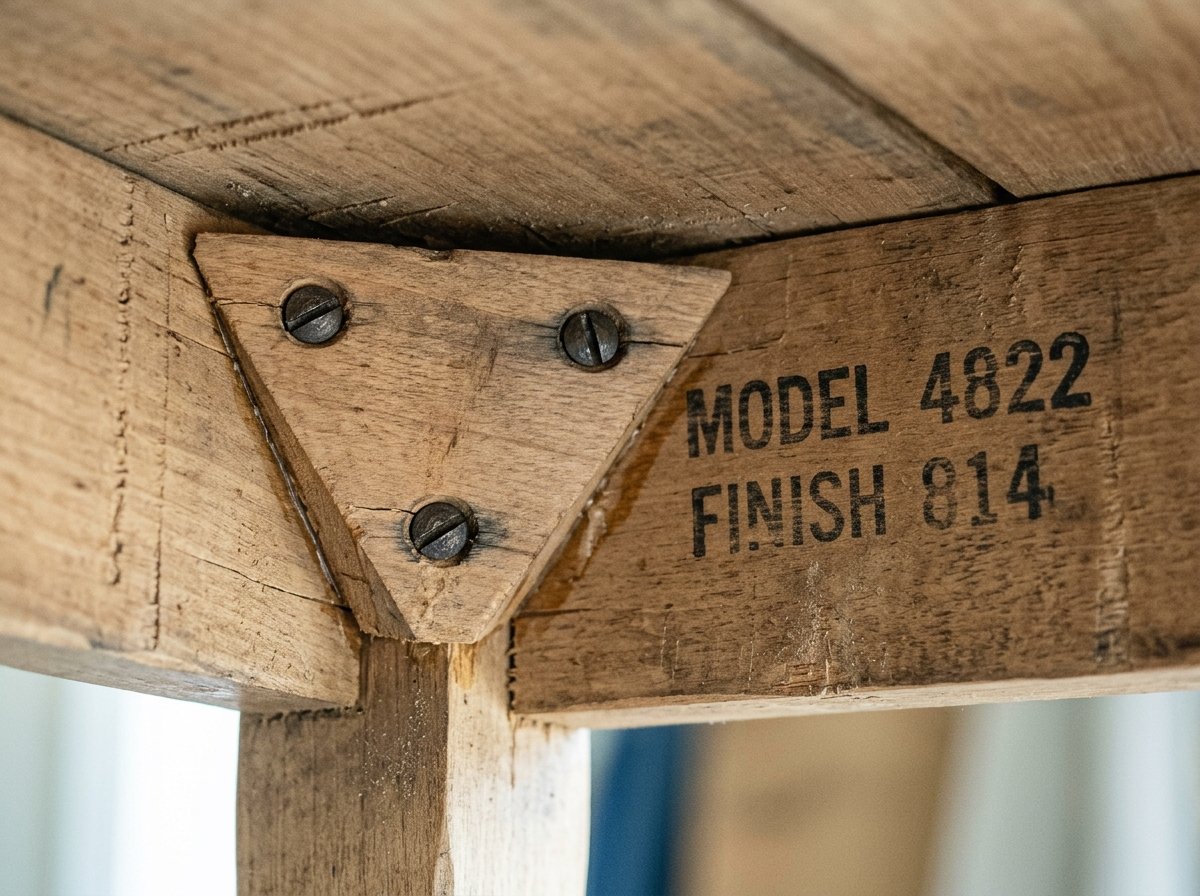
- Model Number (3 or 4 Digits): Preceded by “MODEL” or “NO.”, this numeral identifies the specific catalog design pattern. For example, 3000-series numbers frequently designate French Provincial lines; 4000-series numbers designate Georgian and Federal Neoclassical dining tables; and 8000-series numbers designate Palladian and English Regency models.
- Finish Code (2 or 3 Digits): Stamped alongside or below the model number, this code corresponds to Baker’s proprietary hand-rubbed finish formulas (e.g., “FINISH 814” for dark antique distressed mahogany, or “OLD WORLD” for hand-glazed French walnut).
- Order & Batch Marks: Occasional pencil notations or chalk grease-pencil numbers reflect custom showroom orders, client fabric specifications, or individual craftsman inspection checks.
Construction Forensics: How to Verify Authentic Baker Quality
Because unethical sellers occasionally harvest brass Baker tags from damaged nightstands and affix them to lesser tables, collectors must verify structural construction forensics:
1. 5-Ply Lumber-Core Construction vs. Cheap Particleboard
Baker was famous for utilizing the finest multi-layer lumber-core veneering techniques in the world. Rather than cutting corners, Baker bonded premium book-matched crotch mahogany or walnut veneers over stable, cross-banded solid chestnut or poplar cores. Look at the edge profile: genuine Baker tables feature solid hardwood edge banding with delicate mitered corners and satinwood or ebony inlay stringing. Read our forensic comparison on solid wood vs veneer in antique furniture to understand why Baker’s lumber-core engineering surpasses solid wood in dimensional stability.
2. Triangular Corner Glue Blocks & Fasteners
Crawl beneath the table with a flashlight. Authentic vintage Baker tables feature robust, triangular solid hardwood corner bracing blocks glued and screwed directly into the aprons. In pre-1960s production, these blocks are secured with single-slotted, flathead steel wood screws driven into pre-drilled countersunk holes. Cross-reference our collector guide on dating antique furniture by screws and hardware—the presence of modern Phillips screws in original factory blocks indicates 1960s+ production or later amateur repairs.
3. Pedestal Architecture & Brass Paw Ferrules
On Baker’s celebrated Duncan Phyfe style and Regency double-pedestal dining tables, the sweeping sabre legs terminate in heavy, custom-cast solid brass lion-paw ferrules fitted with functioning casters. Unlike cheap stamped-sheet reproductions that bend easily, Baker brass caps are sand-cast, hand-chased with realistic claw details, and secured with threaded brass machine screws. For in-depth diagnostics on authentic claw hardware, examine our guide to antique claw foot table identification and styles.
2026 Valuation Matrix: What Is Your Vintage Baker Table Worth?
Values for vintage Baker furniture remain exceptionally resilient in 2026, outperforming generic mass-market brands due to strong designer demand and museum-level craftsmanship. Realized auction and estate sale benchmarks:
| Baker Collection / Table Type | Identifying Features & Era | Fair Market Value (2026) | Key Value Factors |
|---|---|---|---|
| The Stately Homes Dining Suite | Brass coronet plaque; Sir Humphry Wakefield provenance; massive multi-pedestal dining table | $4,500 – $18,000+ | Presence of all original leaves, matching dining chairs, documented ancestral seat, untouched finish |
| Finn Juhl for Baker (c. 1951–1955) | Stamped Finn Juhl cartouche; organic sculpted walnut legs; floating top design | $5,000 – $25,000+ | Original finish condition, designer attribution documentation, absence of structural repairs |
| Classic Double-Pedestal Mahogany Dining Table | Oval or rectangular brass tag (1940s–1970s); satinwood crossbanding; brass claw casters | $1,500 – $4,500 | Number of original extension leaves, original table pads, pristine tabletop lacquer without heat rings |
| The Far East Collection Cocktail / Dining Table | 1949–1960s; Ming horsehoof feet; brass Asian corner brackets; exotic wood veneers | $900 – $3,200 | Complete original cast brass hardware, unchipped lacquer, highly figured exotic burl inlays |
| Historic Charleston Collection Occasional Table | Historic Charleston brass badge (1970s–1990s); piecrust, tea table, or Pembroke table form | $450 – $1,400 | Carved ball-and-claw or tilt-top mechanism integrity, original brass hinges and drawer pulls |
| Milling Road Side / End Tables | Milling Road script tag or brand; French provincial or casual country revival | $250 – $750 | Sturdiness of joinery, pair matching, intact original painted or glazed distress finish |
Preservation & Care: Protecting Baker’s Hand-Rubbed Finishes
A critical factor in preserving your Baker table’s secondary-market value is maintaining its original factory finish. Stripping a vintage Baker table down to raw wood cuts its collector value by 50% or more (compare our diagnostics on how to tell if antique furniture has been refinished). Follow these conservation guidelines:
- Avoid Silicone Polishes: Never apply aerosol furniture sprays containing dimethicone or silicone oils. They penetrate micro-fissures in nitrocellulose lacquer, preventing future French polishing and creating a permanent, sticky haze that attracts dust.
- Buff with Pure Microcrystalline Wax: Apply a microscopically thin coat of Renaissance microcrystalline wax or high-grade carnauba paste wax once or twice a year. Buff with a clean microfiber cloth to create a hard, fingerprint-resistant moisture barrier.
- Treat White Heat Hazes Promptly: Vintage Baker nitrocellulose lacquers can trap moisture from warm plates, creating cloudy surface blushes. If your tabletop has suffered moisture clouding, follow our gentle restoration protocol on how to remove white heat rings from antique tables before resorting to abrasive stripping.
Frequently Asked Questions
Where can I find the marking on a Baker Furniture table?
On tables with drawers (such as sofa tables, Pembroke tables, or hunt boards), the brass Baker plaque is almost always tacked to the interior right side of the main drawer. On pedestal dining tables or end tables without drawers, inspect the underside apron, center support rails, or beneath the tabletop near the pedestal mounting blocks. Additionally, check for black ink factory stencils stamped directly onto the unfinished secondary wood.
What is the difference between Baker Furniture and Milling Road?
Milling Road was established by Baker Furniture as a dedicated subsidiary division (named after their original manufacturing location on Milling Road in Allegan, Michigan). While primary Baker lines focused on ultra-formal, museum-grade 18th-century European and Asian reproductions, Milling Road specialized in slightly more relaxed, country provincial, and casual lifestyle furniture. Milling Road pieces share Baker’s high structural build quality but generally command slightly lower secondary market values than formal Baker lines.
Are Baker Furniture tables solid wood or veneer?
Baker utilized a combination of both: legs, pedestal shafts, corner blocks, and carved perimeter moldings were carved from solid hardwoods (such as genuine Honduran mahogany, American walnut, or European beech), while expansive tabletop surfaces were constructed using master-grade 5-ply lumber-core veneering. This multi-layer technique allowed Baker to showcase magnificent crotch mahogany and burl wood patterns while preventing tabletop warping, splitting, and seasonal seasonal expansion.
How do I date my Baker table using the stenciled model number?
The 3- or 4-digit number stenciled on the underside identifies the design collection pattern. 3000-series models typically reflect 1930s–1950s French Provincial and country revival; 4000-series models designate English Georgian and Federal Neoclassical suites from the 1940s–1970s; and specialized collections like Stately Homes (1980s+) bear specific historical mansion attribution numbers alongside the model stamp.
Is vintage Baker Furniture considered valuable?
Yes. Unlike many mid-century mass-production brands whose market values have softened, Baker retains substantial commercial and collector demand. Authentic dining tables consistently sell between $1,500 and $4,500, while iconic designer collaborations (such as Finn Juhl) and Stately Homes tables regularly exceed $5,000 to $15,000+ at certified antique auctions.
Pingback: Imperial Furniture Company Grand Rapids: Marks, History & Value Guide - Antique Tables
Pingback: Cushman Colonial Creations Table Marks: Identification, History & Value Guide