
From the stately Federal dining parlors of early nineteenth-century Manhattan to the bustling Thanksgiving banquet rooms of the late Victorian Golden Oak era, the antique pedestal table stands as one of the most celebrated domestic furniture engineering triumphs in Western cabinetmaking. By eliminating the cumbersome four-corner perimeter legs of traditional farmstead tables, the central pedestal emancipated diner legroom and revolutionized entertaining hospitality.
Today, antique pedestal dining tables command passionate collector demand across estate sales, architectural auctions, and decorative arts galleries. However, establishing an accurate antique pedestal table identification and value assessment requires forensic insight into structural anatomy: distinguishing genuine hand-carved lion paw feet from 1970s resin casts, identifying split-pedestal sliding extension mechanisms, measuring cross-grain shrinkage ovalization, and evaluating timber species from quartersawn white oak to figured Cuban flame mahogany.
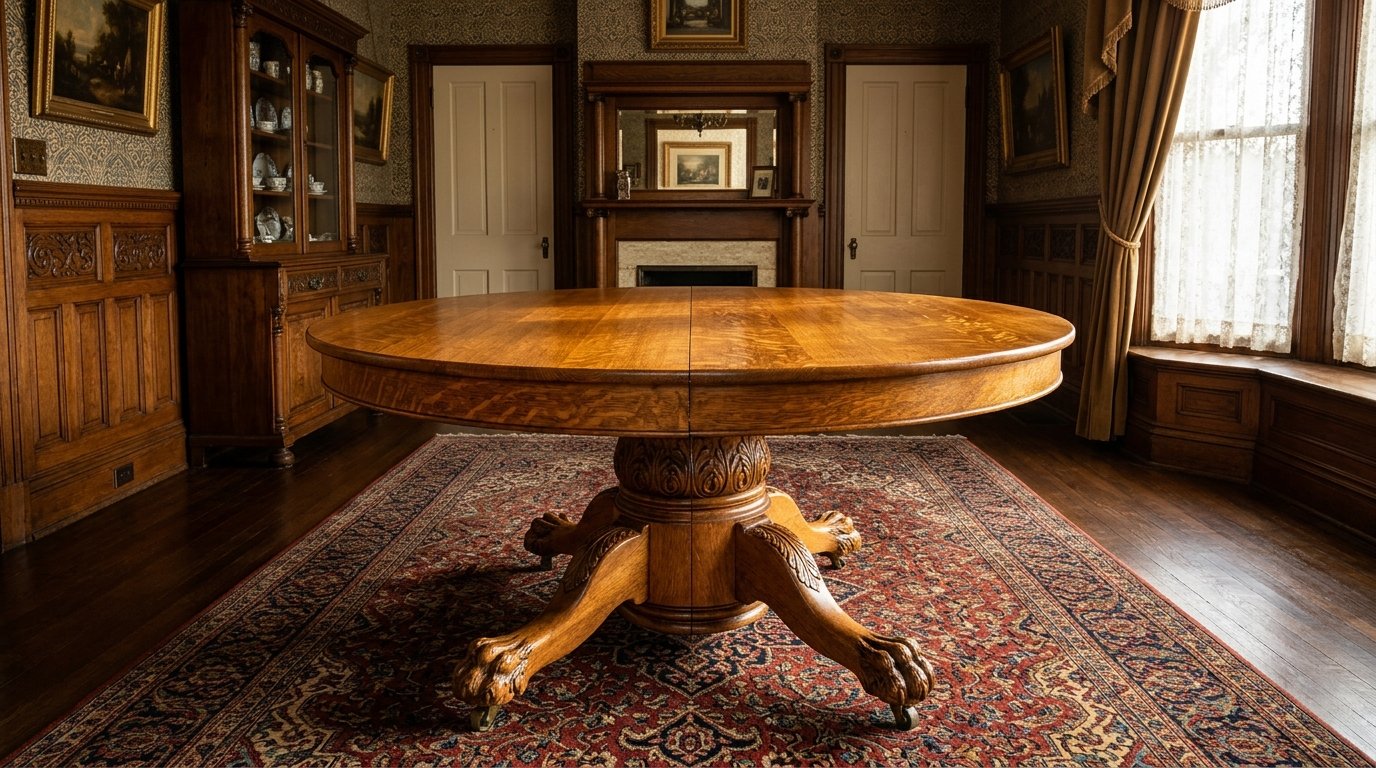
Quick Reference: 2026 Antique Pedestal Table Valuation Matrix
In the current 2026 antiques marketplace, pedestal table values fluctuate based on historical era, carving quality, extension mechanics, wood figure, and originality of finish:
| Style Era & Configuration | Production Era | Typical Valuation Range (2026) | Distinguishing Features & Authenticity Markers |
|---|---|---|---|
| Victorian High-Style Tiger Oak Split-Pedestal | 1885–1915 | $1,200 – $3,800+ | Massive split column (8–12″ diameter); Watertown iron slide tracks; heavy hand-carved lion paw or griffin feet; thick quartersawn medullary rays; 3–5 original leaves. |
| American Classical Empire Flame Mahogany Pedestal | 1820–1845 | $2,200 – $8,500+ | Vigorous architectural octagonal or columnar pillar; concave platform base plinth; carved acanthus leaves; winged paw feet; book-matched crotch mahogany veneers. |
| Federal / Duncan Phyfe Urn or Lyre Pedestal | 1800–1825 | $3,500 – $22,000+ | Classical turned urn or open brass-stringed lyre shaft; reeded saber legs terminating in brass hairy paw caster cups; Santo Domingo mahogany; unthreaded screws. |
| Victorian Tilt-Top Loo / Breakfast Pedestal Table | 1840–1880 | $650 – $2,400 | Circular or oval top (40–54″); heavy brass spring-loaded tilt latch; solid walnut, rosewood, or mahogany; carved tripod or quadripod scrolled cabriole legs. |
| Standard Turn-of-the-Century Plain Oak Pedestal | 1895–1920 | $350 – $850 | Plain-sawn oak with modest turned center post; plain splayed legs or simple ball feet; basic wooden slides; often found missing extension leaves. |
| 20th-Century Colonial Revival Reproduction | 1930–1975 | $100 – $300 | Rotary-cut veneer over particle board; hollow composite pedestal columns; modern machine phillips screws; sprayed synthetic lacquer finish. |
1. The Three Primary Pedestal Configurations Explained
Pedestal table configurations fall into three architectural categories: solid single-column stationary tables, split-pedestal extension tables, and multi-pedestal banquet tables. Single pedestals support fixed or tilt tops; split pedestals divide along their centerline to accommodate leaves; multi-pedestals link modular bases for expansive grand banquets.
Configuration A: The Victorian Split-Pedestal Extension Table
Engineered between 1880 and 1915, the split-pedestal table solved the greatest structural riddle of late Victorian dining rooms: how to provide the foot-clearing comfort of a round pedestal table while retaining the capacity to expand into a 10-to-14-foot banquet table for holiday family gatherings. Cabinetmakers achieved this by slicing the heavy central vertical column down the exact center axis.
When closed, the two halves lock together seamlessly, appearing as a massive solid cylinder, octagonal column, or urn. When pulled apart, each half carries two of the four base legs outward, while heavy hardwood extension slides reveal a hidden fifth stationary center leg to prevent center sagging under the weight of heavy china and silver tureens.
Configuration B: The Classical Solid Single-Column Pedestal
Prevalent in Georgian, Federal, Empire, and early Victorian periods, the single-column pedestal table remains permanently fixed at the center of the room. The tabletop is fastened directly to a massive sub-top batten block or mounted onto a heavy brass pivot hinge allowing the circular surface to tilt vertically when cleared against the parlor wall. In dining formats, single pedestals accommodate perimeter diners comfortably, typically seating four to six guests without mechanical leaf extensions.
Configuration C: Multi-Pedestal Banquet Tables (Duncan Phyfe Modulars)
Developed during the Federal and Regency eras by master cabinetmakers such as Duncan Phyfe, the grand banquet pedestal table consists of two or three distinct pedestals mounted on splayed tripod or quadripod saber bases. The terminal pedestals feature semicircular “D-ends”, while a square or rectangular center pedestal connects them. Brass banquet forks (clips) mortised beneath the tabletop aprons secure the sections together, capable of seating up to twenty guests when fully assembled.
2. Historical Eras, Design Movements & Hallmark Diagnostic Features
Dating antique pedestal tables relies on identifying stylistic markers: Federal tables (1800–1825) exhibit slender reeded saber legs and turned urns; Classical Empire tables (1820–1845) feature heavy octagonal pillars and concave plinths; Victorian Golden Oak tables (1885–1915) display quartersawn tiger oak and carved beast paws.
Federal & Duncan Phyfe Era (1800–1825)
The pinnacle of American Neoclassical cabinetmaking, Federal pedestal tables are defined by geometric restraint and exquisite wood selection:
- Central Shaft: Gracefully turned vase or urn profiles, often fluted or carved with delicate waterleaf acanthus foliage. High-style New York examples frequently incorporate an open brass-strung lyre with carved ebony bridge pegs.
- Leg Geometry: Three or four arching, sweeping saber legs (curvilinear legs tapering toward the floor), decorated with precise hand-reeded bead profiles along the top edge.
- Hardware & Casters: Legs terminate in cast brass box cups or hollow brass hairy paw feet housing small solid brass or boxwood caster wheels fastened with unthreaded, hand-filed steel screws.
- Timber: Dense Santo Domingo or Cuban mahogany displaying deep chatoyancy, contrasted with satinwood stringing and secondary white pine or tulip poplar sub-framing.
American Classical & Empire Period (1820–1845)
Following the War of 1812, American tastes shifted toward monumental French Empire and Grecian forms, prioritizing sheer mass, book-matched veneer drama, and architectural plinths:
- Central Shaft: Thick cylindrical or bold octagonal columns, frequently supported on a circular or concave incurving four-sided platform plinth.
- Foot Architecture: Heavy carved acanthus bracket feet, stylized dolphin fish carvings, or massive Egyptian-revival winged lion paws with deeply carved knuckles.
- Veneer Artistry: Heavy reliance on imported flame crotch mahogany veneers, sliced by water-powered vertical sash saws (1/16″ to 1/8″ thick) and mirrored across table aprons and tops.
- Top Profiles: Massive circular tops measuring 48 to 60 inches across, frequently banded with cross-banded mahogany border veneers over solid white pine or chestnut cores.
Victorian Golden Oak & Horner Era (1885–1915)
The golden age of the American round dining table witnessed the mass adoption of quartersawn white oak and exuberant, muscular sculptural carving:
- Split-Pedestal Innovation: Massive turned pedestals measuring 8, 10, or 12 inches in diameter that pull apart into twin half-cylinders. Elite models produced by makers like Hastings or the Larkins Company feature locking mechanisms that conceal the split when closed.
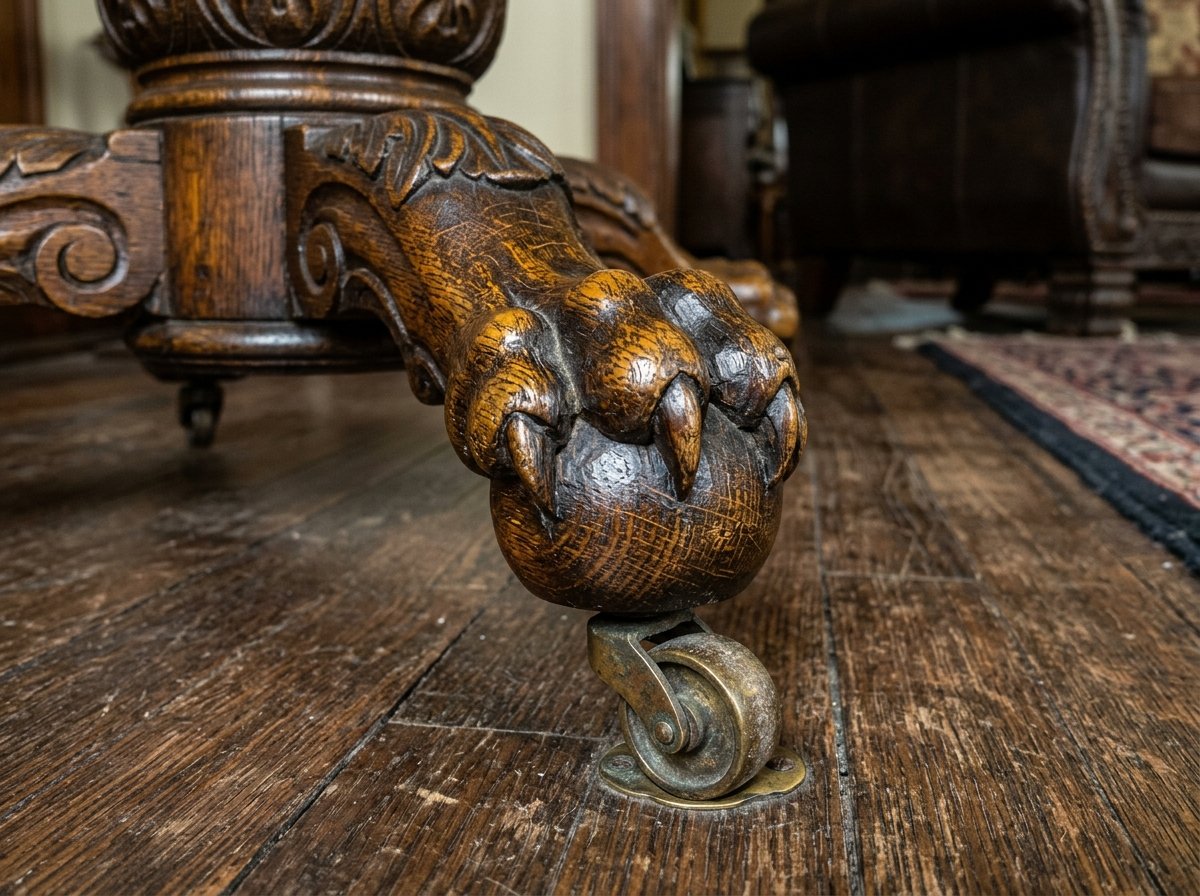
- Beast Carvings: Four sprawling cabriole legs terminating in deeply undercut lion paws, dragon talons, or griffin claws clutching solid wood spheres, often displaying detailed carved sinews, vein structures, and knuckles. For detailed foot comparisons, review our guide to antique claw foot table identification.
- Timber Diagnostics: Exclusively quartersawn white oak (*Quercus alba*), cut radially to slice through the wood’s medullary rays, generating shimmering “tiger ray” or ribbon flecks across the top. Learn more in our guide to antique oak tables.
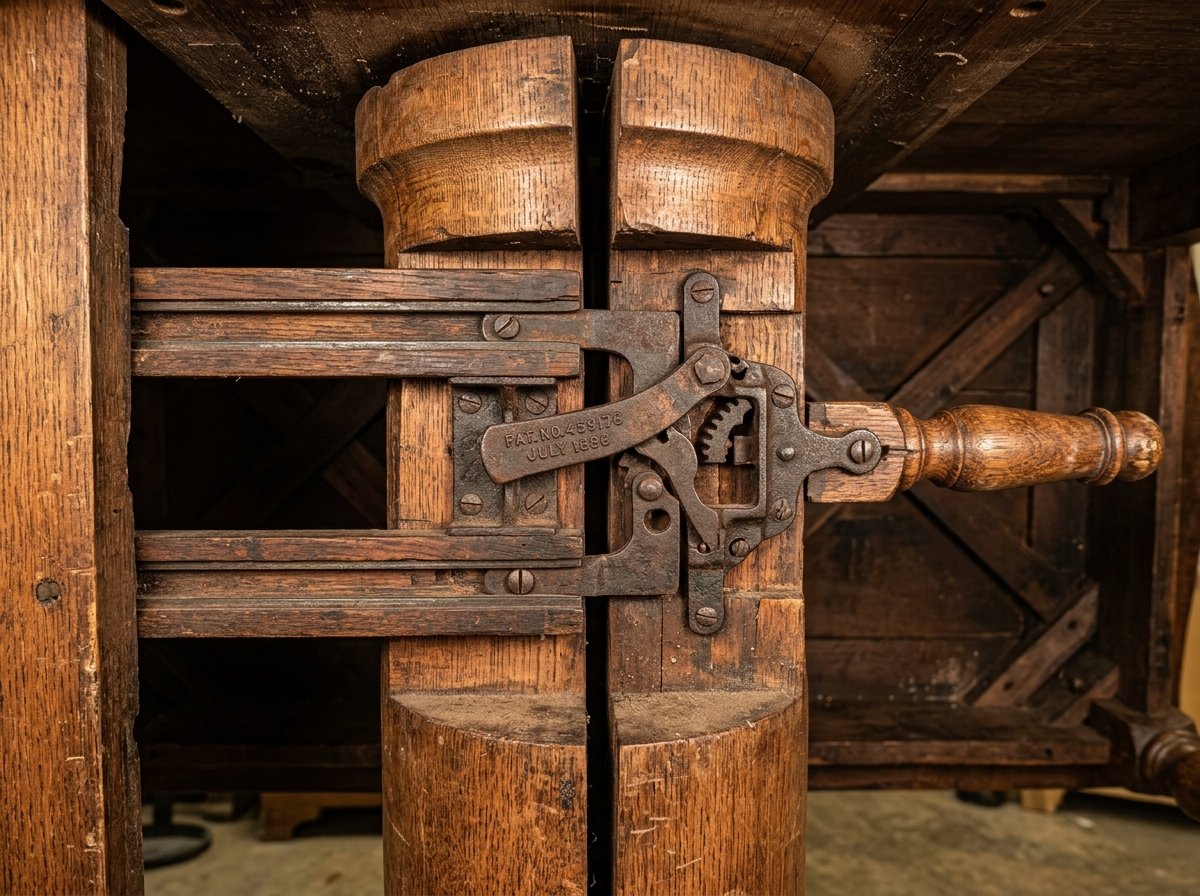
- Mechanical Hardware: Heavy cast-iron track locks manufactured by the Watertown Slide Company (Watertown, Wisconsin) or Seng Company (Chicago, Illinois).
3. Four Forensic Diagnostic Tests to Authenticate an Antique Pedestal Table
Authenticating an antique pedestal table requires four physical tests: 1) Measuring cross-grain shrinkage ovalization; 2) Inspecting extension slide patina and patent hardware; 3) Verifying genuine quartersawn medullary rays versus faux decals; and 4) Examining hand-cut sliding dovetail leg joints.
Test 1: Transverse Cross-Grain Shrinkage (The Diameter Measurement Test)
The single most definitive test of age on any round antique table is differential cross-grain shrinkage. Wood is an anisotropic cellular material; as centuries of ambient seasonal humidity changes pass, wood shrinks and expands significantly across its grain width (tangentially and radially), but virtually zero percent along its grain length.
Take a rigid steel measuring tape and measure the diameter of the table top directly parallel to the wood grain lines. Next, measure the exact diameter perpendicular (at a 90-degree angle) across the grain lines. In an authentic 19th-century table, the cross-grain measurement will be between 1/4 inch and 5/8 inch shorter than the parallel-grain measurement. A table that measures perfectly circular to within 1/16 inch across all angles is either a 20th-century reproduction, built from stable modern plywood, or has been mechanically turned down on a modern lathe.
Test 2: Extension Slide Mechanics & Watertown Iron Patents
Crawl underneath the table and inspect the telescoping slide tracks that allow the tabletop to expand. Authentic 19th-century extension slides reveal distinctive forensic hallmarks:
- Timber Selection: Original slides are crafted from rock-hard, fine-grained northern maple or dense ash to withstand decades of friction without binding. The sliding faces should exhibit decades of amber hand-rubbed wax lubricant buildup, not modern petroleum grease.
- Hardware Patents: Look for embossed cast-iron hardware mounted to the slides. The most prestigious American maker was the Watertown Slide Co. (patented 1889, 1892, and 1902 in Watertown, Wisconsin). Other prominent authentic hardware marks include Seng Co. Chicago, Syracuse Slide, and Sun Manufacturing. Authentic castings display slightly rough granular sand-cast textures with natural dark iron oxidation.
- Fasteners: Original hardware is secured by early slotted steel wood screws with uncentered, hand-cut head slots. The presence of modern Phillips-head screws, zinc plating, or nylon roller wheels indicates mid-to-late 20th-century retrofitting.
Test 3: Quartersawn Medullary Rays vs. Faux “Tiger Oak” Decals
During the early 1900s, cheaper catalog furniture manufacturers attempted to mimic expensive quartersawn white oak by using rotary-cut plain oak and applying faux “printed” medullary ray patterns using photographic ink transfers (often marketed as “Graining” or “Decalcomania”).
To verify authentic quartersawn timber, inspect the table under raking incandescent light. True medullary ray flecks are dense cellular ribbons that catch light with an iridescent, optical “chatoyancy”—shifting from bright silver-gold to dark amber as you tilt your viewing angle. Faux printed grain decals remain flat, dull, and static regardless of light angle. Furthermore, examine the table’s perimeter edge: authentic solid tops show the growth rings running vertically at near-90-degree angles through the entire edge thickness.
Test 4: Dovetailed Leg-to-Pedestal Mortises vs. Modern Lag Bolts
Examine the anatomical junction where the three or four sprawling legs enter the base of the central pedestal column. Historic cabinetmakers understood that the massive downward and lateral leverage exerted by dining guests would rip out simple dowel joints or screws:
- Authentic Joinery: Each leg terminates in a heavy hand-cut sliding dovetail tenon that slides vertically or horizontally into a corresponding tapered mortise cut directly into the solid wood pedestal base plinth, locked with reversible animal hide glue.
- Reinforcement: Federal and Empire tables frequently reinforced this joint with a heavy hand-forged wrought iron or cast brass three-point spider plate screwed beneath the pedestal base.
- Reproduction Red Flag: If the legs are attached to the column using threaded steel lag bolts, modern hexagonal nuts, or stamped sheet-metal corner brackets, the table is a modern commercial reproduction.
4. Claw Feet, Lion Paws & Base Foot Typologies
Base foot designs indicate provenance and value: Hand-carved lion paws with defined knuckles and floor wear command highest premiums; brass hairy paw castor cups define Federal elegance; smooth splayed feet indicate early 20th-century transitional manufacture.
The sculptural execution of the foot is one of the most reliable indicators of cabinetmaker skill and commercial value. In the Golden Oak era, premier New York and Grand Rapids cabinet shops employed master European woodcarvers to create bespoke sculptural bases. For collectors, the foot hierarchy spans:
- Deeply Undercut Full Lion Paws: Carved from the solid leg blank with hollowed spaces between the outer claws, defined sinew tendons, and realistic knuckle joints. These represent top-tier collector status.
- Ball-and-Claw Feet: A ferocious eagle talon or stylized dragon claw gripping an egg or wooden sphere. Popular across both 18th-century Chippendale revivals and late Victorian eclectic designs.
- Mythological Figures (Griffins & North Wind Faces): High-end Victorian tables by Horner or St. Johns often feature mythical winged griffins or lion masks carved directly into the upper knee of the cabriole leg, sweeping down into carved paws.
- Turned Spool & Pad Feet: Plain, understated country designs featuring turned wooden buns, pads, or simple splayed feet without carving. While practical, these command lower secondary valuations.
5. Condition Penalties, Red Flags & Valuation Impacts
Condition significantly impacts market pricing: Missing original extension leaves reduce value by 30% to 50%; modern polyurethane refinishing cuts value by 40% to 65%; replaced pedestal columns or non-original split mechanisms destroy up to 80% of investment grade.
Before purchasing or insuring an antique pedestal dining table, check for these frequent structural defects and historical alterations:
| Alteration or Condition Flaw | Forensic Diagnostic Clue | Typical Valuation Penalty |
|---|---|---|
| Missing Original Leaves | Table top has extension slides extending to 10 feet, but only 1 or no leaves remain. Leaves that do not match the tabletop’s wood grain or aged color. | -30% to -50% |
| Polyurethane Stripping & Refinishing | Glossy plastic-like surface with no micro-crazing; absence of dark patina in crevices; fails denatured alcohol test. See how to tell if antique furniture is refinished. | -40% to -65% |
| Replaced or Marriage Base | Wood species mismatch between top sub-frame and pedestal; modern screw holes drilled beside plug marks; mismatch in finish oxidation under blacklight UV. | -70% to -85% |
| Cut-Down Pedestal (Coffee Table Conversion) | Pedestal column measures under 24 inches tall; lathe turning profiles truncated abruptly; modern saw kerfs on column tenon. | -75% to -90% |
| Broken or Re-Glued Lion Claws | Visible glue lines along toe knuckles; modern epoxy filler colored to match wood; missing brass caster ferrules. | -15% to -25% |
| Warped or Cupped Tabletop Halves | When closed, tabletop halves do not meet flush along the center split, creating a ridge or 1/4″ gap at the perimeter. | -20% to -35% |
6. Collector Care: Preserving Split-Pedestal Slide Mechanics & Patina
Maintaining an antique pedestal table requires balancing mechanical slide preservation with wood finish conservation:
- Lubricating Sliding Tracks: Never apply silicone spray, WD-40, or vegetable oils to antique wooden extension slides; petroleum solvents deteriorate wood fibers and attract dust that jams the tracks. Instead, rub plain paraffin canning wax or beeswax along the dovetail grooves twice a year to maintain effortless glide.
- Protecting the Tabletop Finish: Never use aerosol dust sprays containing silicone or ammonia. Protect historic shellac and varnish with an application of museum-grade microcrystalline wax (such as Renaissance Wax). For step-by-step guidance, read our tutorial on the best wax for antique dining tables.
- Managing Indoor Humidity: Keep indoor relative humidity between 40% and 55%. Extreme dry winter heating causes solid oak tops to shrink rapidly, leading to hairline splits along board glue joints, while excessive humidity can cause split pedestals to bind tightly.
Frequently Asked Questions: Antique Pedestal Table Identification
How can I tell if an antique pedestal table is authentic solid oak or a reproduction?
Authentic antique oak pedestal tables (c. 1880–1915) were built using thick solid quartersawn white oak displaying dramatic medullary ray flecks across the top and base, secured by hand-cut sliding dovetails or cast-iron patent slide hardware underneath. Modern reproductions use thin rotary-cut veneer over MDF or plywood cores, lack transverse shrinkage ovalization, and rely on zinc lag bolts or stamped sheet-metal corner brackets.
How does an antique split-pedestal table work?
In a split-pedestal table, the central vertical column is engineered in two symmetrical halves. When the tabletop halves are pulled apart to insert extension leaves, the central pedestal halves separate along heavy dovetailed wooden or steel slide tracks (frequently manufactured by the Watertown Slide Co. or Seng Co.), revealing an internal fifth center drop leg that lowers automatically or rests stationary to support the center span under banquet load.
What makes an antique pedestal dining table valuable?
Value is determined by historical style era, carving artistry, timber rarity, and completeness of original components. High-value examples feature vigorous hand-carved lion paw or griffin claw feet, documented workshop origins (such as Duncan Phyfe, Horner, or Hastings), original quartersawn tiger oak or Cuban flame mahogany, intact original finish, and all matching factory extension leaves with their original leaf storage caddy.
How do you measure an antique round pedestal table for transverse wood shrinkage?
Measure the circular tabletop twice with a rigid steel tape: once parallel to the wood grain and once perpendicular (across) the wood grain. Because solid hardwood expands and contracts tangential to the annual rings over centuries, an authentic pre-1900 round pedestal table will almost always measure 1/4 to 1/2 inch narrower across the grain than with the grain, producing an ovalized cross-section impossible to fake in modern composite plywood.
How much does a typical antique round oak pedestal dining table sell for in 2026?
In 2026, standard turn-of-the-century American Golden Oak round pedestal tables without elaborate carvings trade between $350 and $850. Elaborate Victorian split-pedestal tables with dramatic quartersawn tiger oak ray flecks, hand-carved lion paw claw feet, and full sets of matching leaves range from $1,200 to $3,800. Exceptional signed high-style pieces by master makers like R.J. Horner can exceed $6,500 to $12,000+ at decorative arts auctions.
What impact does stripping or refinishing have on antique pedestal table value?
Refinishing an antique pedestal table with modern polyurethane or chemical dip-tank stripping destroys the historic patination, softens crisp hand-carved foot details, and dissolves original shellac or spirit varnish, resulting in a 40% to 65% loss in secondary market valuation. Preserving original finishes through gentle conservation cleaning and microcrystalline waxing is strongly recommended.
Pingback: Antique Claw Foot Table Identification: Styles, Eras & Value Guide
Pingback: Antique Tilt-Top Tables: History, Identification & Value Guide